










Angelman Syndrome: Symptoms, Genetic Tests and How to Read the Results
The essentials
Angelman syndrome is a rare genetic condition of the brain. It causes severe developmental delay, little or no speech, balance problems, seizures and a happy, excitable behavior. A genetic test on a blood sample confirms it, usually a DNA methylation test first. The exact cause tells the family the chance of it happening again. There is no cure yet, but symptoms can be treated and life expectancy is close to normal.
What is Angelman syndrome, at a glance?
Angelman syndrome is a genetic disorder that mainly affects the nervous system[1]. People with it need lifelong support, but most have good general health[2].
| Topic | Key facts |
|---|---|
| Other names | AS; "happy puppet syndrome" is an old name that is no longer used |
| How common | About 1 in 12,000 to 20,000 people[1]; 1 in 24,580 births in a national Danish study[7] |
| Cause | The mother's copy of the UBE3A gene on chromosome 15 is missing or not working in the brain[1] |
| Key tests | DNA methylation test of chromosome 15 (15q11-q13), chromosomal microarray, UBE3A gene sequencing; EEG for seizures[4][5] |
| Usual age at diagnosis | Between 9 months and 6 years[2]; earlier when the cause is a deletion (about 21 months on average) than with other causes (about 46 months)[7] |
| Life expectancy | Nearly normal[1][2] |
What are the symptoms of Angelman syndrome?
Not every child has every sign[3][4].
- Common Developmental delay, noticeable by 6 to 12 months: the baby does not sit unsupported or babble[2].
- Common Little or no speech. Most learn to communicate with gestures, signs or pictures[2].
- Common Movement and balance problems (ataxia): jerky movements, trembling arms, walking with the arms raised[2]. At least 80% of children learn to walk on their own[6].
- Common A happy, excitable behavior: frequent laughter, hand-flapping, hyperactivity, a fascination with water[1][2].
- Common Seizures in up to 90% of people, most often when the cause is a deletion[6]; they usually start before age 3[8]. A small head (microcephaly) often becomes visible around age 2[2].
- Common Sleep problems and constipation, each in about 80%[6].
- Possible Crossed eyes (strabismus), paler skin and hair, feeding problems and reflux in babies, heat sensitivity[2][4].
- Rare but serious: seizures that do not stop, or quiet seizures with drowsiness lasting hours or days (non-convulsive status), sometimes with a loss of skills[6].
Angelman syndrome, autism or cerebral palsy?
Early on, the delay and the movement problems can look like cerebral palsy or unexplained seizures, until more typical features appear[8]. Many children with Angelman syndrome also meet the criteria for autism[4]. If a child diagnosed with autism or cerebral palsy also has seizures and almost no words, ask whether a genetic test has been done.
When should I see a doctor?
When to see a doctor
- Emergency: call 911 for a seizure that does not stop, repeated seizures without waking up in between, trouble breathing, a serious head injury or a near-drowning[6].
- Within 24 to 48 hours if your child is unusually sleepy for hours, suddenly loses skills, refuses to drink, vomits repeatedly or seems in pain for a long time: the happy behavior can hide pain from reflux, constipation or an infection[6][8].
- At your next appointment if a baby does not sit or babble by 6 to 12 months, if the head grows slowly, or if a diagnosed child has new sleep, behavior or walking problems[2].
What causes Angelman syndrome, and is it inherited?
We all receive two copies of the UBE3A gene, one from each parent. In brain cells, only the mother's copy works; the father's copy is naturally switched off. (genomic imprinting). When the mother's copy is lost or broken, the brain has no working UBE3A[1]. Nothing the parents did during pregnancy causes it[2].
The mechanism matters, because it changes the chance of another affected child[5]:
| Genetic cause | Share of cases | Chance for a next child |
|---|---|---|
| Deletion of a piece of the mother's chromosome 15 (15q11-q13), new in the child | About 75% | Below 1% if the mother's chromosomes are normal |
| Change (variant) in the mother's copy of UBE3A | 5 to 10% | Up to 50% if the mother carries it |
| Two copies of chromosome 15 from the father (paternal uniparental disomy, UPD) | 1 to 2% | Below 1% if parents' chromosomes are normal |
| Imprinting defect (the switch on chromosome 15 is set wrongly) | About 3% | Below 1%, but up to 50% when a small "imprinting centre" deletion is found |
| No cause found despite a typical picture | 10 to 15% | Unknown |
Most cases are therefore not inherited and appear by chance[1].
How is Angelman syndrome diagnosed, and which genetic tests are used?
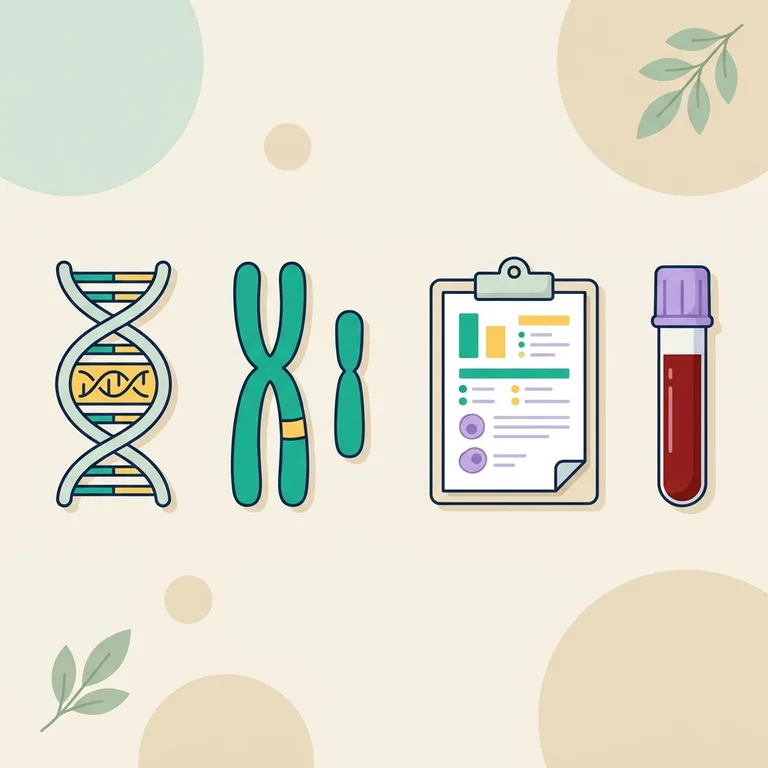
The syndrome is suspected from development and behavior, then confirmed by genetic tests on a blood sample, step by step[2][4][5]:
- DNA methylation test of 15q11-q13 (often MS-MLPA). It checks for both the mother's and the father's "marks" and finds about 80% of people with Angelman syndrome: those with a deletion, UPD or an imprinting defect[5].
- Finding the exact cause if methylation is abnormal: copy-number analysis or a chromosomal microarray (deletion), DNA from both parents (UPD), or imprinting centre analysis[5].
- UBE3A sequencing if methylation is normal but the picture is convincing, because a UBE3A variant does not change methylation[4].
Children with a delay often have a microarray first. A normal microarray does not rule out Angelman syndrome: it sees deletions, but not imprinting defects, UBE3A variants or most cases of UPD[5]. When all tests are normal, doctors consider look-alike conditions such as Pitt-Hopkins, Mowat-Wilson or Rett syndrome[4][8].
An EEG (brain wave recording) supports the diagnosis: more than 90% of people show a typical pattern of large, slow "notched" waves[6]. Like the EEG in epilepsy, it can be abnormal even without seizures[8].
How do you read a genetic test report for Angelman syndrome?
| Test | Result | Reference | Flag |
|---|---|---|---|
| 15q11-q13 methylation analysis (MS-MLPA), SNRPN locus | Maternal methylation pattern absent | Biparental pattern (maternal and paternal) | Abnormal |
| 15q11-q13 copy number (MS-MLPA) | Heterozygous deletion, class II (about 5 Mb) | No deletion | Abnormal |
| UBE3A sequencing | Not performed | Not applicable | |
| Interpretation | Consistent with Angelman syndrome, deletion class | Genetic counseling recommended |
- Methylation "maternal pattern absent": the region carries only the father's mark. This confirms the syndrome, not yet its cause[5].
- Copy number "deletion": a missing piece of the mother's chromosome 15, the most common cause. Results are written in words, with no H or L flag, unlike an HLA typing report or a blood count[5].
- UBE3A "Not performed": needed only when methylation is normal[4].
- Interpretation: with a new deletion and normal chromosomes in the mother, the chance for a future child is below 1%[5]. An "imprinting defect" or a "UBE3A variant" calls for testing a parent.
"Biparental pattern", "class II deletion"? BloodSense explains each line of your child's results in plain words, so you can prepare your questions for the genetics team.
Get my results explainedWhich tests are used to follow Angelman syndrome?
No blood marker measures the syndrome itself. Follow-up looks for treatable problems[6]:
- Eyes: an eye examination at diagnosis, then every year; about 30% of people need surgery for strabismus[6].
- Seizures: EEG when seizures are suspected; video-EEG tells a seizure from a non-epileptic movement[6].
- Spine and bones: scoliosis affects 10 to 30% of children; a bone density (DEXA) scan every 2 years on a long-term ketogenic diet or if the child does not walk[6]. See also osteoporosis.
- Blood tests: the consensus lists a complete blood count, a comprehensive metabolic panel, vitamin D, and ferritin with ESR; on a diet therapy, also carnitine, selenium, zinc, magnesium, phosphorus and a lipid panel[6].
How is Angelman syndrome treated?
There is no cure yet. Treatment targets each symptom[2][6]. No doses are given here.
- Seizures: anti-seizure medicines, often levetiracetam or a benzodiazepine such as clonazepam[8]; sometimes a ketogenic or low glycemic index diet[6].
- Sleep: bedtime routines and behavioral strategies first; low-dose melatonin can help[6]. Read more about insomnia and its causes.
- Digestion: daily treatment of constipation, and treatment of acid reflux, which can worsen sleep and behavior[6].
- Therapies: physiotherapy, occupational therapy, communication therapy with signs, pictures or speech devices, and behavioral therapy[2].
- Research: treatments that switch on the father's silent copy of UBE3A are being tested in phase 3 trials, such as obudanersen (ION582)[10]. Vitamin supplements meant to change methylation did not help[4].
What is life like with Angelman syndrome, from childhood to adulthood?
With age, hyperactivity and sleep usually improve; seizures often ease in later childhood but can return in adulthood[2]. Adults may lose some mobility, become less active and develop reflux, constipation or anxiety, so care must continue after pediatrics[6].
- Never leave your child alone near water: the attraction to water is strong[4], and a seizure in the bath or pool can be dangerous.
- Protect from heat: limit time outside on hot days, offer cold drinks, use fans and shade[6].
- Treat a change in sleep or behavior as a possible sign of pain, constipation, reflux, a dental problem or an infection[6].
- Ask about early intervention, school support and respite for caregivers[2][6].
Questions to ask your doctor
- Which genetic test was done, and does it look at methylation or only at deletions?
- What is the exact genetic cause in my child, and what does it mean for a future pregnancy?
- How do we tell a seizure from an ordinary movement?
- Which specialists should follow my child, and how often?
Frequently asked questions
Can Angelman syndrome be found before birth?
Yes, when the cause is already known in the family: methylation testing on a sample from the pregnancy can be offered, and it is strongly advised when a parent carries an imprinting centre deletion[5].
Why do people with Angelman syndrome laugh so often?
Frequent laughter is part of the syndrome and often comes with little reason[2]. They are not a sign of constant well-being: a smiling child can still be in pain[8].
Do the symptoms depend on the genetic cause?
Partly. Seizures affect at least 80 to 90% of children with a deletion, up to 75% with UPD or a UBE3A variant and up to 50% with an imprinting defect[6]. Paler skin and hair are linked to deletions, because the deleted piece also contains a pigment gene[1].
Can adults with Angelman syndrome learn new skills?
Yes. Speech stays limited, but many keep improving their communication throughout life[2].
Related articles
- AutismSigns, causes and the genetic tests offered after diagnosis
- EpilepsyWhat an EEG and blood tests can and cannot show
- Cerebral palsyAnother cause of early motor delay
- Trisomy 21Another chromosomal condition, with its screening and follow-up tests
- Vitamin D blood testA common check for bone health on anti-seizure medicines
- MedlinePlus Genetics. Angelman syndrome. US National Library of Medicine. medlineplus.gov (accessed November 10, 2026)
- NHS. Angelman syndrome. nhs.uk (accessed November 10, 2026)
- Williams CA, Beaudet AL, Clayton-Smith J, et al. Angelman syndrome 2005: updated consensus for diagnostic criteria. Am J Med Genet A. 2006;140(5):413-418. doi:10.1002/ajmg.a.31074 (accessed November 10, 2026)
- Bird LM. Angelman syndrome: review of clinical and molecular aspects. Appl Clin Genet. 2014;7:93-104. doi:10.2147/TACG.S57386 (accessed November 10, 2026)
- Beygo J, Buiting K, Ramsden SC, Ellis R, Clayton-Smith J, Kanber D. Update of the EMQN/ACGS best practice guidelines for molecular analysis of Prader-Willi and Angelman syndromes. Eur J Hum Genet. 2019;27(9):1326-1340. doi:10.1038/s41431-019-0435-0 (accessed November 10, 2026)
- Duis J, Nespeca M, Summers J, et al. A multidisciplinary approach and consensus statement to establish standards of care for Angelman syndrome. Mol Genet Genomic Med. 2022;10(3):e1843. doi:10.1002/mgg3.1843 (accessed November 10, 2026)
- Mertz LG, Christensen R, Vogel I, et al. Angelman syndrome in Denmark: birth incidence, genetic findings, and age at diagnosis. Am J Med Genet A. 2013;161A(9):2197-2203. doi:10.1002/ajmg.a.36058 (accessed November 10, 2026)
- Topical Reviews in Pediatrics (TRiP), University of Utah. Angelman syndrome: pediatric primary care guide. trip.utah.edu (accessed November 10, 2026)
- MedlinePlus Genetics. Will health insurance cover the costs of genetic testing? US National Library of Medicine. medlineplus.gov (accessed November 10, 2026)
- ClinicalTrials.gov. REVEAL: a phase 3 study of obudanersen (ION582) in Angelman syndrome. NCT06914609. clinicaltrials.gov (accessed November 10, 2026)
This page is general information. It does not replace the advice of a doctor or a genetics team, who interpret a genetic result together with the child's examination and family history.