









Amylase Blood Test: Normal Range, High or Low Results and What They Mean
The essentials
Amylase is a digestive enzyme made mostly by the pancreas and the salivary glands. A blood test measures how much of it is in your blood, mainly to look for pancreatitis when you have sudden upper abdominal pain. Many labs use a range of about 40 to 140 U/L, but yours may differ. A high value is not specific to the pancreas, and a normal value does not rule pancreatitis out, which is why doctors usually prefer lipase.
What does my amylase result mean, line by line?
Amylase helps break down starch into sugars[1]. When the pancreas is inflamed or blocked, it releases more amylase into the blood[2]. Here is a fictitious report in US format, with amylase and lipase side by side because they are often ordered together.
| Test | Result | Reference range | Flag |
|---|---|---|---|
| Amylase, serum | 182 U/L | 40-140 U/L | H |
| Lipase, serum | 95 U/L | 0-160 U/L | - |
| Creatinine | 0.9 mg/dL | 0.6-1.2 mg/dL | - |
- Result: enzyme activity in your blood, in units per liter (U/L).
- Reference range: set by your laboratory. A commonly quoted range is 40 to 140 U/L, and it varies slightly between labs and methods[2].
- Flag H: above the range. Here amylase is only mildly high (182 against an upper limit of 140) while lipase is normal, so the rise points away from an acute pancreatic problem and toward another source, such as the salivary glands, a medicine or the kidneys. Your doctor reads it together with your symptoms.
Got a report with H next to amylase? BloodSense explains every line of your results and helps you prepare questions for your doctor.
Get my amylase result explainedWhat is the amylase test used for?
Amylase tests are used mainly to diagnose problems of the pancreas, such as pancreatitis, and to monitor chronic pancreatitis[1]. Your doctor may order it if you have pain in the upper abdomen that spreads to the back or gets worse after eating, nausea and vomiting, fever, jaundice or greasy, foul-smelling stool[1]. It is also used to follow conditions such as pancreatic cancer, cystic fibrosis, eating disorders and recovery after gallstone removal[1].
In practice, the diagnosis of acute pancreatitis needs two of three findings: typical abdominal pain, lipase or amylase at least three times the upper limit of normal, and typical imaging[4]. The American College of Gastroenterology guideline uses the same logic[5]. With an upper limit of 140 U/L, three times the limit is 420 U/L. A result of 182 U/L therefore does not meet that threshold on its own.
What is the normal range for amylase in the blood?
MedlinePlus gives a normal range of 40 to 140 U/L, or 0.67 to 2.34 µkat/L, and notes that ranges vary among laboratories and methods[2]. Always compare your result with the range printed on your own report.
| Unit | Commonly quoted range | Source |
|---|---|---|
| U/L (conventional) | 40-140 | MedlinePlus[2] |
| µkat/L (SI) | 0.67-2.34 | MedlinePlus[2] |
Your laboratory's range prevails. Pregnancy, age and the method used can shift what a given lab considers normal.
Why is my amylase high?
A high amylase has many sources because the enzyme comes from several organs. The magnitude of the rise does not tell how severe a pancreatic problem is[3].
- Common Acute pancreatitis, often from gallstones or alcohol. About 80% of people with acute pancreatitis have a raised amylase within 24 hours[3]. Read more about pancreatitis and gallstones.
- Common Medicines. Aspirin, birth control pills, opiates (codeine, morphine), thiazide diuretics and some other drugs can raise amylase[2].
- Possible Salivary gland problems, such as infection or a blocked duct. Mumps is a classic example[2].
- Possible Digestive causes: a blocked bile or pancreatic duct, cholecystitis, intestinal blockage, a perforated ulcer or viral hepatitis[2][3].
- Possible Kidney disease, because the kidneys clear amylase. Compare with your creatinine.
- Rare Macroamylasemia. Amylase sticks to an antibody and forms a large complex that the kidneys cannot clear, so blood amylase stays high without any disease. A persistently raised amylase with a low urine amylase should raise this possibility[3].
- Rare Tumors of the pancreas, ovaries or lungs[2]. See pancreatic cancer.
Why is my amylase low?
A low amylase is uncommon and usually not alarming on its own. It may reflect long-standing damage to the pancreas (chronic pancreatitis), cystic fibrosis, kidney disease, liver disease or pre-eclampsia in pregnancy[1]. MedlinePlus also lists pregnancy, heart failure and bone fracture[2]. A very high triglyceride level in the sample can falsely lower the result[3]; check your triglycerides.
Amylase or lipase: which one is better?
For suspected acute pancreatitis, lipase is preferred. It is more specific to the pancreas and stays raised longer, up to about two weeks, whereas amylase peaks early and stays up for 3 to 5 days[3][6]. Ordering both adds cost and only marginally improves accuracy[3]. Amylase can still be useful when lipase is not available, or to follow other pancreatic diseases[3]. See the lipase blood test page, and fecal elastase for pancreatic function.
How should I prepare for an amylase blood test?
No special preparation is usually needed, but avoid alcohol for 24 hours before the test[1]. Your provider may ask you to fast for two hours[1]. Tell them about every medicine and supplement you take, and do not stop any without medical advice[1]. Before the draw, run through this list:
- No alcohol in the 24 hours before the test.
- Ask whether you should fast, and for how long.
- Bring your medicine list (aspirin, birth control pills, opiates and diuretics can raise amylase).
- Mention recent pancreatitis, gallstones, mumps or kidney problems.
- Do not stop a prescribed medicine on your own.
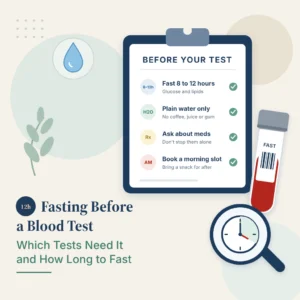
More practical tips are in our guide to what to expect at a blood draw and fasting before a blood test.
When should I see a doctor about my amylase?
When to see a doctor
- Emergency: call 911 for severe, constant upper abdominal pain spreading to the back, especially with repeated vomiting, fever, fast heartbeat, fainting or yellow skin or eyes[1].
- Within 24 to 48 hours if you have upper abdominal pain that lasts or returns after meals, nausea, loss of appetite, or greasy, foul-smelling stool along with a high amylase[1].
- At your next appointment if you feel well and amylase is mildly high. Your doctor may repeat it, add lipase or review your medicines.
Questions to ask your doctor
- Is my amylase explained by my symptoms, or by a medicine I take?
- Should I also have a lipase test?
- Do I need imaging, such as an ultrasound?
- Could this be macroamylasemia, and would a urine amylase help?
- When should the test be repeated?
Frequently asked questions
Can amylase be high without pancreatitis?
Yes. Amylase also comes from the salivary glands, and it can rise with medicines, kidney disease, bowel or bile duct problems and macroamylasemia[2][3].
Can pancreatitis happen with a normal amylase?
Yes. Amylase rises early and then falls, so a test taken late may be normal, and the magnitude does not reflect severity[3]. That is why lipase and the clinical picture matter.
How long does amylase stay high in pancreatitis?
Usually 3 to 5 days, with a half-life of 10 to 12 hours[3].
Can alcohol or medicines change the result?
Yes. Alcohol before the test and drugs such as aspirin, opiates, thiazide diuretics and birth control pills can raise amylase[1][2].
Related tests
- Lipase blood testThe preferred pancreatic enzyme when pancreatitis is suspected
- PancreatitisCauses, symptoms and treatment of pancreatic inflammation
- High liver enzymesAnother common set of abnormal digestive-organ results
- GGTOften checked with bile duct or alcohol-related problems
- Total bilirubinHelps spot a blocked bile duct
- CRPA general marker of inflammation
- MedlinePlus. Amylase Test. US National Library of Medicine. medlineplus.gov (accessed October 23, 2026)
- MedlinePlus Medical Encyclopedia. Amylase - blood. Reviewed January 2025. medlineplus.gov (accessed October 23, 2026)
- Association for Diagnostics & Laboratory Medicine. Amylase: Optimal Testing Recommendations. myadlm.org (accessed October 23, 2026)
- Banks PA, Bollen TL, Dervenis C, et al. Classification of acute pancreatitis 2012: revision of the Atlanta classification and definitions by international consensus. Gut. 2013;62(1):102-111. doi:10.1136/gutjnl-2012-302779 (accessed October 23, 2026)
- Tenner S, Vege SS, Sheth SG, et al. American College of Gastroenterology guidelines: management of acute pancreatitis. Am J Gastroenterol. 2024;119(3):419-437. doi:10.14309/ajg.0000000000002645 (accessed October 23, 2026)
- Ismail OZ, Bhayana V. Lipase or amylase for the diagnosis of acute pancreatitis? Clin Biochem. 2017;50(18):1275-1280. doi:10.1016/j.clinbiochem.2017.07.003 (accessed October 23, 2026)
This page is general information. It does not replace the advice of a doctor, who interprets your results with your symptoms, history and examination.