










Prostate Exam: What the Checkup Involves, From Rectal Exam to MRI
The essentials
A prostate exam is not one test but a short set of checks: a quick finger exam, a PSA blood test and often a urine test. A raised result often comes from an enlarged or inflamed prostate, not cancer. An MRI, and only then a biopsy, answer the questions the first tests leave open.
When do prostate problems need urgent care?
When to see a doctor
- Emergency: call 911 or go to the ER if you cannot urinate at all, or if fever, chills and severe pain start after a prostate biopsy or come with burning, urgent urination. Both need same-day care[1][2][9].
- Within 24 to 48 hours if you see blood in your urine, have strong pain in the lower belly or urinary tract, or urine turns cloudy after a test[1][9].
- At your next appointment for a weak stream, waking at night to urinate, or to discuss screening[5].
What does a prostate exam include?
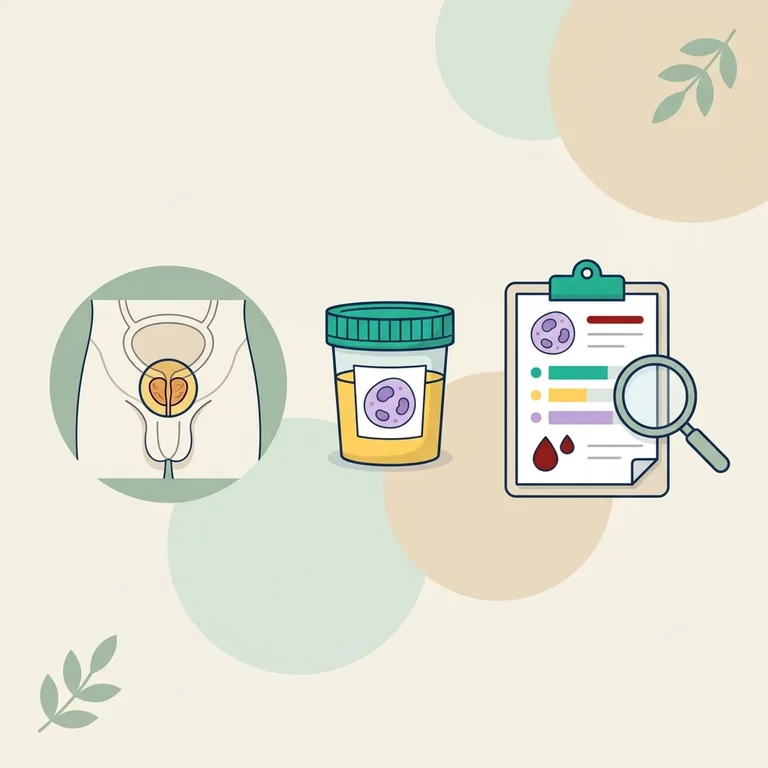
The prostate sits below the bladder and wraps around the tube that carries urine out[2]. After questions about your symptoms, drinks and family history[1], the visit can include three checks[2]:
- Digital rectal exam (DRE). Bent forward or lying on your side, you feel a gloved, lubricated finger in the rectum checking the gland's size and surface. It may be slightly uncomfortable, but it is brief[1].
- PSA blood test. A standard blood draw that measures a protein made by the prostate[3]. How to read the number in detail is in our guide to reading your PSA numbers.
- Urinalysis. A urine sample checked for infection or blood[2]; see urinalysis results.
What can a prostate exam find?
Benign conditions often cause frequent urination at night, a weak stream, burning or blood in the urine[2]. Several prostate problems share these lower urinary tract symptoms, so tests sort them out[1].
- Common Enlarged prostate (BPH). The gland grows with age, from walnut size in the 20s to lemon size by 60. BPH symptoms are one of the most common reasons older men see a urologist[2].
- Common Prostatitis. Inflammation of the prostate is the most common urinary condition in men under 50, and it can raise PSA[2]. See prostatitis types.
- Possible A urinary tract infection, which can also push PSA up[3]: see urinary tract infection.
- Possible Prostate cancer. Early cancer usually causes no symptoms[2], which is why screening relies on the PSA and sometimes the DRE. BPH and prostatitis do not raise cancer risk[2]. The disease itself is covered in our prostate cancer guide.
- Rare A bladder stone or tumor behind the same symptoms, ruled out when needed by a camera exam of the bladder (cystoscopy)[1].
At what age should you get a prostate exam?
With symptoms, at any age. Without symptoms, screening is a personal decision: the USPSTF says men aged 55 to 69 should decide with their clinician, and advises against PSA screening from age 70[5]. The American Urological Association says clinicians may offer a first PSA between 45 and 50, should offer screening from 40 to 45 to men at higher risk (Black ancestry, inherited gene changes, strong family history), and should offer it every 2 to 4 years from 50 to 69[6].
Which prostate tests might the doctor order?
| Test | What it answers | When it is used |
|---|---|---|
| Digital rectal exam | Is the gland enlarged, tender, hard or lumpy? | Often with the PSA, not alone[6] |
| PSA blood test | Is PSA higher than expected? | First screening test[6]; also for symptoms[3] |
| Urinalysis, urine culture | Is there infection or blood? | Symptoms, raised PSA[3]; see urine culture |
| Prostate health index (PHI) | PSA plus two blood tests, to refine risk | PSA between 4 and 10[1] |
| Transrectal ultrasound | Size of the gland; guides a biopsy needle | Usually during a biopsy[1] |
| Prostate MRI | Is there an area suspicious for significant cancer? | May come before a first biopsy[7] |
| Biopsy | Are there cancer cells, and what grade? | The only way to diagnose cancer[3] |
How do I read my prostate exam results?
| Test | Result | Reference range | Flag |
|---|---|---|---|
| PSA, total | 5.6 ng/mL | ≤ 4.0 ng/mL | H |
| Urinalysis: leukocyte esterase | Negative | Negative | |
| Urinalysis: nitrite | Negative | Negative | |
| Urinalysis: blood | Negative | Negative | |
| DRE (clinician note) | Enlarged, smooth, symmetric, no nodule | No nodule, not tender | |
| Prostate MRI | PI-RADS 2 | PI-RADS 1–2: negative |
- Reference range: a PSA above 4.0 ng/mL is usually called abnormal, but there is no single threshold[4]. Your lab's own range applies.
- Flag: H means above the range. The DRE and MRI are read as words or scores.
Back from a prostate checkup? BloodSense explains every line of your report in plain language, so you know what to raise at your visit.
Explain my prostate resultsThe DRE note: size and surface
An enlarged gland with no lump fits BPH, an overgrowth of prostate tissue[2]. A hard area or a lump is a reason for more tests, sometimes a biopsy[1]. Sudden fever, chills and burning urination point to acute bacterial prostatitis, which is treated right away[2].
The PSA line: confirm before acting
PSA rises with BPH, prostatitis, infection, ejaculation, vigorous cycling and a recent biopsy[1][4]. Only about 1 in 4 men biopsied because of a raised PSA turns out to have cancer[4]. A newly raised PSA returns to normal in 25% to 40% of men when retested, so guidelines repeat it before imaging or biopsy[6]. Finasteride and dutasteride lower PSA, so a lower cutoff applies[4].
The urine lines: infection or blood
Positive leukocyte esterase or nitrite suggests infection; blood in the urine needs its own work-up.
The MRI score: PI-RADS 1 to 5
Prostate MRI is scored with the PI-RADS system[8]. A score of 3 to 5 counts as abnormal and usually leads to a targeted biopsy of that area. A score of 1 or 2 is "negative": about 9 in 10 such men have no significant cancer on biopsy, so your overall risk still guides the next step[7].
What should I note before a prostate exam?
- No ejaculation for 24 hours before the PSA blood draw[3]; skip long bike rides for 2 days[4]
- Any recent urinary infection, catheter or prostate biopsy, which can raise PSA for a while[4][6]
- Your medicines, especially finasteride or dutasteride
- Your symptoms: night urination, stream, pain, blood
- Prostate cancer in a father, brother or son
- Your past PSA results, with dates
- For an MRI: any implant or metal in your body[11]
Questions to ask your doctor
- Why do I need this test: symptoms, or screening?
- Should we repeat my PSA before anything else?
- Do my urine results show an infection?
- Would an MRI help before a biopsy?
Frequently asked questions
Is a blood test enough, or do I still need the finger exam?
For screening, the PSA blood test comes first. US urologists say the DRE may be added to it, not used on its own[6]. With urinary symptoms, the DRE helps judge the size of the gland[1].
Is bleeding after a prostate exam normal?
Slight rectal bleeding after a DRE can happen, mostly with hemorrhoids. After a biopsy, some blood in urine, semen or stool for a short while is expected; fever or not being able to urinate is not[1].
How long do biopsy results take?
Results can take several days to a few weeks[1]. The report gives a grade for any cancer found; guidelines focus on Grade Group 2 or higher, the cancers that may need treatment[7].
Related tests and guides
- PSA numbers explainedLevels by age and what a high value means.
- ProstatitisThe four types and why inflammation raises PSA.
- Prostate cancerScreening, diagnosis and treatment.
- Urinalysis resultsEvery line of the urine test.
- CreatinineThe kidney check if urine flow is blocked.
References
- National Institute of Diabetes and Digestive and Kidney Diseases. Prostate tests. niddk.nih.gov (accessed November 4, 2026)
- National Cancer Institute. Understanding prostate changes and conditions. cancer.gov (accessed November 4, 2026)
- MedlinePlus Medical Tests. Prostate-specific antigen (PSA) test. medlineplus.gov (accessed November 4, 2026)
- National Cancer Institute. Prostate-specific antigen (PSA) test. cancer.gov (accessed November 4, 2026)
- US Preventive Services Task Force. Screening for prostate cancer: US Preventive Services Task Force recommendation statement. JAMA. 2018;319(18):1901-1913. doi:10.1001/jama.2018.3710 (accessed November 4, 2026)
- Wei JT, Barocas D, Carlsson S, et al. Early detection of prostate cancer: AUA/SUO guideline part I: prostate cancer screening. J Urol. 2023;210(1):46-53. doi:10.1097/JU.0000000000003491 (accessed November 4, 2026)
- Wei JT, Barocas D, Carlsson S, et al. Early detection of prostate cancer: AUA/SUO guideline part II: considerations for a prostate biopsy. J Urol. 2023;210(1):54-63. doi:10.1097/JU.0000000000003492 (accessed November 4, 2026)
- Turkbey B, Rosenkrantz AB, Haider MA, et al. Prostate Imaging Reporting and Data System version 2.1: 2019 update of Prostate Imaging Reporting and Data System version 2. Eur Urol. 2019;76(3):340-351. doi:10.1016/j.eururo.2019.02.033 (accessed November 4, 2026)
- National Institute of Diabetes and Digestive and Kidney Diseases. Enlarged prostate (benign prostatic hyperplasia). niddk.nih.gov (accessed November 4, 2026)
- Medicare.gov. Prostate cancer screenings. medicare.gov (accessed November 4, 2026)
- RadiologyInfo.org (Radiological Society of North America, American College of Radiology). Magnetic resonance imaging (MRI) – prostate. radiologyinfo.org (accessed November 4, 2026)
This article is general health information. It does not replace a medical examination, diagnosis or treatment. If you cannot urinate, or have fever and pain after a prostate test, seek care without waiting.