MRSA Infection: Symptoms, Culture Tests, Treatment and Prevention
The essentials
MRSA is a staph bacterium (Staphylococcus aureus) that resists the antibiotics usually used against staph. It usually lives harmlessly on the skin and only causes trouble when it gets inside the body, most often as a red, swollen, painful skin infection like a boil. Only a lab test on a sample (a swab of the wound, pus, blood or urine) can tell whether it is MRSA and which antibiotics work. Do not squeeze or drain it yourself. Confusion, trouble breathing or a rash that does not fade are emergencies.
What is MRSA, at a glance?
- What it is: methicillin-resistant Staphylococcus aureus, a staph that resists the antibiotics usually used to treat staph infections[1][3].
- Carriers: about one in three people carry staph on the skin or in the nose without a problem[3]. Most people who carry MRSA have no symptoms[2].
- Spread: mainly skin-to-skin contact and contaminated objects[1][3].
- Diagnosis: a laboratory test on a sample, with a test of which antibiotics work[1][3].
- Treatment: antibiotics chosen from the lab results, and sometimes drainage of an abscess[1][3].
What are the symptoms of an MRSA infection?
- Skin: a red (harder to see on brown or black skin), swollen, warm, painful area that may leak pus, often like a boil[1][2]. It may be mistaken for a spider bite[3].
- Spread into the body: fever or chills, shortness of breath, dizziness or confusion[2]. Serious infections can reach the blood, heart, lungs, urine, bones, joints or surgical sites, with chest pain, cough, fatigue, headache, rash or wounds that do not heal[1].
"You cannot tell by looking at the skin if it's a MRSA infection"[3]. That is why a sample is needed.
When should I see a doctor?
When to see a doctor
- Emergency: call 911 for confusion or slurred speech, trouble breathing, blue, grey or pale skin, lips or tongue, a rash that does not fade when pressed under a glass[2]. Do not drive yourself.
- Within 24 to 48 hours for a painful, swollen, warm, red wound or cut that leaks pus, for a boil that is growing, or for a skin infection with fever or no improvement within 48 hours[2][3].
- At your next appointment for repeated boils or skin infections, a wound that is slow to heal, or before surgery if you have had MRSA before[1].
What causes MRSA and who is at risk?
- Common Skin-to-skin contact with an infected person or wound, shared towels, razors or equipment, and cuts or broken skin[1][3].
- Common Health care settings: long hospital stays, surgery, dialysis, drips and implanted devices, cancer treatment or medicines that weaken the immune system[1][2][3].
- Possible Athletes, children in daycare, military members in barracks, people who inject drugs, recent tattoos and a recent flu or lung infection[1][3].
- Rare Complications when the infection is left untreated: pneumonia, bloodstream infection, surgical site infection, sepsis or death[3].
Which tests diagnose MRSA?
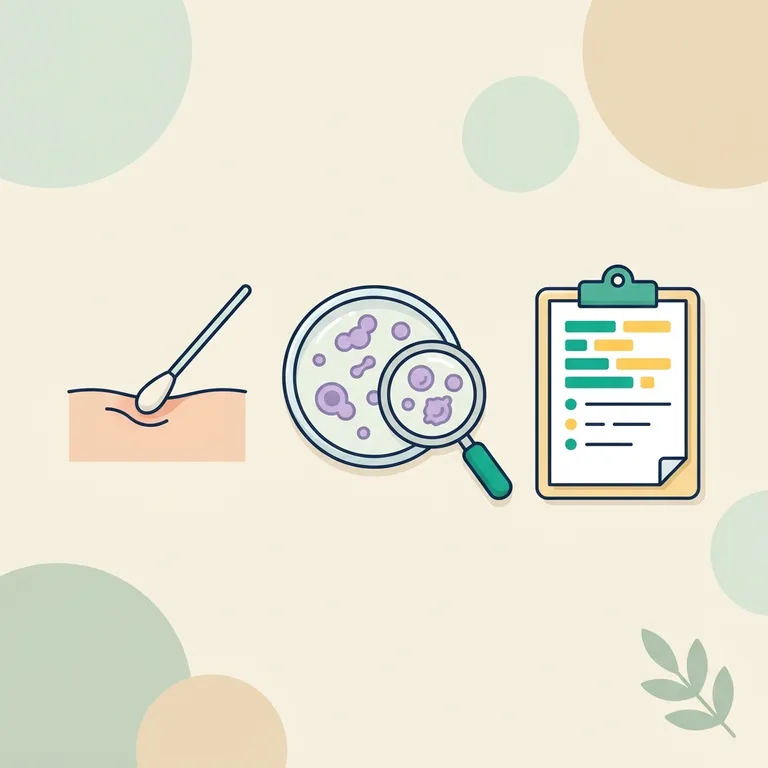
The only way to know for sure is to be tested[1]. A health care provider sends a sample to a laboratory[3]: a swab from a skin sore, pus from an abscess, or blood, urine or sputum[1]. The lab identifies the bacteria and tests which antibiotics work against them[1]. This "culture and sensitivity" report works the same way as a urine culture or a stool culture. Here is a fictitious report.
| Test | Result | Reference | Flag |
|---|---|---|---|
| Wound culture | Staphylococcus aureus, methicillin-resistant (MRSA) | No pathogen | POS |
| Oxacillin | Resistant | Susceptible | R |
| Vancomycin | Susceptible | Susceptible | S |
| Doxycycline | Susceptible | Susceptible | S |
| Trimethoprim-sulfamethoxazole | Susceptible | Susceptible | S |
- Methicillin-resistant (MRSA): the staph was found and resists the usual staph antibiotics[1].
- Susceptibility (S, R): S means the antibiotic is expected to work, R means it is not. Your doctor picks from the "S" lines, in line with your health history[1].
- Screening swabs: before surgery, swabs from the nostril, mouth, armpits, groin and any sore can be sent for testing[2]. A person who carries MRSA without an active infection rarely needs treatment[1].
Got a culture and susceptibility report you do not understand? BloodSense explains each line of your complete report and helps you prepare your questions for your doctor.
Get my culture report explainedWhat does a positive MRSA screening swab mean?
Hospitals may take swabs from the nostril, mouth, armpits, groin and any sore or broken skin before surgery, and send them for testing[2]. A positive screening result means that you carry MRSA on your skin or in your nose. It does not mean that you are ill: people who carry the germ without an active infection rarely need treatment[1]. If your result is positive, your care team may offer a nasal cream or spray and a body wash for around 5 to 10 days[2]. Always tell your providers about a past MRSA result[1].
Is MRSA mostly a hospital problem?
Serious infections are more common in people with long-term illness, long hospital or care-facility stays, dialysis, cancer treatment or immune-weakening medicines[1]. But healthy people can also get skin infections, especially athletes who share towels or razors, children in daycare and people with recent tattoos[1][3]. The germ can reach bones, joints, blood and organs once inside the body[1].
Which blood tests can go with an MRSA infection?
When an infection spreads, doctors may add a complete blood count, CRP or procalcitonin and blood cultures, to check how much inflammation there is and whether bacteria are in the blood. These tests do not identify MRSA by themselves: only a culture does[1][4].
How is an MRSA infection treated?
No drug names or doses are given here: your doctor chooses them.
- Skin infection: draining it by a provider may be the only treatment needed. Do not drain it yourself[1][3].
- Antibiotics: the choice depends on the lab results, guidelines and your health history. Mild infections may use tablets; serious ones may need intravenous antibiotics in hospital[1][2].
- Serious infections in the lungs or blood are harder to treat, and antibiotics may continue after you leave hospital[1]. Guidelines cover skin and soft tissue, bloodstream and heart valve, lung, bone and joint, and nervous system infections separately[5].
- Carriers: after a positive screening, a nasal cream or spray and a body wash and shampoo may be used for about 5 to 10 days (NHS)[2].
How can I prevent MRSA?
- Wash your hands with soap and water or use an alcohol-based sanitizer, including after leaving a health care facility[1].
- Keep cuts covered with clean, dry bandages and never pick at or pop a bump[1][3].
- Do not share towels, clothing, razors or cosmetics[1].
- Athletes: cover wounds, shower after exercise and clean shared equipment[1].
- Tell your provider before surgery if you have had frequent infections or MRSA[1].
Questions to ask your doctor
- Was my sample tested for MRSA, and which antibiotics does the report say will work?
- Does my infection need to be drained, and by whom?
- How can I keep other people in my home from catching it?
- Do I need a screening swab or a decolonization treatment?
- Which signs should make me call you or go to the emergency room?
Frequently asked questions
Is MRSA the same as a staph infection?
MRSA is one kind of staph infection, caused by a staph that resists several antibiotics. Most staph infections are caused by Staphylococcus aureus[3][4].
Can I carry MRSA without being sick?
Yes. Many carriers have no symptoms and rarely need treatment[1][2].
Can MRSA be treated?
Yes. Antibiotics are available to treat MRSA infections, and some infections need drainage[3].
Is MRSA contagious?
Yes, mainly through skin contact and contaminated objects[1][3]. Good hand hygiene lowers the risk.
Can a blood test show MRSA?
Only a blood culture can show bacteria in the blood. Routine blood counts show inflammation, not the germ[1].
Related articles
- Urine cultureHow a culture and susceptibility report is read
- Stool cultureAnother culture report, explained line by line
- SepsisA serious complication when bacteria reach the blood
- CellulitisA deeper skin infection that can be caused by staph
- ProcalcitoninA blood marker used in severe bacterial infection
- Complete blood countWhite cells and the infection picture
- MedlinePlus Medical Encyclopedia. MRSA. Reviewed August 29, 2024. US National Library of Medicine. medlineplus.gov (accessed October 24, 2026)
- National Health Service. MRSA. Reviewed October 9, 2026. nhs.uk (accessed October 24, 2026)
- Centers for Disease Control and Prevention. About MRSA. Reviewed June 26, 2025. cdc.gov (accessed October 24, 2026)
- MedlinePlus. Staphylococcal infections (health topic). Updated November 8, 2023. US National Library of Medicine. medlineplus.gov (accessed October 24, 2026)
- Liu C, Bayer A, Cosgrove SE, et al. Clinical practice guidelines by the Infectious Diseases Society of America for the treatment of methicillin-resistant Staphylococcus aureus infections in adults and children. Clin Infect Dis. 2011;52(3):e18-e55. doi:10.1093/cid/ciq146 (accessed October 24, 2026)
This page is general information. It does not replace the advice of a doctor, who interprets your results with your symptoms, history and examination.