










Creutzfeldt-Jakob Disease (CJD): Symptoms, Causes and the Tests That Confirm It
The essentials
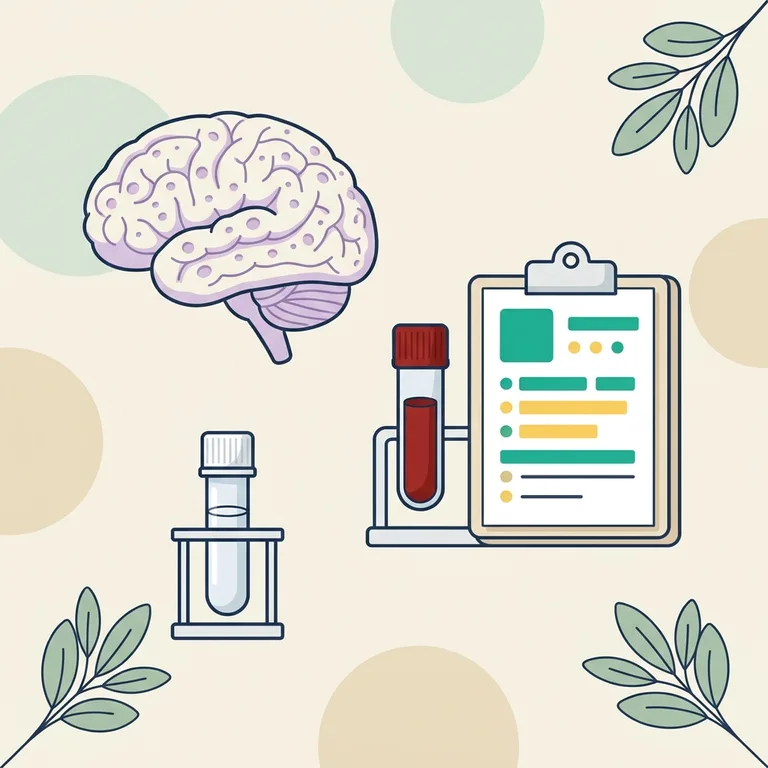
Creutzfeldt-Jakob disease (CJD) is a rare, fatal brain disease caused by a misfolded protein called a prion. It causes a dementia that worsens over weeks to months, often with sudden muscle jerks. Doctors confirm it in life mainly with a spinal fluid test called RT-QuIC and a brain MRI, after blood tests have ruled out treatable look-alikes.
What is Creutzfeldt-Jakob disease, at a glance?
CJD is the most common human prion disease. A normal brain protein, the prion protein, changes shape and pushes nearby copies to fold the same wrong way. The misfolded protein builds up and nerve cells die, leaving small holes that give the brain a sponge-like look[1][3].
- Other names: CJD, Jakob-Creutzfeldt disease, a transmissible spongiform encephalopathy (TSE). Variant CJD (vCJD) is the separate form linked to "mad cow disease"[1].
- How common: about 1 to 2 cases per million people each year, in the United States as in many countries[1], or roughly 500 to 600 US cases a year[2].
- Key tests: spinal fluid RT-QuIC, 14-3-3 protein and tau; brain MRI; EEG; blood tests to exclude other causes of fast memory loss.
CJD is one of the rare types of dementia; its speed, over months rather than years, sets it apart.
What are the symptoms of CJD?
Classic CJD usually starts after age 55, on average in the late 60s[2]. Early signs can be vague, which is why the first diagnosis is often wrong[8]:
- Memory loss, confusion and changes in personality or behavior that worsen week after week.
- Unsteady walking and poor coordination.
- Vision problems: blurred vision, blind areas, seeing things that are not there.
- Sudden jerks of the muscles (myoclonus), often triggered by noise or touch[3], unlike ordinary muscle twitching.
- Low mood, anxiety and slurred speech[4].
In the late stage, the person can no longer move or speak (akinetic mutism). Half of patients with classic CJD die within about 4 to 5 months of the first symptoms, most within a year[1][3]. Variant CJD affects younger people, around 28 years on average, and lasts 13 to 14 months on average[5].
When should I see a doctor?
When to see a doctor
- Emergency: call 911 for confusion that appears over hours or a day, a first seizure, sudden weakness of one side or trouble speaking (possible stroke), or choking and breathing difficulty in someone already ill.
- Within 24 to 48 hours if memory, behavior or walking get worse from one week to the next, especially with new muscle jerks. A fast decline needs an urgent work-up, because several causes are treatable[9].
- At your next appointment if a close relative had a genetic prion disease, or you received human-derived growth hormone or a dura mater graft in the past, and you want advice on what that means for you.
What causes CJD, and is it contagious?
There are several forms, from the most to the least frequent[1][2][5]:
- Common Sporadic CJD, about 85% of cases. The protein misfolds by chance; no cause is found. Age is the main risk factor.
- Possible Genetic (familial) CJD, 5 to 15%. A change in the prion protein gene, PRNP, is passed from a parent; each child has a 1 in 2 chance of inheriting it, as in Huntington's disease.
- Rare Iatrogenic CJD, under 1%: transmission by human-derived growth hormone (given before 1978 in the US), dura mater grafts, corneal transplants or, in the past, brain surgery instruments. No US case from instruments has been reported since 1976[2].
- Rare Variant CJD, from eating beef products infected with bovine spongiform encephalopathy (BSE). There have been 233 cases worldwide since 1996, mostly in the United Kingdom; the 4 US patients were most likely infected abroad[5].
There is no evidence that sporadic CJD spreads through everyday contact, the air, blood or sex[4]. The known routes of the acquired forms are contaminated tissue or medical products and, for vCJD, infected food; in the United Kingdom, vCJD was also passed on 5 times by blood transfusion[2][4]. The incubation can last up to 40 years in acquired forms[7].
How is CJD diagnosed, and how do I read the test results?
No single blood test shows CJD. Doctors combine symptoms, spinal fluid tests, MRI and EEG, using CDC criteria[1]. The spinal fluid is collected by a lumbar puncture, explained in our CSF analysis guide. Below, a fictitious report for a 66-year-old man with three months of decline.
| Test | Result | Reference range | Flag |
|---|---|---|---|
| WBC count, CSF | 1 /µL | 0-5 /µL | - |
| Protein, CSF | 52 mg/dL | 15-60 mg/dL | - |
| 14-3-3 protein | Positive | Negative | A |
| Total tau | 4,800 pg/mL | Below the lab cutoff (about 1,100 to 1,400) | H |
| RT-QuIC (prion seeding) | Positive | Negative | A |
- Cells and protein: usually normal in CJD. In 450 patients, only 3 of 298 had more than 5 white cells per µL and none had protein above 100 mg/dL[10].
- 14-3-3 and tau: they leak from dying nerve cells, so they rise in CJD but also after a stroke, a seizure or encephalitis. 14-3-3 has a sensitivity around 92% but a specificity of only 40 to 92% across studies; tau is about 90% for both[6].
- RT-QuIC: the lab mixes the fluid with normal prion protein and watches whether it is converted. A positive result is close to specific: 97% of CJD cases were positive and none of 100 people with other diseases[11]. A negative result does not fully exclude CJD.
Received spinal fluid or blood results you find hard to follow? BloodSense explains each line of your lab report in plain words, so you can prepare your questions for the neurologist.
Explain my lab reportBrain MRI. Diffusion-weighted images (DWI) show bright ribbons in the cortex or deep gray matter. In one study, MRI separated CJD from other fast dementias with 96% sensitivity and 93% specificity[12].
EEG. Periodic sharp waves are typical but appear late and in only 39 to 64% of patients[6].
Blood tests. They do not show CJD; they look for the treatable causes of a rapidly progressive dementia[9]:
| Test | What it looks for |
|---|---|
| Comprehensive metabolic panel, calcium, magnesium | Low sodium, high calcium, kidney or liver failure, low or high sugar |
| Vitamin B12 | A deficiency that affects memory and nerves |
| TSH and thyroid antibodies | Thyroid disease; a high anti-TPO raises the question of Hashimoto encephalopathy, a frequent misdiagnosis[8] |
| HIV test and syphilis test | Infections that can damage the brain (see syphilis) |
| Autoimmune and paraneoplastic antibodies | Autoimmune encephalitis, a treatable mimic |
The diagnosis can be probable when the symptoms fit and RT-QuIC is positive, or when the symptoms fit with a typical MRI, EEG or 14-3-3. It is definite only with brain tissue, usually at autopsy[1]. A blood test for the PRNP gene looks for a genetic form[6].
Which tests are used to follow CJD?
No blood or spinal fluid marker is used to track CJD over time. Once the diagnosis is made, care focuses on comfort, and tests are kept for new problems:
- A blood count, urine test or chest X-ray if fever suggests an infection, the most common complication[3].
- Sodium, kidney tests and blood sugar if swallowing becomes difficult and the person drinks or eats little.
- A genetic counseling visit if PRNP testing is positive, before relatives decide whether to be tested.
How is CJD treated?
There is no cure and no medicine that slows the disease[1]. Care aims at comfort and safety[3][4]:
- Medicines for anxiety, depression, agitation and pain.
- Nursing care and help with feeding.
- Palliative and hospice care, at home or in a facility.
- Early planning: advance directives and health care power of attorney.
Can CJD be prevented, and how do families cope?
Sporadic CJD cannot be prevented. Acquired forms became very rare thanks to synthetic growth hormone, stricter instrument cleaning and controls on cattle feed and meat[2][4]. People with CJD should not donate blood, corneas or other tissue[3].
Families face a fast loss and often need counseling[3]. A caregiver who feels low for weeks should talk to their own doctor (see depression). An autopsy confirms the diagnosis, helps surveillance and tells relatives whether a genetic form was present.
Questions to ask your doctor
- Which treatable causes of a fast dementia have been ruled out, and which tests are still pending?
- Was RT-QuIC done, and what does a positive or negative result mean here?
- Should the PRNP gene be tested, and what would it mean for our children?
Frequently asked questions
Is CJD the same as mad cow disease?
No. Mad cow disease (BSE) affects cattle. Eating infected beef caused variant CJD in humans, a different illness from classic CJD, which has nothing to do with food[5].
Has anyone survived prion disease?
No form of CJD is curable. Some patients, especially with variant CJD or rare subtypes, live 1 to 2 years or more[3][5]. When someone "recovers", the cause was usually a treatable mimic.
Can I catch CJD by caring for a relative?
There is no evidence that everyday contact with a person who has sporadic CJD spreads the disease[4]. The acquired cases came from tissue, medical products or, for vCJD, food[2].
Is there a blood test for CJD?
Not in routine care. Blood tau and neurofilament light rise in CJD but also in other brain diseases, so they are research tools[6].
Related articles
- CSF analysisHow to read cells, protein and glucose in spinal fluid.
- Types of dementiaHow the main dementias differ and which causes are reversible.
- Lewy body dementiaAnother dementia with hallucinations and movement problems.
- Neuron-specific enolase (NSE)A marker of nerve cell damage sometimes measured with 14-3-3.
- DiseasesAll our guides to diseases and their tests.
References
- Centers for Disease Control and Prevention. Clinical overview of Creutzfeldt-Jakob disease (CJD), including diagnostic criteria. January 21, 2026. cdc.gov (accessed November 21, 2026)
- Centers for Disease Control and Prevention. About classic Creutzfeldt-Jakob disease. January 21, 2026. cdc.gov (accessed November 21, 2026)
- MedlinePlus. Creutzfeldt-Jakob disease. Medical Encyclopedia. US National Library of Medicine. Reviewed July 17, 2025. medlineplus.gov (accessed November 21, 2026)
- NHS. Creutzfeldt-Jakob disease. Reviewed September 7, 2021. nhs.uk (accessed November 21, 2026)
- Centers for Disease Control and Prevention. About variant Creutzfeldt-Jakob disease. May 13, 2024. cdc.gov (accessed November 21, 2026)
- Hermann P, Appleby B, Brandel JP, et al. Biomarkers and diagnostic guidelines for sporadic Creutzfeldt-Jakob disease. Lancet Neurol. 2021;20(3):235-246. doi:10.1016/S1474-4422(20)30477-4 (accessed November 21, 2026)
- Uttley L, Carroll C, Wong R, Hilton DA, Stevenson M. Creutzfeldt-Jakob disease: a systematic review of global incidence, prevalence, infectivity, and incubation. Lancet Infect Dis. 2020;20(1):e2-e10. doi:10.1016/S1473-3099(19)30615-2 (accessed November 21, 2026)
- Paterson RW, Torres-Chae CC, Kuo AL, et al. Differential diagnosis of Jakob-Creutzfeldt disease. Arch Neurol. 2012;69(12):1578-1582. doi:10.1001/2013.jamaneurol.79 (accessed November 21, 2026)
- Geschwind MD. Rapidly progressive dementia. Continuum (Minneap Minn). 2016;22(2 Dementia):510-537. doi:10.1212/CON.0000000000000319 (accessed November 21, 2026)
- Green A, Sanchez-Juan P, Ladogana A, et al. CSF analysis in patients with sporadic CJD and other transmissible spongiform encephalopathies. Eur J Neurol. 2007;14(2):121-124. doi:10.1111/j.1468-1331.2006.01630.x (accessed November 21, 2026)
- Franceschini A, Baiardi S, Hughson AG, et al. High diagnostic value of second generation CSF RT-QuIC across the wide spectrum of CJD prions. Sci Rep. 2017;7(1):10655. doi:10.1038/s41598-017-10922-w (accessed November 21, 2026)
- Vitali P, Maccagnano E, Caverzasi E, et al. Diffusion-weighted MRI hyperintensity patterns differentiate CJD from other rapid dementias. Neurology. 2011;76(20):1711-1719. doi:10.1212/WNL.0b013e31821a4439 (accessed November 21, 2026)
- Case Western Reserve University School of Medicine. National Prion Disease Pathology Surveillance Center. case.edu (accessed November 21, 2026)
- US Food and Drug Administration. Recommendations to reduce the possible risk of transmission of Creutzfeldt-Jakob disease and variant Creutzfeldt-Jakob disease by blood and blood components. Guidance for industry, May 2022. fda.gov (accessed November 21, 2026)
This page gives general information about Creutzfeldt-Jakob disease and its tests. It does not replace the advice of the neurologist who knows the full history, examination and results.