






Types of Dementia: Symptoms, Causes, and Treatment
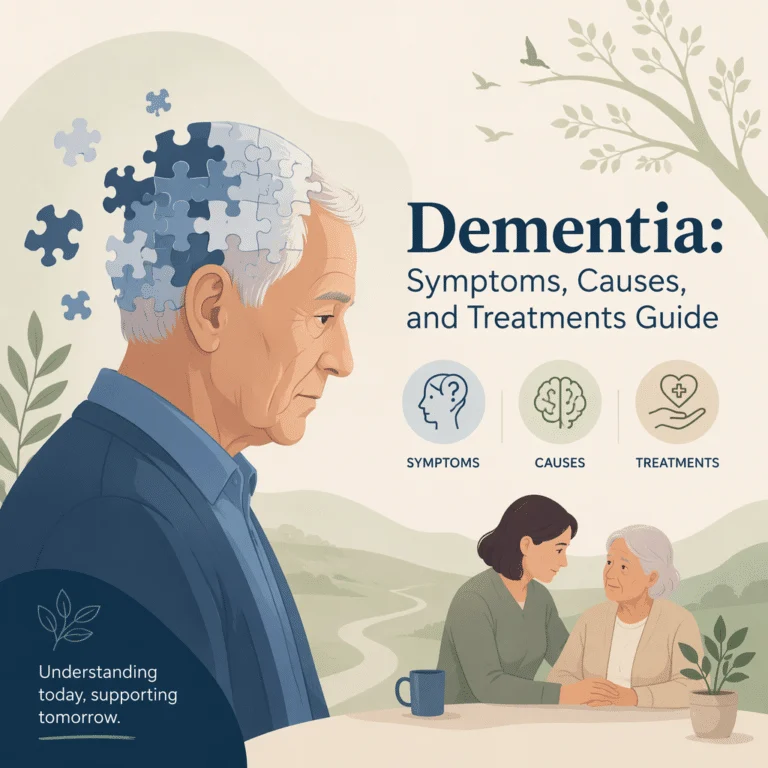
All the main types of dementia share one core feature — a lasting decline in memory, thinking or judgment that interferes with everyday life — but they differ in what they damage first, how they progress and what helps. Dementia is not a single disease. It is an umbrella term for a syndrome that several brain conditions can produce, and that a handful of treatable medical problems can imitate closely enough to fool a rushed appointment. In this article you will learn how the major types of dementia differ, how ordinary aging is distinguished from mild cognitive impairment and from dementia, which reversible contributors a work-up must exclude, which risk factors are modifiable, and what current treatments realistically deliver.
What dementia is, and what it is not
Dementia describes a pattern, not a cause. A doctor uses the word when someone has a measurable, persistent decline in at least two areas of thinking — memory, language, attention, visual-spatial skill, planning or social judgment — severe enough to interfere with independent daily life.
Saying someone has dementia is a little like saying someone has a fever: it describes what is happening without explaining why. The why determines the outlook, the treatment and, in a small minority of cases, whether the situation can be reversed. That is why the types of dementia are worth telling apart.
Dementia is not a normal part of aging
Most people over 80 do not have dementia. Age is the strongest risk factor, but aging alone does not produce it, and treating dementia as the price of a long life delays assessment.
Normal aging, mild cognitive impairment, and dementia
Normal age-related change looks like this: you take longer to recall a name but it surfaces later, you occasionally misplace keys, you need a list where you once did not. Independence is intact.
Mild cognitive impairment sits in between. Thinking has measurably declined, enough for a relative to notice and to show on testing, but independence holds. It is not a guarantee of dementia: some people stay stable for years, some improve once an underlying cause is treated, and some progress.
Dementia is diagnosed when the decline erodes independence — bills unpaid, medications doubled or skipped, familiar routes confusing, cooking unsafe. The line between the three is clinical judgment informed by testing, not a single score.
When to see a doctor
- Someone close has noticed repeated changes in memory, language or judgment over months rather than days.
- The same question gets asked twice in one conversation, or money and medication management has slipped.
- Personality or social behavior has changed noticeably, or getting lost has happened somewhere familiar.
- Confusion has appeared abruptly over hours or days — a reason to seek urgent care, since sudden confusion usually means delirium from infection, medication or a metabolic problem rather than dementia.
The main types of dementia, side by side
Telling the types of dementia apart matters practically. The subtype shapes which symptoms come next, which medications help and — for one subtype in particular — which can cause serious harm. The table below compares the four commonest causes plus mixed disease, which is more common in older brains than any pure diagnosis.
| Type | Usual first signs | What tends to stand out | Practical note |
|---|---|---|---|
| Alzheimer’s disease | Trouble holding on to new information; repeated questions | Slow, steady progression; word-finding and orientation follow memory | The commonest single cause; social manners are often preserved early, masking the extent of the problem |
| Vascular dementia | Slowed thinking, difficulty planning, poor concentration | Stepwise after strokes, or gradual with small-vessel damage; walking and balance affected early | Memory is often spared at first; blood pressure, diabetes and cholesterol control are central |
| Lewy body dementia | Fluctuating alertness, detailed visual hallucinations, acting out dreams | Parkinson-like stiffness and slowness; attention varies hour to hour | Severe sensitivity to many antipsychotic drugs makes the right subtype diagnosis a safety issue |
| Frontotemporal dementia | Personality change, loss of empathy or restraint, or progressive loss of language | Memory may look normal early; the change is in conduct or speech | Often starts between 45 and 65 and is frequently mistaken for a psychiatric condition |
| Mixed dementia | A blend, usually Alzheimer-type memory loss plus vascular slowing | Symptoms do not fit one textbook picture | Probably the commonest situation over 80; treating the vascular part still matters |
Alzheimer’s disease, the most common cause
Alzheimer’s disease accounts for the largest share of cases and has its own biology, markers and newer treatments, so it deserves a full article. Readers who want that detail can read our detailed Alzheimer’s disease guide.
Where Parkinson’s disease fits
Lewy body dementia and the dementia that can develop later in Parkinson’s disease involve the same protein deposits and overlap heavily. The distinction is timing: when movement problems clearly come first and thinking changes follow a year or more later, it is called Parkinson’s disease dementia. Families facing tremor and stiffness alongside cognitive change often also review our Parkinson’s disease overview.
Rarer causes worth knowing
Less common types of dementia follow repeated head injury, untreated HIV infection, late-stage syphilis and some autoimmune brain inflammations. Several are treatable, which is why a good assessment does not assume the commonest answer.
Reversible and treatable causes that a work-up must rule out
This is where a patient has the most to gain. A minority of people referred for memory problems have a contributor that can be corrected, and even when a degenerative disease is present, an untreated thyroid problem or a sedating medication can make it look worse than it is. Correcting those does not cure dementia, but it buys back real function.
| Contributor | How it can look | Usual checks |
|---|---|---|
| Thyroid disease | Slowed thinking, low mood, fatigue, apathy | Thyroid-stimulating hormone, sometimes free T4 |
| Vitamin B12 or folate deficiency | Poor concentration, irritability, tingling feet, unsteady walking | Serum B12, folate, blood count, sometimes methylmalonic acid |
| Depression | Attention and memory complaints with low mood, withdrawal, poor sleep | Structured mood questionnaire and clinical interview |
| Medication effects | Foggy thinking, sedation, unsteadiness after a new prescription | Review of prescriptions, over-the-counter drugs and supplements |
| Obstructive sleep apnea | Daytime sleepiness, morning headache, snoring, poor attention | Sleep questionnaire and a sleep study |
| Normal pressure hydrocephalus | Shuffling walk, urinary urgency and thinking changes together | Brain imaging, then trial removal of spinal fluid in selected cases |
| Alcohol | Memory gaps, poor planning, unsteadiness, poor nutrition | Drinking history, liver tests, thiamine status |
| Metabolic and organ problems | Confusion, drowsiness, fluctuating alertness | Sodium, calcium, glucose, kidney and liver panels |
| Infections | Cognitive change with other systemic or neurological signs | Syphilis and HIV testing where the history suggests it |
The blood work behind the exclusions
Most of that list is checked with a short panel a primary care doctor can order in one visit. It includes a thyroid-stimulating hormone test, because an underactive thyroid produces slowness and apathy that read convincingly as early dementia; readers can also consult a plain-language hypothyroidism guide. Doctors order a vitamin B12 blood level with folate, since deficiency hits nerves and thinking together and is easy to correct.
A basic metabolic panel measures total blood calcium, sodium and glucose, any of which disturbs thinking when badly out of range, and checks a serum creatinine result alongside liver enzymes, because failing organs let substances build up that cloud the brain. Work-ups also request a complete blood count, which can reveal anemia or the enlarged red cells typical of B12 deficiency, and where the history points that way, a syphilis screening test or HIV testing.
Blood work never diagnoses any of the types of dementia by itself. It narrows the field and catches the correctable, which is why skipping it is a mistake.
Depression deserves its own line
Late-life depression produces measurable difficulty with attention and recall, and often coexists with early dementia rather than replacing it as an explanation. A thorough assessment always evaluates depression and its physical symptoms before concluding that thinking changes are purely degenerative.
How doctors diagnose dementia
There is no single test for any of the types of dementia. A good clinician spends as much time on the history as on any scan, because the most valuable information is a timeline from someone who knows the person well: what changed, when, in what order, how fast. Sudden onset points elsewhere. Stepwise decline hints at vascular disease. Behavior changing before memory suggests a frontotemporal process.
Brief office tests screen for a problem and track change over time. When the picture is unclear, formal neuropsychological testing maps which abilities are affected — usually more informative than a single global score.
Among investigations the reversible-cause panel comes first, followed by brain imaging, usually magnetic resonance imaging, which looks for strokes, small-vessel damage, tumors, bleeding and hydrocephalus but is weak at separating the types of dementia early on. Specialized scans and specific blood markers can support a subtype diagnosis in memory clinics, but remain specialist tools rather than routine screening.
Risk factors you can actually change
Age, family history and certain genetic variants are fixed. A surprising amount of the rest is not. A 2024 international expert review identified fourteen risk factors together linked to close to half of dementia cases worldwide — meaning that if all were eliminated across a population, that share might in principle be delayed or prevented. No individual gets a guarantee, but the evidence points one way.
- Hearing loss and vision loss left untreated.
- High blood pressure in midlife, high LDL cholesterol, diabetes and obesity.
- Smoking, heavy alcohol use and physical inactivity.
- Depression, social isolation and low educational attainment in early life.
- Traumatic brain injury and air pollution exposure.
- The practical translation: aerobic activity, hearing aids, social engagement, treated sleep apnea, modest alcohol.
The vascular cluster offers the clearest gains, because those factors are measurable and treatable. It is worth taking the time to understand high blood pressure and its treatment, since midlife blood pressure control protects the small vessels that several types of dementia damage. Some clinicians also measure a homocysteine level, which rises when B vitamins run low, though lowering it has not been shown to prevent dementia.
What today’s treatments do and do not do
Honesty matters more than optimism here. No approved treatment restores lost cognitive function, and none stops any of the types of dementia.
Medications for symptoms
Cholinesterase inhibitors and memantine produce modest improvements in thinking, function or behavior for some people, particularly in Alzheimer’s disease and Lewy body dementia. The benefit is real but small, and side effects such as nausea, slow heart rate or vivid dreams need monitoring. They are worth trying, and worth stopping if nothing changes.
Disease-modifying antibody treatments
A newer class of infused antibodies clears amyloid protein and modestly slows decline in early Alzheimer’s disease specifically. They do not apply to the vascular, Lewy body or frontotemporal types of dementia, they require confirmed amyloid biology and monitoring scans because brain swelling and small bleeds occur, and they slow decline rather than stop it.
Treating the cause behind the syndrome
For vascular dementia, firm control of blood pressure, cholesterol, diabetes and atrial fibrillation is the treatment. For alcohol-related damage, stopping drinking and correcting thiamine can produce genuine recovery. For normal pressure hydrocephalus, a shunt helps selected patients. This is the argument for pinning down which of the types of dementia is present instead of stopping at the label.
Non-drug approaches
Structured routines, a simplified environment, exercise, occupational therapy, music and caregiver training consistently outperform expectations for agitation, disturbed sleep and apathy. Looking for a behavior’s trigger — pain, constipation, infection, boredom, fear — is safer and more effective than sedating medication.
Living well after a diagnosis
A diagnosis is not the end of a person’s agency. Many people live meaningfully for years, and how those around them respond shapes that experience.
Paperwork, safety and independence
While the person can still express their wishes, complete a healthcare proxy, a durable power of attorney and an advance directive. Doing this early is respect, not pessimism.
- Simplify medication with a weekly organizer rather than taking the task away.
- Address driving early, with a formal assessment where possible, so the decision is not a family betrayal.
- Reduce home hazards and keep a consistent daily rhythm, since predictability lowers anxiety better than any reminder system.
- Let the person do everything they still can, even slowly. Taking tasks over early accelerates their loss.
Communication and caregiver health
Short sentences, one question at a time and unhurried pauses work better than repetition at volume. Correcting a factual error rarely helps; responding to the emotion underneath usually does. Never discuss the person in the third person in front of them.
Caregiver exhaustion, depression and illness are predictable, and are the commonest reason a person moves into residential care sooner than necessary. Respite care, support groups and treating the caregiver’s own health as a medical priority are good dementia care, not optional extras.
Latest scientific advances
Research on the types of dementia has moved fast, but most progress is in prevention rather than cure. Here is what recent work adds, in plain terms.
Nearly half of the global risk is potentially modifiable
A large international expert commission published in 2024 extended its list of dementia risk factors to fourteen, adding untreated vision loss and high LDL cholesterol. What this means for you: the ordinary things your doctor already nags about — blood pressure, cholesterol, hearing aids, an eye exam, exercise, not smoking — are the best-evidenced brain protection available. This is population-level modeling, not a personal guarantee.
Low vitamin B12 is common in older adults and easy to miss
A 2025 review concluded that vitamin B12 deficiency in older adults is common and often undiagnosed, that it is linked to cognitive decline, low mood, unsteady walking and falls, and that the standard blood test is not always sensitive enough alone. Improvement after treatment was clearest in early cases. What this means for you: if a relative is assessed for memory problems, B12 belongs in the work-up, and a borderline result deserves a second look. This was a narrative review, a summary of existing studies rather than a new trial.
Small-vessel damage sits behind more dementia than people realize
A 2023 review of cerebral small vessel disease — gradual damage to the tiny arteries deep inside the brain — reported that it is found in more than half of people aged 65 and over when brains are examined after death, and that it drives most vascular contributions to dementia, with high blood pressure its main modifiable cause. What this means for you: treating blood pressure in midlife is brain treatment, and this damage builds silently for years before symptoms appear.
Alcohol raises dementia risk, and some damage can improve
A 2024 review of decades of research concluded that sustained heavy drinking accelerates brain aging and raises dementia risk overall, though not Alzheimer’s risk specifically, and highlighted an encouraging difference: some alcohol-related brain damage partly recovers with lasting abstinence, which is not true of degenerative disease. What this means for you: cutting down is worth doing at any age. This was a narrative review, describing patterns rather than proof of cause.
Glossary
| Term | Definition |
|---|---|
| Dementia | An umbrella term for a lasting decline in thinking that interferes with everyday independence. It names a pattern of symptoms, not one specific disease. |
| Mild cognitive impairment (MCI) | A measurable decline in thinking that has not yet cost the person their independence. Some people with MCI progress to dementia, some stay stable and some improve. |
| Delirium | Sudden, fluctuating confusion that develops over hours or days, usually caused by infection, medication or a metabolic problem. It is a medical emergency and is often reversible. |
| Cerebral small vessel disease | Gradual damage to the tiny arteries deep inside the brain, strongly linked to high blood pressure and a major contributor to vascular dementia. |
| Cholinesterase inhibitor | A class of medication that raises levels of a brain messenger chemical involved in memory. It can modestly ease symptoms but does not stop the underlying disease. |
| Amyloid | A protein that clumps abnormally in the brain in Alzheimer’s disease. Newer antibody treatments are designed to clear it. |
| Normal pressure hydrocephalus | A build-up of fluid in the brain’s cavities that causes an unsteady walk, urinary urgency and thinking changes. Selected patients improve after a shunt is placed. |
| Neuropsychological testing | A detailed set of pencil-and-paper and computer tasks that maps which specific thinking abilities are affected and by how much. |
| Basic metabolic panel | A common blood test measuring salts, glucose, kidney markers and calcium, used to spot metabolic causes of confusion. |
| Methylmalonic acid | A substance that builds up when vitamin B12 is genuinely low inside cells. It is used to confirm borderline B12 results. |
Frequently asked questions
What are the earliest warning signs of dementia?
The earliest signs depend on the type. In Alzheimer’s disease it is usually difficulty holding on to new information: the same question asked twice in a conversation, appointments forgotten despite reminders, recent events lost while old memories stay vivid. In vascular disease it is often slowed thinking and trouble planning. In frontotemporal dementia the first change is behavioral — uncharacteristic bluntness, loss of empathy, impulsive spending — or a gradual loss of words. A useful rule of thumb is that a change noticed consistently by other people over months, rather than an occasional lapse noticed by yourself, is the one worth investigating.
Can any type of dementia be reversed?
The common degenerative types cannot currently be reversed. However, a proportion of people assessed for memory problems have a contributing condition that can be treated, and their thinking can improve substantially once it is addressed. Thyroid disease, vitamin B12 deficiency, depression, sedating medications, sleep apnea, heavy alcohol use and normal pressure hydrocephalus all belong to that group. This is precisely why a proper work-up, including blood tests, is worth insisting on rather than accepting a diagnosis based on age and a short questionnaire.
What are the stages of dementia?
Clinicians usually speak of early, middle and late stages rather than a fixed numbered scale, and the popular seven-stage charts describe Alzheimer’s disease more closely than the other types. Early stage generally means independence is largely intact with support for complex tasks; middle stage means help is needed with daily activities such as dressing and bathing; late stage means extensive assistance with most personal care. Progression speed varies widely between individuals and between types, so a stage label describes where someone is now rather than predicting how long they will remain there.
Why do dementia symptoms sometimes get worse suddenly?
Dementia itself changes over months and years, not overnight. A sudden worsening over hours or days almost always signals something else: a urinary or chest infection, dehydration, constipation, pain, a new medication, or a stroke. This is called delirium, it is a medical emergency, and it usually improves once the trigger is treated. Sundowning — increased confusion in the late afternoon and evening — is different and follows a daily pattern rather than appearing abruptly.
What physical symptoms can dementia cause?
Dementia is not only about thinking. Depending on the type, people may develop an unsteady or shuffling walk, stiffness and slowness of movement, difficulty swallowing, weight loss, disturbed sleep including acting out dreams, incontinence and increased falls. Balance and walking problems appear early in vascular and Lewy body types, whereas in Alzheimer’s disease they generally arrive later. Any new physical symptom deserves its own assessment rather than being attributed automatically to the dementia.
Is dementia hereditary?
For most people the answer is: family history raises risk modestly, but does not determine outcome. Genuinely inherited forms, in which a single gene passes the condition directly through generations, are rare and usually cause symptoms unusually early, often before the age of 65. Frontotemporal dementia has a stronger familial component than the others. If several close relatives developed dementia young, genetic counseling is reasonable; otherwise, attention is better spent on the risk factors that can actually be changed.
Sources
- Centers for Disease Control and Prevention — About Dementia — CDC, 2025 — cdc.gov
- Mayo Clinic — Dementia: symptoms and causes — Mayo Foundation for Medical Education and Research, 2025 — mayoclinic.org
- MedlinePlus, National Library of Medicine — Dementia — National Institutes of Health, 2025 — medlineplus.gov
- Livingston G, Huntley J, Liu KY, et al. — Dementia prevention, intervention, and care: 2024 report of the Lancet standing Commission — The Lancet, 2024 — doi.org/10.1016/S0140-6736(24)01296-0
- Papazachariou A, Papakitsou I, Malikides V, Filippatos TD — Vitamin B12 deficiency among older adults and its associations with geriatric syndromes — Current Opinion in Clinical Nutrition and Metabolic Care, 2025 — doi.org/10.1097/MCO.0000000000001171
- Hainsworth AH, Markus HS, Schneider JA — Cerebral small vessel disease, hypertension, and vascular contributions to cognitive impairment and dementia — Hypertension, 2023 — doi.org/10.1161/HYPERTENSIONAHA.123.19943
- Zahr NM — Alcohol use disorder and dementia: a review — Alcohol Research: Current Reviews, 2024 — doi.org/10.35946/arcr.v44.1.03
Further reading
- Diabetes: symptoms, causes and treatments
- High cholesterol: causes, symptoms and treatments
- Anemia: symptoms, causes and effective treatments
- Chronic kidney disease: symptoms, causes and treatments
- HIV testing: understanding your results
Understand your lab results with BloodSense
When memory or thinking changes appear, the first useful step is often a short blood panel that looks for the contributors nobody wants to miss. Thyroid function, vitamin B12 and folate, blood counts, calcium and sodium, kidney and liver markers all sit on that list, and their results are rarely self-explanatory. BloodSense reads your report in plain language and shows you which values sit outside their reference range and what that generally means, so you arrive at your appointment with better questions. It helps you understand your results; it does not diagnose, and it does not replace your doctor.