






Finding red blood cells in stool on a laboratory report usually means a technician looked at a small smear of your sample under a microscope and saw intact red cells that should not be there. Healthy digestion does not release red cells into the bowel, so their presence is a signal that blood is entering the digestive tract somewhere between the mouth and the anus. The finding is common, and most causes turn out to be minor and treatable. It is still never a result to file away and forget, because the same finding can also be the first clue to a condition that responds best to early treatment. In this article you will learn what a stool microscopic exam actually measures, how microscopic red cells differ from visible blood and from occult blood, which conditions cause each pattern, which foods and pills only look like blood, and what testing usually follows.
What a stool microscopic exam measures
The test that reports red blood cells in stool is one of the oldest and simplest parts of a stool workup. A laboratory scientist places a thin film of stool on a slide, sometimes with a stain or a drop of saline, and examines it under magnification. The report lists what was seen and roughly how much: red blood cells, white blood cells, fat droplets, mucus, undigested muscle fibers, yeast, bacteria, and parasite eggs.
When the report says red blood cells were present, it means whole cells survived the trip through the gut intact enough to be recognized under the lens. That detail matters. Red cells break apart quickly in the acidic stomach and in the small intestine, so cells that still look like cells usually entered the stream low down, in the colon, rectum or anal canal. Blood from higher up is normally digested along the way and no longer looks like anything under the microscope, even though the iron in it is still chemically detectable.
How red blood cells in stool are reported
Most laboratories report red cells per high-power field, the small circle of sample visible at a given magnification. You may see phrases such as none seen, rare, few, moderate or many, or a number range such as 5 to 10 per high-power field. There is no universal reference range, because normal is simply none. The count gives a rough sense of how much blood reached the sample, but it does not identify the cause and it does not measure how much blood you are losing overall. That is why the microscopic finding is always read alongside your symptoms, your physical examination and your blood work.
How the sample is collected
You are given a clean container and a small scoop or spatula, and asked to catch the stool before it touches the toilet water, usually with a collection sheet or a clean dry basin. Water dilutes the sample and destroys fragile cells, and urine contaminates it. The sample needs to reach the laboratory quickly, often within an hour or two, or be refrigerated, because red and white cells degrade fast at room temperature. If you were menstruating or had recent bleeding hemorrhoids on the day of collection, mention it, because blood can reach the sample from outside the bowel and produce a result that means nothing about your digestion.
Visible blood, red blood cells in stool and occult blood are three different things
These three terms sound interchangeable and are constantly confused, including in clinics. They answer different questions and they are not substitutes for one another.
Visible blood is blood you or a clinician can see with the naked eye: streaks on the surface of the stool, red drips in the bowl, clots, or a black tarry appearance. Our guide explains what to make of visible blood in a stool sample.
Microscopic red blood cells in stool are cells seen under the lens when nothing was visible to the eye, or when a visible amount was examined more closely. This is what your report is describing.
Occult blood is blood detected by a chemical or antibody-based test rather than by sight. It has no visible trace and often no intact cells left. The modern version is the fecal immunochemical test, which uses antibodies against human hemoglobin and therefore reacts only to blood from the lower gut. If you want the detail, review our fecal occult blood test results guide.
The practical consequence is that a negative occult blood test does not cancel out microscopic red cells, and microscopic red cells do not replace a screening occult blood test. Bleeding is often intermittent, and a single sample only captures one moment. A clinician reads all available findings together rather than letting one override another.
What the appearance of blood suggests about its source
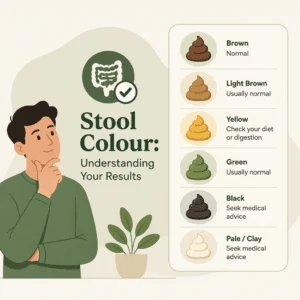
The color and pattern of blood give a first orientation, because blood changes as it travels. Fresh blood entering near the exit stays red. Blood entering in the stomach or duodenum is exposed to acid and enzymes for hours, turning it dark and tarry with a distinctive smell. Cleveland Clinic frames it the same way: bright red generally points low, black points high. Appearance alone, though, never settles the question. A brisk bleed high in the tract can move through so fast that it still looks red, and slow bleeding in the right side of the colon can look dark.
| What you see | Likely bleeding zone | Frequent causes | Usual next test |
|---|---|---|---|
| Bright red streaks on the surface, or drips after wiping | Anus and rectum | Hemorrhoids, anal fissure | Rectal examination, anoscopy |
| Red blood mixed evenly through the stool | Left colon and sigmoid | Diverticular disease, polyps, colitis | Colonoscopy |
| Dark red or maroon stool, sometimes with clots | Right colon or small intestine | Angiodysplasia, tumors, brisk upper bleeding | Colonoscopy, CT angiography |
| Black, sticky, tarry stool with a strong odor | Esophagus, stomach, duodenum | Ulcer, gastritis, esophageal varices | Upper endoscopy |
| Nothing visible, red cells only under the microscope | Most often the colon or rectum | Small polyps, mild colitis, early hemorrhoids, infection | Occult blood test, colonoscopy by age and risk |
| Blood with mucus and urgent, frequent stools | Colon lining | Inflammatory bowel disease, invasive infection | Calprotectin, stool culture, colonoscopy |
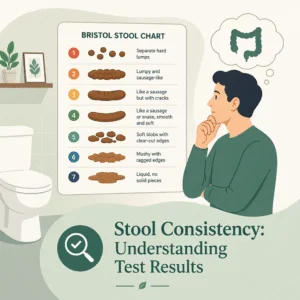
Blood is often accompanied by other visible changes, and those changes carry information of their own. Mucus, a shift in stool color unrelated to bleeding, and a sudden change in consistency all add context, which is why a clinician asks what the stool looked like rather than relying on the laboratory line alone.
Common causes, from the anus upward
Anus and rectum
The great majority of red blood cells in stool in otherwise healthy adults come from the last few centimeters of the digestive tract. Enlarged veins in the anal canal bleed easily when stools are hard or when straining is prolonged, and our guide covers the symptoms and treatment of hemorrhoids. An anal fissure, a small tear in the lining, typically produces a sharp burning pain during a bowel movement and a bright streak of blood afterward. Both are benign, but neither can be assumed without an examination, because they are so common that they can coexist with something else.
Colon
Small pouches in the colon wall can bleed suddenly and painlessly, sometimes heavily, and you can read about the causes and treatment of diverticulitis. Chronic inflammation of the colon lining produces blood mixed with mucus, urgency and diarrhea over weeks to months, a pattern described in our overview of the symptoms and management of ulcerative colitis. Polyps, which are growths on the lining, may shed small amounts of blood before they cause any symptom at all, and some eventually become malignant. Our resource explains the warning signs of colorectal cancer, which is exactly why painless bleeding after age 45 is investigated rather than watched.
Infection
Certain intestinal infections invade the bowel wall rather than simply irritating it, and those produce blood and white cells together. Shigella, invasive Salmonella, Campylobacter, some strains of Escherichia coli and the parasite Entamoeba histolytica all belong to this group. Fever, cramping and a short, intense course point in this direction, and our page on the causes and course of gastroenteritis gives the wider picture.
Stomach and small intestine
Ulcers and inflammation of the stomach lining bleed slowly and often silently, and the blood is digested before it reaches the toilet, so intact red cells are usually absent while occult blood tests turn positive. Our article details the symptoms and treatment of gastritis. Regular use of aspirin or anti-inflammatory painkillers, and blood thinners, both increase this kind of bleeding.
What looks like blood but is not
Before anyone reaches for an endoscope, the obvious impostors are ruled out. A stool microscopic exam is helpful here precisely because it shows actual cells: pigments do not look like red blood cells under a lens. What confuses people at home, and sometimes triggers the test in the first place, includes beets, which can turn stool and urine pink or red; red gelatin, fruit punch, tomato-heavy dishes and red food coloring; iron supplements and bismuth-containing stomach remedies, both of which turn stool black without any bleeding; and certain antibiotics in liquid form. Activated charcoal and licorice also darken stool. If a color change follows a specific food or a new pill by a day or so and disappears when you stop it, that is reassuring, though it is not a reason to skip a test your clinician has ordered.
The other results that travel with this finding
Red blood cells in stool are rarely interpreted alone. A stool panel and a blood panel each answer a different half of the question: where is the blood coming from, and what is it costing you?
On the stool side
White cells in the sample suggest that the bowel wall itself is inflamed or invaded, which shifts attention toward infection or inflammatory bowel disease. Two proteins released by those same white cells, calprotectin and lactoferrin, are measured chemically and are more reliable than looking for cells; our guide covers the meaning of fecal calprotectin levels. A culture identifies which bacteria are growing, and you can read about the interpretation of a stool culture report. An occult blood test adds a chemical answer to the microscope’s visual one.
On the blood side
A complete blood count shows whether repeated small losses have lowered your hemoglobin. Iron stores fall before the count does, which makes the iron panel the earliest warning, and our article explains what your ferritin blood level indicates. When both are low, the picture is described in our overview of the symptoms and causes of anemia. In adults, unexplained iron deficiency with anemia is treated as bleeding until proven otherwise and prompts a look at the digestive tract, even when no blood has ever been seen.
What usually happens next
The follow-up after red blood cells in stool depends on your age, your symptoms and how much blood is involved, not on the microscope report alone.
For a young adult with a painful tear or obvious hemorrhoids and a small amount of bright blood, an examination of the anal canal may be all that is needed, with treatment of constipation and a review if bleeding continues. For anyone from middle age onward, for anyone with a family history of bowel cancer, and for anyone with weight loss, a change in bowel habit or low iron, a colonoscopy is the usual step, because it both finds and removes polyps in one session. When the pattern suggests bleeding higher up, an upper endoscopy comes first. When bleeding is heavy and the source is not obvious, computed tomography angiography can locate an actively bleeding vessel quickly. When both ends are normal and bleeding continues, a swallowed camera capsule can survey the small intestine, the stretch that standard scopes cannot reach.
When to see a doctor
Call emergency services or go to an emergency department if you pass a large volume of blood or many clots, if stool is black and tarry and you feel faint, dizzy, breathless or clammy, if you vomit blood or material that looks like coffee grounds, or if bleeding comes with severe abdominal pain or a high fever.
Arrange a prompt appointment, within days rather than weeks, if bleeding continues beyond a couple of days, if it returns repeatedly, if it comes with a lasting change in your bowel habit, unexplained weight loss or persistent tiredness, if you are 45 or older and have not been screened for bowel cancer, if you take a blood thinner, or if a close relative had bowel cancer or polyps at a young age.
Even a finding you are confident about deserves one conversation. Hemorrhoids are so common that they are present in many people who also have something else, and the reassuring explanation is the one most likely to hide the important one.
Latest scientific advances
Research published between 2023 and 2025 on the causes of red blood cells in stool has mostly refined how doctors act on blood in the digestive tract, rather than changing what the finding means. Here is what stands out, in plain language.
An emergency medicine review of lower gastrointestinal bleeding, published in 2024, confirmed that most bleeding from the colon and rectum stops on its own, and that the two most frequent causes are diverticular pouches and problems around the anus. What this means for you is that the common outcome is reassuring, and that the urgent question in a hospital is not what caused the bleeding but whether your circulation is stable. The same review found that rushing a colonoscopy into the first few hours does not improve results for stable patients, so a scheduled examination is not a sign that anyone is taking your bleeding lightly.
A 2023 review of occult and obscure bleeding from Harvard-affiliated gastroenterologists set out how to proceed when blood is clearly being lost but the usual examinations find nothing. Their conclusion was that a swallowed camera capsule and deeper small-bowel scopes now resolve most of these cases. What this means for you is that unexplained bleeding is rarely a dead end, though the process can take several appointments.
On the screening side, a 2023 trial published in JAMA compared a stool test that measures genetic material shed by the bowel lining against a standard immunochemical stool test in nearly 9,000 adults. The newer test found substantially more cancers and more advanced pre-cancerous growths, though it also flagged more people who turned out to have nothing wrong. This was a single company-sponsored trial, so it is one strong result rather than a settled consensus. What this means for you is that stool-based screening is improving, and that a positive stool test of any kind still has to be confirmed by colonoscopy.
Two 2024 and 2025 reviews of colorectal cancer detection reached a consistent conclusion: stool tests are valuable mainly because people actually do them, and their real-world benefit depends less on laboratory accuracy than on whether a positive result leads to a colonoscopy. What this means for you is simple and practical. A stool finding is a doorway, not a diagnosis, and its value comes from the step you take after it.
Glossary
| Term | Definition |
|---|---|
| Stool microscopy | Examination of a thin film of stool under a microscope. It reports cells, fat, mucus and parasites seen in the sample. |
| Occult blood | Blood present in stool in amounts too small to see. It is detected by a chemical or antibody test, not by the eye. |
| Fecal immunochemical test (FIT) | A stool test that uses antibodies against human hemoglobin. It reacts to blood from the lower digestive tract and needs no dietary preparation. |
| Melena | Black, sticky, strong-smelling stool caused by blood that has been digested. It usually indicates bleeding in the stomach or upper small intestine. |
| Hematochezia | The passage of fresh red blood through the anus. It most often reflects bleeding in the colon, rectum or anal canal. |
| High-power field | The small circular area of a slide visible at high magnification. Cell counts in stool and urine reports are often given per high-power field. |
| Anal fissure | A small tear in the lining of the anal canal. It causes sharp pain during bowel movements and bright red bleeding afterward. |
| Angiodysplasia | Fragile, abnormally formed small blood vessels in the bowel wall. They can bleed slowly and repeatedly, particularly in older adults. |
| Capsule endoscopy | A swallowed camera the size of a large pill that photographs the small intestine as it passes through. It is used when standard scopes find nothing. |
| Calprotectin | A protein released by white blood cells into the bowel. Its level in stool reflects how much inflammation is present in the intestinal lining. |
FAQ
What does it mean when red blood cells are found in stool?
It means blood entered your digestive tract and reached the sample as intact cells. Because red cells are broken down as they travel, cells that still look like cells usually came from the colon, rectum or anus rather than the stomach. The finding identifies that bleeding happened; it does not identify the cause or how serious it is. Common explanations are hemorrhoids, a small anal tear, diverticular pouches, inflammation of the colon lining or an intestinal infection. Less common but more important explanations include polyps and colorectal cancer. Your clinician interprets the result alongside your age, symptoms, iron levels and blood count before deciding what to do next.
Is this the same as a positive occult blood test?
No, and the two are not interchangeable. Microscopy shows whole cells that a person can see under a lens. An occult blood test uses chemistry or antibodies to detect hemoglobin that leaves no visible trace and no recognizable cells. You can have red cells under the microscope with a negative occult blood test, or the reverse, because bleeding tends to come and go and each test samples a different moment. Screening programs rely on the immunochemical version because it is standardized and repeatable. A microscopic finding does not replace screening, and a normal screening test does not cancel out a microscopic finding.
Can food or medication make my stool look red or black?
Yes, and this is a frequent source of alarm. Beets, red gelatin, fruit punch, tomato-based dishes and red food coloring can tint stool red. Iron supplements, bismuth-containing stomach remedies, activated charcoal and licorice can turn it black. These changes usually start within a day of the food or pill and fade once you stop. A laboratory can tell the difference easily, since pigments do not produce red blood cells under a microscope and do not react to a hemoglobin test. If you are unsure, note what you ate or took and tell your clinician rather than waiting to see what happens.
How is the stool sample collected?
You collect the stool in a clean container using the scoop provided, catching it before it touches toilet water and keeping urine out of the sample. Water and urine both damage cells and dilute the result. The sample should reach the laboratory within a couple of hours or be refrigerated, because red and white cells break down quickly at room temperature. Tell the laboratory if you are menstruating or have actively bleeding hemorrhoids, since blood can reach the sample from outside the bowel. Some tests ask you to collect on more than one day, because bleeding is often intermittent.
What tests usually come after red blood cells are found?
Typically a small group of tests rather than one. Stool testing may be extended with an occult blood test, a calprotectin or lactoferrin level, and a culture if infection is suspected. Blood testing usually includes a complete blood count and an iron panel to see whether the loss has had consequences. Depending on your age, symptoms and family history, a colonoscopy is the usual visual examination of the colon and rectum, while an upper endoscopy is chosen if the pattern suggests bleeding higher up. Imaging or a camera capsule is reserved for cases where those examinations do not explain the bleeding.
Can this finding appear without any symptoms?
Yes, and that is one reason the test exists. Small polyps, early inflammation and gentle hemorrhoidal bleeding often cause nothing you would notice. Sometimes the first sign is not a symptom at all but a falling ferritin level or a mild anemia picked up on a routine blood test. The absence of pain, urgency or visible blood is not evidence that the finding is unimportant. It simply means the amount of blood is small, which is common in exactly the conditions that respond best to early treatment.
Sources
- MedlinePlus, National Library of Medicine — Black or Tarry Stools — MedlinePlus Medical Encyclopedia, reviewed 2024 — medlineplus.gov
- Cleveland Clinic — Blood in Stool (Rectal Bleeding): Causes and What It Looks Like — Cleveland Clinic Health Library, 2026 — my.clevelandclinic.org
- Mayo Clinic — Rectal Bleeding: Causes and Definition — Mayo Clinic Symptoms — mayoclinic.org
- Centers for Disease Control and Prevention — Screening for Colorectal Cancer — CDC Colorectal Cancer — cdc.gov
- Long B, Gottlieb M — Emergency Medicine Updates: Lower Gastrointestinal Bleeding — The American Journal of Emergency Medicine, 2024 — doi.org/10.1016/j.ajem.2024.04.022
- Thakral D, Stein DJ, Saltzman JR — Diagnosis of Occult and Obscure Gastrointestinal Bleeding — Gastrointestinal Endoscopy Clinics of North America, 2023 — doi.org/10.1016/j.giec.2023.09.006
- Barnell EK, Wurtzler EM, La Rocca J, et al. — Multitarget Stool RNA Test for Colorectal Cancer Screening — JAMA, 2023 — doi.org/10.1001/jama.2023.22231
- Liu SC, Zhang H — Early Diagnostic Strategies for Colorectal Cancer — World Journal of Gastroenterology, 2024 — doi.org/10.3748/wjg.v30.i33.3818
- Tsukanov VV, Vasyutin AV, Tonkikh JL — Risk Factors, Prevention and Screening of Colorectal Cancer: A Rising Problem — World Journal of Gastroenterology, 2025 — doi.org/10.3748/wjg.v31.i5.98629
Further reading
- Understand what inflammation in the bowel wall looks like on a sample by reading our fecal leukocytes results guide.
- Compare the second protein marker of intestinal inflammation with our fecal lactoferrin test guide.
- Explore the condition that most often causes blood and mucus together in younger adults with our Crohn’s disease overview.
- Measure how much circulating iron remains after repeated small losses by consulting our serum iron test guide.
- Identify the intestinal parasites that can inflame and ulcerate the bowel lining with our ova and parasites results guide.
Understand your lab results with BloodSense
A stool report that mentions red blood cells in stool raises an immediate question that the report itself cannot answer: what does this mean for me, and what should I do about it? BloodSense reads your results in context, connecting a stool microscopy finding to your occult blood test, your calprotectin level, your complete blood count and your ferritin, so you can see the whole picture instead of a single line. It helps you understand what your numbers describe and which questions are worth raising, and it does not diagnose you or replace your doctor.