






When diarrhea will not stop, one of the oldest laboratory questions is also the simplest: are there white blood cells in the sample? Fecal leukocytes are those immune cells, spotted under a microscope after a stool smear is stained. Their presence suggests the intestinal lining is inflamed rather than merely irritated, which can steer a doctor toward stool cultures, toxin testing, or a look at the colon. Their absence points more often toward a virus or a food-related upset. This guide explains how to read a positive or negative report, which conditions it flags, and why newer stool markers have largely taken over.
What fecal leukocytes are and why laboratories look for them
Leukocytes are white blood cells, the mobile part of your immune defense. They circulate in blood and patrol tissues, and you can see how many are in circulation on a routine count of white blood cells in a standard blood panel. They are not supposed to appear in stool in any real number. When the mucosa (the inner lining of the bowel) is attacked by a pathogen or an autoimmune process, neutrophils migrate through the wall into the gut cavity and are carried out with the stool.
That migration is the whole basis of the test. A technician spreads a little stool on a slide, adds a stain such as methylene blue, and counts white cells per high-power field. Most reports are descriptive rather than numeric: none, few, moderate, or many.
Inflammatory versus non-inflammatory diarrhea
Clinicians divide acute diarrhea into two families. Inflammatory diarrhea involves damage to the lining and typically brings fever, cramping, urgency, and sometimes visible blood. Non-inflammatory diarrhea is watery and voluminous, driven by toxins or viruses that disturb fluid balance without destroying tissue. Detecting white blood cells sorts a patient into one family before more specific results arrive.
How the fecal leukocytes test is performed and reported
Collection is straightforward. You provide a fresh sample in a clean container, ideally without urine or toilet water mixed in, and the laboratory processes it quickly because white cells degrade fast. Mucus-containing or bloody portions are preferred, since immune cells concentrate there; if you are noticing slime in the bowl, our guide to mucus in stool and what it signals covers that finding. No fasting, no needles.
Reading a negative result
A negative report means no white blood cells were seen. With watery diarrhea and no fever, that usually supports a viral cause such as norovirus, a toxin-mediated food poisoning, or a non-infectious trigger such as a medication. It is reassuring but not a guarantee: cells break down in transit, sampling can miss the affected area, and some inflammatory infections shed cells only intermittently.
Reading a positive result
A positive report describes white cells as few, moderate, or many. It shows inflammation somewhere in the colon or lower small bowel, but not its cause. That is the crucial limitation: the test raises a flag, and something else identifies the culprit, usually a stool culture for bacterial pathogens or a molecular panel.
What a positive fecal leukocytes result can point to
Most positive results in a healthy adult come from invasive bacteria acquired through contaminated food or water, fewer from antibiotic-associated infection, and fewer still from inflammatory bowel disease presenting for the first time.
| Cause | Typical picture | Usual confirming test |
|---|---|---|
| Shigella | Fever, cramping, small bloody stools, urgency | Stool culture or molecular panel |
| Salmonella | Fever and cramping 6 to 72 hours after contaminated food | Stool culture or molecular panel |
| Campylobacter | A day of malaise, then cramping diarrhea | Stool culture or molecular panel |
| Clostridioides difficile | Recent antibiotics or hospital stay, watery stools | Toxin and gene testing on stool |
| Ulcerative colitis or Crohn disease | Weeks of symptoms, weight loss, blood or mucus | Colonoscopy with biopsies |
| Ischemic or radiation colitis | Sudden pain then bleeding, often in older adults | Imaging and endoscopy |
Bacterial infections that invade the lining
Shigella, Salmonella, Campylobacter, invasive strains of Escherichia coli, and Yersinia damage the mucosa directly, which is why they pull neutrophils into the stool. According to the Centers for Disease Control and Prevention, shigellosis alone causes roughly 450,000 US infections a year and usually resolves within a week.
Antibiotic-associated colitis
When antibiotics wipe out protective gut bacteria, Clostridioides difficile can take over and inflame the colon. The CDC counts nearly half a million US infections a year, with antibiotic exposure the dominant risk factor. Fecal leukocytes are often present, but diagnosis relies on dedicated C. difficile toxin testing on a stool sample, not the smear.
Chronic inflammatory bowel disease
Ulcerative colitis and Crohn disease produce ongoing mucosal inflammation, so smears are often positive during a flare. The smear is a poor tool here, because it cannot quantify disease activity or track treatment response. Blood markers such as C-reactive protein in a blood test add context but are not gut-specific either.
Why the fecal leukocytes test has been largely replaced
The smear is fast and cheap, but subjective, operator-dependent, and unreliable once a sample has sat for hours. Practice has shifted toward measurable proteins released by the same neutrophils, and toward molecular detection of pathogens.
| Test | What it measures | Main strength | Main weakness |
|---|---|---|---|
| Fecal leukocytes smear | Visible white cells on a stained slide | Cheap, available almost anywhere | Subjective, degrades with time, no number |
| Fecal calprotectin | A neutrophil protein, reported in micrograms per gram | Quantifiable, stable, good at ruling inflammation out | Rises with infection and some medications too |
| Fecal lactoferrin | Another neutrophil protein, measured by immunoassay | Objective, robust in transported samples | Less widely stocked than calprotectin |
| Multiplex PCR panel | Genetic material of many pathogens at once | Names the organism within hours | Can detect organisms that are not causing symptoms |
Two of these descend directly from the smear. Measuring fecal calprotectin levels in a stool sample gives a number instead of an impression, and measuring fecal lactoferrin as an inflammation marker does the same with a different protein. Multiplex stool panels that screen for many pathogens answer what the smear never could: which organism is responsible.
The US National Institute of Diabetes and Digestive and Kidney Diseases lists stool testing alongside blood tests, breath testing, and endoscopy in its overview of how diarrhea is diagnosed — no single stool result stands alone.
When to see a doctor about diarrhea and stool inflammation
Most diarrhea settles within a few days without testing. Certain features change that calculation and deserve prompt medical attention.
- Diarrhea lasting more than three days, or any diarrhea in an infant or older adult that is not improving.
- Visible blood in the stool, black tarry stools, or persistent severe abdominal pain.
- Fever above 102 degrees Fahrenheit alongside loose stools.
- Signs of dehydration such as dizziness on standing or very dark urine.
- Diarrhea that begins during or shortly after a course of antibiotics.
- Recurring symptoms with weight loss or a family history of inflammatory bowel disease.
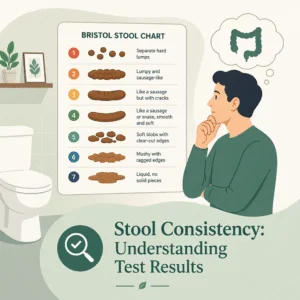
Bring context: recent travel, restaurant meals, new medications, and whether household members are ill too. If stool form has changed, our overview of stool consistency and what each type means helps you describe the pattern.
Latest scientific advances
Research over the last three years has focused less on the microscope and more on the markers and molecular tools that replaced it.
Calprotectin is very good at ruling inflammation out
A 2023 systematic review with meta-analysis in Alimentary Pharmacology and Therapeutics pooled seventeen studies and found that fecal calprotectin separates inflammatory bowel disease from irritable bowel syndrome well, and that a normal result in a low-risk population makes inflammatory bowel disease very unlikely. In those same low-risk groups, a raised result was far more often a false alarm than a true diagnosis. What this means for you: a normal calprotectin is strong reassurance, while a high one is a reason to look further, not a diagnosis.
Stool proteins can warn of a flare before symptoms return
A 2023 meta-analysis in the Journal of Clinical Medicine asked whether calprotectin can predict relapse in people with inflammatory bowel disease who are in remission (a symptom-free period). The pooled evidence supported it as an early warning signal, though thresholds vary between laboratories. What this means for you: a rising stool marker may prompt your team to act before you feel worse, but the cutoff should come from the lab running your sample.
Non-invasive markers are being tested against colonoscopy after surgery
A 2025 analysis in Clinical Gastroenterology and Hepatology compared stool markers and imaging with endoscopy for detecting Crohn disease that returns after bowel surgery. Calprotectin performed well enough to help decide who genuinely needs a scope, without replacing endoscopy. What this means for you: stool testing increasingly serves to triage, sparing some people a procedure.
Molecular panels are reshaping the workup of acute diarrhea
A 2025 review in Revista Espanola de Quimioterapia assessed rapid multiplex molecular syndromic panels (tests that look for the DNA or RNA of many gut pathogens in one run) in children with acute gastroenteritis. The authors concluded such panels shorten time to correct treatment and can reduce unnecessary hospital stays, if used thoughtfully rather than on every loose stool. What this means for you: a panel ordered instead of a smear reflects current practice.
Glossary of key terms
| Term | Definition |
|---|---|
| Fecal leukocytes | White blood cells found in a stool sample. Their presence suggests the intestinal lining is inflamed. |
| Neutrophil | The most common white blood cell and first responder to bacterial infection. It is the cell seen on a stool smear. |
| Mucosa | The soft inner lining of the intestine, which absorbs nutrients and blocks microbes. |
| Inflammatory diarrhea | Diarrhea caused by damage to the intestinal lining, often with fever, cramping, or blood. |
| Calprotectin | A neutrophil protein measured in stool to estimate how much gut inflammation is present. |
| Lactoferrin | Another neutrophil protein measured in stool as a marker of intestinal inflammation. |
| Multiplex PCR panel | One test that searches stool for the genetic material of many bacteria, viruses, and parasites at once. |
| Colitis | Inflammation of the colon from infection, autoimmune disease, poor blood supply, or radiation. |
| Stool culture | A test that grows bacteria from a stool sample so the responsible organism can be identified. |
FAQ
What does it mean when fecal leukocytes are positive?
A positive result means white blood cells were visible on the stained slide, indicating that the intestinal lining is inflamed. The usual explanations are invasive bacterial infections such as Shigella, Salmonella, or Campylobacter, antibiotic-associated Clostridioides difficile infection, and flares of inflammatory bowel disease. The smear never names the cause, so clinicians follow it with a stool culture, a toxin test, or a molecular panel. On its own it is a signal to look further, not a diagnosis.
Are white blood cells in stool always a sign of infection?
No. Infection is the most frequent explanation in sudden diarrhea, but the same finding appears in ulcerative colitis and Crohn disease, in colitis from reduced blood flow to the bowel, after pelvic radiation, and occasionally with certain medications. The cells only show that neutrophils crossed into the gut cavity. Interpretation needs the clinical picture: symptom duration, recent travel or antibiotic use, and whether blood or weight loss is present.
Can a fecal leukocytes test be negative even with a real infection?
Yes. White blood cells break down quickly once stool leaves the body, so a sample sitting for hours may look falsely clean. Shedding is also intermittent, and some pathogens release toxins without invading the lining, so no cells appear. A negative smear therefore does not rule out a bacterial cause when symptoms are severe or persistent. That fragility is a main reason laboratories moved to protein-based markers, which stay stable far longer.
How is the fecal leukocytes test different from fecal calprotectin?
Both reflect neutrophils in the gut but differ in method and precision. The smear is a visual impression reported as none, few, moderate, or many, and depends on who is at the microscope. Calprotectin is an immunoassay returning a number in micrograms per gram, reproducible between labs and stable during transport. That number can be tracked over time, which makes it far more useful for monitoring inflammatory bowel disease.
Do I need to prepare for a stool white blood cell test?
Very little preparation is needed: no fasting and no medication stop unless your clinician says otherwise. Collect a fresh sample in the container provided, avoid mixing in urine or toilet water, and return it promptly, since delays reduce accuracy. If part of the stool contains blood or mucus, include that portion, because immune cells concentrate there. Mention any recent antibiotics, barium, or antidiarrheal medication.
Should I ask for a fecal leukocytes test if I have chronic diarrhea?
For diarrhea lasting weeks rather than days, the smear is rarely the right first step. Quantitative stool markers, targeted infection testing, blood work, and often endoscopy give clearer answers. Describe the full pattern to your clinician: duration, stool appearance, night-time symptoms, weight change, and family history. They can then choose between calprotectin, lactoferrin, a pathogen panel, or a gastroenterology referral rather than relying on a slide.
Sources
- MedlinePlus — White Blood Cell (WBC) in Stool — National Library of Medicine, 2024 — medlineplus.gov
- Centers for Disease Control and Prevention — About Shigella Infection — CDC, 2024 — cdc.gov
- Centers for Disease Control and Prevention — About C. diff — CDC, 2024 — cdc.gov
- National Institute of Diabetes and Digestive and Kidney Diseases — Diagnosis of Diarrhea — NIDDK, 2023 — niddk.nih.gov
- Dajti E, Frazzoni L, Iascone V, et al. — Systematic review with meta-analysis: Diagnostic performance of faecal calprotectin in distinguishing inflammatory bowel disease from irritable bowel syndrome in adults — Alimentary Pharmacology and Therapeutics, 2023 — doi.org/10.1111/apt.17754
- Shi JT, Chen N, Xu J, et al. — Diagnostic Accuracy of Fecal Calprotectin for Predicting Relapse in Inflammatory Bowel Disease: A Meta-Analysis — Journal of Clinical Medicine, 2023 — doi.org/10.3390/jcm12031206
- Samnani S, Ray CM, Gill P, et al. — Diagnostic Accuracy of Noninvasive Biomarkers and Imaging for Evaluating Postoperative Recurrence in Crohn’s Disease — Clinical Gastroenterology and Hepatology, 2025 — doi.org/10.1016/j.cgh.2025.03.030
- Jimenez-Jimenez AB, Galan-Sanchez F, Garcia-Lopez Hortelano M, et al. — Acute infectious gastroenteritis in childhood: the role of rapid multiplex molecular syndromic panels in diagnosis and clinical management — Revista Espanola de Quimioterapia, 2025 — doi.org/10.37201/req/026.2025
Further reading
- Screen for hidden bleeding in the bowel by reading our fecal occult blood test results guide.
- Track systemic inflammation over time with our erythrocyte sedimentation rate explainer.
- Understand chronic small-bowel inflammation through our Crohn disease symptoms and treatment guide.
- Compare persistent colon inflammation with our ulcerative colitis overview for patients.
- Rule out parasites behind long-lasting diarrhea using our ova and parasites stool exam guide.
Understand your lab results with BloodSense
A stool report full of terms like leukocytes, calprotectin, and culture can feel impenetrable even when the findings are ordinary. BloodSense turns those lines into plain language, showing how a stool smear, a calprotectin level, a stool culture, and a C-reactive protein result fit together. It helps you understand what was measured and what to ask your doctor. It does not diagnose and does not replace medical care.