






Seeing visible blood in stool is unsettling, and it is one of the few findings that sends people to a search engine before they call anyone. Most episodes come from small, treatable problems near the exit of the digestive tract. But the appearance of the blood carries real information: bright red streaks and black, tar-like stools point to different places in the gut and call for different follow-up. This guide explains what a laboratory records, which foods and medicines create false alarms, which tests come next, and which warning signs mean you should be seen the same day.
What visible blood in stool actually means
Blood becomes visible when bleeding is brisk enough, or close enough to the anus, that it is not fully digested on the way out. The further upstream it starts, the more acid and enzymes break it down, and the darker it becomes. That single principle explains most of what you see in the bowl, and it is why clinicians ask so carefully about color and whether the blood is mixed in or sitting on the surface.
Bright red blood (hematochezia)
Bright red blood usually means the source is low in the digestive tract: the rectum, the anal canal, or the left colon. Doctors call this hematochezia, from the Greek for blood and stool. It often appears as streaks on a formed stool, drops in the bowl, or stains on toilet paper. Common sources include hemorrhoids and their typical symptoms, anal fissures, diverticular bleeding, inflammation of the colon lining, polyps, and, less often, colorectal cancer.
Black, tarry stools (melena)
Stool that is black, sticky, and unusually foul-smelling suggests bleeding higher up: the esophagus, the stomach, or the first part of the small intestine. This is called melena, and the color comes from hemoglobin chemically altered by stomach acid and gut bacteria on the long trip downstream. Classic causes include peptic ulcer disease and its warning signs, inflammation of the stomach lining, and esophageal varices, which are swollen veins in the food pipe associated with advanced liver disease.
Maroon blood and blood mixed through the stool
Dark red or maroon stool sits in the middle. It can come from the right colon or the small intestine, or from an upper source bleeding fast enough to move through before it darkens. Blood mixed evenly through the stool, rather than coating it, also shifts attention upstream. These patterns help a clinician decide how quickly to investigate.
False alarms: when it is not blood at all
Plenty of red and black stools have nothing to do with bleeding. Food pigments, iron supplements, and some over-the-counter medicines mimic the real thing convincingly. A useful clue is timing: a dietary color change appears within a day or two of the meal and fades just as fast. Still, do not diagnose yourself with beets. If the color persists, a simple stool test settles the question.
| What you see | Possible harmless explanation | How to tell it apart |
|---|---|---|
| Reddish or pink stool | Beets, tomato skins, red gelatin, red food coloring, some fruit drinks | Color is uniform rather than streaked, and clears about two days after stopping the food |
| Black stool | Iron tablets, bismuth stomach remedies, activated charcoal, black licorice, blueberries, blood sausage | Usually firm and odorless rather than sticky and strongly foul-smelling |
| Dark green stool mistaken for black | Leafy greens, green dyes, rapid transit through the gut | Looks green under good lighting or on white toilet paper |
| Red on the paper only | Skin irritation, a small anal tear, vigorous wiping | Small volume, often with stinging after a bowel movement |
Bright red versus black: a side-by-side comparison
Neither column below is a diagnosis, and both deserve a conversation with a clinician, but the urgency and first investigation differ.
| Feature | Bright red blood (hematochezia) | Black tarry stool (melena) |
|---|---|---|
| Likely origin | Anus, rectum, colon | Esophagus, stomach, first part of small intestine |
| Texture and smell | Normal stool with red streaks, drops, or clots | Sticky, tar-like, distinctly foul-smelling |
| Frequent causes | Hemorrhoids, anal fissure, diverticular bleeding, colitis, polyps, colorectal cancer | Peptic ulcer, gastritis, esophageal varices, upper tract tumors |
| Typical accompanying clues | Anal pain, itching, urgency, diarrhea, mucus | Upper abdominal pain, heartburn, nausea, coffee-ground vomiting |
| Usual first investigation | Anal examination and colonoscopy | Upper endoscopy |
What the laboratory records and what it cannot see
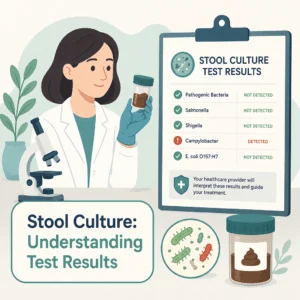
When a stool sample reaches the laboratory, visible blood is documented as a macroscopic observation, meaning it is described by eye before any chemistry happens. The report may note the color, whether blood is mixed in or on the surface, and whether clots or mucus accompany it.
Microscopy adds a layer. A technician can look for intact red blood cells in a stool sample, which survive when bleeding starts close to the anus and are destroyed when it starts higher up. What the laboratory cannot do is locate the bleeding site or name a cause: only imaging or endoscopy points to a specific lesion.
Follow-up tests your clinician may order
Visible blood is a starting point, not an endpoint. The tests that follow answer three questions: is bleeding still happening, is there inflammation, and is there a structural problem such as a polyp or an ulcer?
- Stool blood testing. A clinician may order a fecal occult blood test and how to read it to confirm the color really is blood and to monitor ongoing loss.
- Inflammation markers. A fecal calprotectin measurement of gut inflammation helps separate inflammatory bowel disease from irritable bowel patterns.
- Blood counts. Measuring hemoglobin in a routine blood test shows whether bleeding has been heavy or long enough to drain your red cell reserves.
- Colonoscopy. A camera examination of the colon remains the definitive way to find and often treat a lower-tract bleeding source, with polyps removed in the same appointment.
- Upper endoscopy. When melena or vomited blood suggests an upstream source, a camera passed through the mouth examines the esophagus and stomach.
- Imaging. In brisk bleeding, computed tomography angiography can localize the source when endoscopy is not yet possible.
A full stool workup often examines infection and inflammation together, because conditions that irritate the colon lining, including ulcerative colitis and its typical course and diverticulitis and its complications, produce blood alongside other findings.
When to see a doctor
Every episode of visible blood deserves medical attention at some point. The question is how fast, so the list below sorts situations by urgency.
- Call emergency services if you pass large amounts of blood or clots, vomit blood or material resembling coffee grounds, or feel faint, dizzy, cold, clammy, or short of breath.
- Seek same-day care for black tarry stools, bleeding with severe abdominal pain or fever, or bleeding while taking an anticoagulant or antiplatelet medicine.
- Book an appointment within days for repeated bright red bleeding, bleeding that does not settle after a week, or a change in bowel habit lasting more than three weeks.
- Raise it at your next visit for a single small streak clearly linked to a hard stool, provided you feel otherwise well.
Two points matter at any age. Unintended weight loss, persistent fatigue, or a new narrow-caliber stool alongside bleeding should always prompt evaluation. And bleeding in a younger adult should never be dismissed as hemorrhoids without an examination, because the incidence of colorectal cancer symptoms and risk factors under age fifty has been rising. Most national programs now advise starting routine screening at age forty-five, as summarized by the Centers for Disease Control and Prevention.
Latest scientific advances
Recent research has focused less on new gadgets than on making existing pathways smarter: testing stool more than once, closing awareness gaps in younger adults, and standardizing how hospitals triage bleeding.
Testing stool twice catches more cancers than testing once
A 2024 systematic review and meta-analysis pooled sixty-eight studies of the faecal immunochemical test, a stool test that detects human hemoglobin. Asking people for a second sample rather than one clearly reduced the number of colorectal cancers missed, both in screening programs and in people who already had symptoms. What this means for you: if your clinician requests a repeat stool sample, that is a deliberate accuracy strategy, not an administrative error. The nuance is that a second test also yields more positive results overall, sending more people on to colonoscopy.
Younger adults often do not recognize blood in stool as a warning sign
A 2025 nationwide United States survey of nearly 750 people aged twenty to forty-nine found wide gaps in awareness: only a minority knew screening is now recommended from age forty-five, and roughly half said they would raise rectal bleeding with a clinician. What this means for you: treating blood in stool as a symptom to report, rather than something to observe quietly, is the single most useful habit here. The study measured knowledge and intentions rather than outcomes, so it describes a communication gap rather than proving awareness alone changes survival.
Hospitals increasingly use scoring systems to decide who needs admission
A 2025 clinical review of lower gastrointestinal bleeding describes how structured scoring systems now separate patients who can be safely investigated as outpatients from those needing inpatient care. What this means for you: if you arrive at hospital with rectal bleeding and are sent home with a scheduled colonoscopy, that usually reflects a validated assessment, not a lack of concern. A 2024 emergency medicine review of upper gastrointestinal bleeding makes a similar point about early risk assessment and prompt endoscopy.
Glossary of key terms
| Term | Definition |
|---|---|
| Hematochezia | The passage of bright red or maroon blood with a bowel movement, usually signalling bleeding from the colon, rectum, or anus. |
| Melena | Black, sticky, strongly foul-smelling stool caused by blood chemically altered on its way through the gut. It points upstream, toward the stomach or esophagus. |
| Occult blood | Blood present in stool in amounts too small to see. It is detected only by a laboratory test. |
| Hemorrhoids | Swollen veins in the anus or lower rectum, the most common reason for bright red bleeding on toilet paper. |
| Anal fissure | A small tear in the anal canal lining, usually caused by a hard stool. It typically causes sharp pain plus a few drops of bright blood. |
| Esophageal varices | Enlarged veins in the food pipe that develop when blood flow through the liver is obstructed. They can bleed heavily. |
| Calprotectin | A protein released by white blood cells into the gut. Higher stool levels suggest active intestinal inflammation. |
FAQ
What does blood in stool look like?
It depends on where the bleeding starts. Blood from the anus or rectum usually appears as bright red streaks on the stool, drops in the toilet water, or smears on the paper. Blood from the colon may be darker red or maroon and mixed evenly through. Blood from the stomach or esophagus is rarely recognizable as blood at all: by the time it emerges it has turned the stool black, sticky, and tar-like. Clots or blood mixed with mucus are worth describing to your clinician.
When should I worry about blood in stool?
Worry proportionately rather than immediately. Seek emergency care for heavy bleeding, clots, black tarry stools, vomited blood, or any dizziness, fainting, or breathlessness. Seek same-day care for bleeding with severe pain or fever, or while taking blood-thinning medication. Arrange an appointment within days for bleeding that keeps returning or comes with a lasting change in bowel habit or unexplained weight loss. A single small streak after a hard stool, in someone who feels well, can wait for a routine visit.
What causes blood in stool most often?
In everyday practice the commonest causes are benign and mechanical: hemorrhoids and anal fissures account for a large share of bright red bleeding, especially when straining is part of the picture. Next come colitis, diverticular bleeding, and polyps. Gut infections can also produce bloody diarrhea, usually with cramps and fever. Colorectal cancer is less frequent overall, but it is the reason evaluation is worthwhile, because it is far more treatable when found early.
Why is there blood in my stool if I feel completely fine?
Painless bleeding is common and does not mean the cause is trivial. Internal hemorrhoids sit above the pain-sensitive zone of the anal canal and often bleed without discomfort. Diverticular pouches can bleed abruptly and painlessly. Polyps and early tumors are frequently silent too, which is exactly why screening programs target them rather than waiting for symptoms. Feeling well is reassuring about how much blood you have lost, but not about the cause.
Does visible blood in stool always mean I need a colonoscopy?
Not always, but often. A clinician weighs your age, the appearance of the blood, how long it has lasted, your family history, and what an anal examination shows. A young person with a painful fissure and bleeding that stops may reasonably be treated and observed first. Recurrent bleeding, bleeding without a visible anal cause, bleeding at or above screening age, or bleeding with anemia usually leads to a colonoscopy. When the stool is black instead of red, an upper endoscopy is the more informative first look.
Sources
- National Institute of Diabetes and Digestive and Kidney Diseases — Gastrointestinal Bleeding — NIDDK, 2024 — niddk.nih.gov
- MedlinePlus Medical Encyclopedia — Black or Tarry Stools — MedlinePlus, 2024 — medlineplus.gov
- Centers for Disease Control and Prevention — Screening for Colorectal Cancer — CDC, 2026 — cdc.gov
- Cleveland Clinic — Blood in Stool (Rectal Bleeding) — Cleveland Clinic, 2024 — my.clevelandclinic.org
- Gerrard AD, Garau R, Xu W, Maeda Y, Dunlop MG, Theodoratou E, Din FVN — Repeat Faecal Immunochemical Testing for Colorectal Cancer Detection: A Systematic Review and Meta-Analysis — Cancers, 2024 — doi.org/10.3390/cancers16183199
- Yen T, Schroy PC, Hampel H, Aubertine M, Sylvester K, Jones W, Patel SG — Knowledge and Perceptions Around Colorectal Cancer Screening Among 20-49 Year Olds — Digestive Diseases and Sciences, 2025 — doi.org/10.1007/s10620-025-09285-4
- Balvardi S, Galante D — Lower Gastrointestinal Bleeding — Surgical Clinics of North America, 2025 — doi.org/10.1016/j.suc.2025.08.010
- Long B, Gottlieb M — Emergency Medicine Updates: Upper Gastrointestinal Bleeding — American Journal of Emergency Medicine, 2024 — doi.org/10.1016/j.ajem.2024.04.052
Further reading
- Decode the other shades your stool can take by reading our complete stool colour interpretation guide.
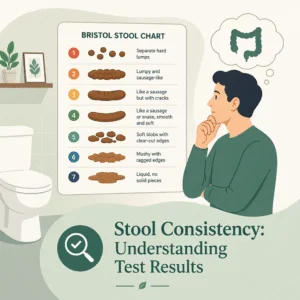
- Understand how shape and firmness are graded in a lab report with our stool consistency results explainer.
- Learn why slippery strands accompany bleeding by consulting our guide to mucus in stool.
- Check whether repeated blood loss drained your iron reserves with our ferritin blood level explainer.
- Recognize the fatigue that follows chronic bleeding by reading our anemia symptoms and causes guide.
Understand your lab results with BloodSense
Blood in the stool rarely travels alone on a report. It usually sits beside a stool blood test, a calprotectin value, a hemoglobin level, and iron studies, and the meaning emerges from how those numbers move together. BloodSense reads your results in plain language and explains what each one contributes. It is a tool for understanding, not a diagnosis, and it does not replace the clinician who examines you.