



Kawasaki Disease: Symptoms, Blood Test Results and Treatment
The essentials
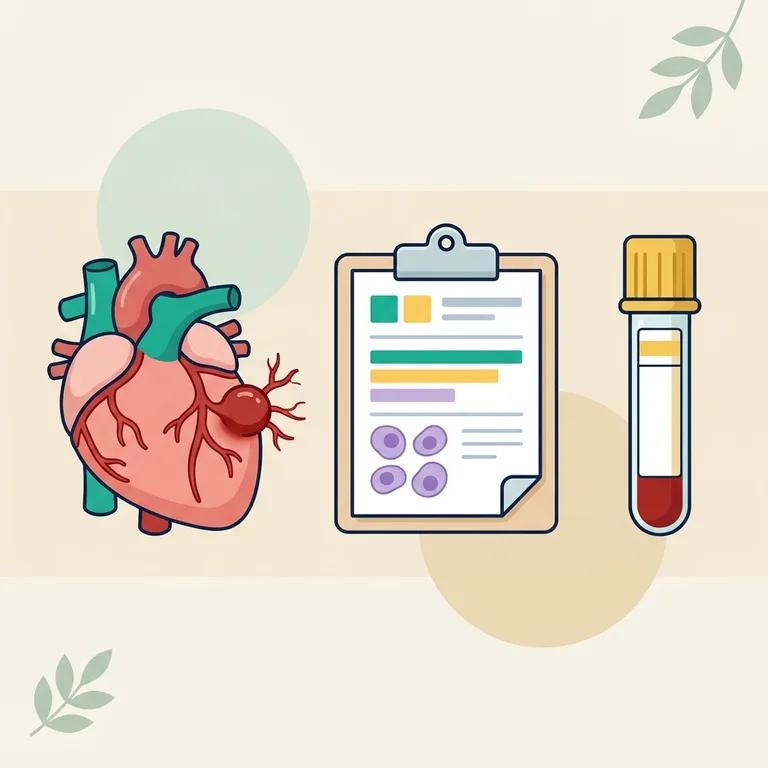
Kawasaki disease inflames the blood vessels of young children, mostly under 5. The key sign is a fever lasting 5 days or more, with red eyes, red lips, a rash or swollen hands. No single blood test confirms it, but a typical pattern (high CRP and sed rate, low albumin, high platelets after day 7) supports it. Treatment within 10 days protects the heart.
What is Kawasaki disease, at a glance?
Kawasaki disease is an acute vasculitis: the walls of small and medium-sized blood vessels become inflamed, especially the coronary arteries that feed the heart[3][9]. It is the leading cause of acquired heart disease in children in developed countries[2].
| Topic | Key facts |
|---|---|
| Other names | Kawasaki syndrome, mucocutaneous lymph node syndrome[9] |
| How common | More than 4,200 children diagnosed each year in the United States[8]; 359 per 100,000 under-5s in Japan in 2018[5] |
| Usual age | 80% to 90% of cases between 6 months and 5 years[8]; boys about 1.5 times more often than girls[3] |
| Key tests | Clinical signs, CRP, sed rate, blood count, albumin, ALT, urinalysis, heart ultrasound[3] |
| Main risk | Coronary artery aneurysms in about 25% of untreated children, around 5% with prompt treatment[2][3] |
What are the symptoms of Kawasaki disease?
The illness starts with a fever above 38.5 °C (101.3 °F) that lasts at least 5 days and, untreated, often 7 to 12 days[9]. Classic Kawasaki disease means fever plus at least 4 of these 5 signs[1][3]:
- Common Red eyes on both sides, without pus or discharge.
- Common Mouth changes: red, dry, cracked lips, a "strawberry tongue" and a red throat.
- Common A rash on the trunk and limbs, often stronger in the diaper area[8].
- Common Red, swollen hands and feet, then peeling of the fingertips and toes 2 to 3 weeks after the fever started[8].
- Possible One swollen gland in the neck, at least 1.5 cm across, usually not very painful[3].
Marked irritability, vomiting, diarrhea or joint pain are frequent[9]. Signs may not appear together, and young infants may show only a few[8]: this incomplete form concerned 1 child in 5 in Japan's national survey[5].
When to see a doctor
- Emergency: call 911 if a child with fever is very drowsy or hard to wake, struggles to breathe, or looks pale or mottled with cold hands and feet: possible signs of shock[3].
- Within 24 to 48 hours if a fever has lasted 4 to 5 days with red eyes, red lips, a rash or swollen hands or feet; a baby under 6 months with an unexplained fever lasting 7 days needs to be checked too[3][8].
- At your next appointment if the follow-up heart scans, due 2 weeks and 6 to 8 weeks after the fever began, are not booked[8].
What causes Kawasaki disease, and who gets it?
The cause is unknown; the leading idea is an abnormal immune reaction to a trigger such as a virus in a genetically predisposed child[3]. Up to 40% of children with the disease also carry a respiratory virus, so a positive virus test does not rule it out[3].
- Age: 2 years on average[9]; older children and adults are rarely affected[10].
- Background: more frequent with Japanese, Korean or other Asian and Pacific Island ancestry, but seen in every group[8][10].
- Family: it may run in families, but it does not spread from child to child[10].
How is Kawasaki disease diagnosed, and what do the blood tests show?
No test proves Kawasaki disease on its own: the diagnosis rests on the clinical signs[9]. Blood and urine tests measure inflammation, help exclude look-alikes such as scarlet fever or measles, and support the diagnosis when the signs are incomplete[3]. Here is a fictitious report for a 3-year-old on day 8 of fever.
| Test | Result | Reference range | Flag |
|---|---|---|---|
| C-reactive protein (CRP) | 8.4 mg/dL | Less than 1.0 mg/dL | H |
| Sedimentation rate (ESR) | 62 mm/h | 0-10 mm/h | H |
| White blood cells (WBC) | 17.8 x10³/µL | 5.0-14.5 x10³/µL | H |
| Hemoglobin | 10.1 g/dL | 11.5-13.5 g/dL | L |
| Platelets | 512 x10³/µL | 150-450 x10³/µL | H |
| Albumin | 2.8 g/dL | 3.5-5.0 g/dL | L |
| ALT | 68 U/L | 5-30 U/L | H |
| Urinalysis, white blood cells | 15 /HPF, culture negative | 0-5 /HPF | H |
- CRP and ESR: for incomplete Kawasaki disease, the AHA algorithm requires a CRP of 3 mg/dL (30 mg/L) or more and/or an ESR of 40 mm/h or more[1][3].
- Supporting results: it then counts anemia for age, platelets of 450,000/µL or more after day 7, albumin of 3 g/dL or less, a raised ALT, white cells of 15,000/µL or more, and 10 or more white cells per field in sterile urine; three or more support the diagnosis[3].
- Timing: platelets rise in the second week, so a normal count on day 4 rules nothing out[3].
A hospital report full of H and L flags? BloodSense explains each line of your child's results in plain words, so you can follow what the team is watching.
Explain my child's lab reportOur guides explain each marker: CRP blood test, sed rate (ESR), platelet count, albumin, ALT and white cells in urine (pyuria). The echocardiogram is the key exam: it measures the coronary arteries against body size (z score), promptly, without delaying treatment[3].
Kawasaki disease or MIS-C?
Since 2020, doctors also consider MIS-C (multisystem inflammatory syndrome in children), which follows a SARS-CoV-2 infection by a few weeks[4]. It affects older children (median 7 to 9 years), causes belly symptoms in about 80% and shock more often[3]. Blood tests usually differ:
| Marker | Kawasaki disease | MIS-C | Source |
|---|---|---|---|
| Lymphocytes | 2,800/µL | 800/µL (low) | AFP 2021[3] |
| Platelets | 365,000/µL, rising after day 7 | 151,000/µL (often low) | AFP 2021[3] |
| CRP | 6.7 mg/dL | 22 mg/dL | AFP 2021[3] |
| Albumin | 3.8 g/dL | 2.4 g/dL | AFP 2021[3] |
| NT-proBNP | 41 pg/mL | 788 pg/mL | AFP 2021[3] |
| Troponin | 10 ng/L | 45 ng/L | AFP 2021[3] |
These are typical values, not cut-offs. MIS-C needs only 24 hours of fever, plus evidence of recent SARS-CoV-2 infection, found in 94% to 99% of cases[3].
Which tests are used to follow Kawasaki disease?
- In hospital: fever and CRP show the response to treatment; 10% to 20% of children do not respond to the first infusion[1] (19.7% in Japan[5]).
- Echocardiogram: at diagnosis, then at 2 weeks and again at 6 to 8 weeks after the fever started; aneurysms usually form after the first weeks[8].
- Higher-risk children: a dilated coronary artery at diagnosis, age under 6 months and no response to the first treatment predict aneurysms in Japanese and US cohorts[7]; these children get closer imaging.
- Later years: children without aneurysms have an excellent outlook; cholesterol is checked every 5 years[8] (see our lipid panel guide). Children with moderate or large aneurysms need lifelong cardiology follow-up[9].
How is Kawasaki disease treated?
Treatment takes place in hospital[9]; started within 10 days of illness, it clearly lowers the risk of aneurysms[8].
- Intravenous immunoglobulin (IVIG): donor antibodies given as one infusion over 8 to 12 hours, then at least 24 hours of observation[8].
- Aspirin: used under medical supervision, then at low dose for 6 to 8 weeks against clots[8]. Never give it to a child without a prescription: it is linked to Reye's syndrome[10].
- Corticosteroids: added for higher-risk children, such as babies under 6 months or severe inflammation[10]; a second IVIG dose or infliximab may follow if fever persists[8]. In a Japanese trial of severe cases, adding prednisolone cut coronary abnormalities from 23% to 3%[6]. The 2024 AHA update adds North American high-risk criteria[2].
Can Kawasaki disease be prevented, and how do children recover?
There is no known prevention[9]. Most children treated early recover fully, though energy can take 1 to 2 months to return[9].
- Give low-dose aspirin exactly as prescribed[8], and ask the doctor what to do if your child catches flu or chickenpox meanwhile.
- Postpone live vaccines (MMR, chickenpox) at least 11 months after IVIG, which can make them less effective[8].
- Keep the inactivated flu shot from 6 months of age[8].
- Call the doctor if fever or other signs return[8].
Questions to ask your doctor
- Is it classic or incomplete, and which results support it?
- What did the first echocardiogram show, including the coronary z scores?
- Does my child have a risk factor that calls for extra treatment?
- When are the next echocardiograms, and how long does the aspirin continue?
Frequently asked questions
Is Kawasaki disease contagious?
No. It does not spread among family members or between children in child care[8][10].
Can adults get Kawasaki disease?
Yes, but it is rare: the vast majority of cases occur before age 5[8][10]. The same signs and tests are used at any age.
Can a normal blood test rule out Kawasaki disease?
Not early on: platelets often rise only after day 7. If the fever goes on, the tests and examination may be repeated[3][8].
Related articles
- Scarlet feverA childhood fever with rash, treated with antibiotics.
- CRP blood testThe main inflammation marker.
- Platelet countWhy platelets rise in the second week.
- Complete blood countWhite cells, hemoglobin, platelets.
- DiseasesAll our disease guides.
References
- McCrindle BW, Rowley AH, Newburger JW, et al. Diagnosis, Treatment, and Long-Term Management of Kawasaki Disease: A Scientific Statement for Health Professionals From the American Heart Association. Circulation. 2017;135(17):e927-e999. doi:10.1161/CIR.0000000000000484 (accessed November 17, 2026)
- Jone PN, Tremoulet A, Choueiter N, et al. Update on Diagnosis and Management of Kawasaki Disease: A Scientific Statement From the American Heart Association. Circulation. 2024;150(23):e481-e500. doi:10.1161/CIR.0000000000001295 (accessed November 17, 2026)
- Darby JB, Jackson JM. Kawasaki Disease and Multisystem Inflammatory Syndrome in Children: An Overview and Comparison. Am Fam Physician. 2021;104(3):244-252. aafp.org (accessed November 17, 2026)
- Henderson LA, Canna SW, Friedman KG, et al. American College of Rheumatology Clinical Guidance for Multisystem Inflammatory Syndrome in Children Associated With SARS-CoV-2 and Hyperinflammation in Pediatric COVID-19: Version 3. Arthritis Rheumatol. 2022;74(4):e1-e20. doi:10.1002/art.42062 (accessed November 17, 2026)
- Ae R, Makino N, Kosami K, et al. Epidemiology, Treatments, and Cardiac Complications in Patients with Kawasaki Disease: The Nationwide Survey in Japan, 2017-2018. J Pediatr. 2020;225:23-29.e2. doi:10.1016/j.jpeds.2020.05.034 (accessed November 17, 2026)
- Kobayashi T, Saji T, Otani T, et al. Efficacy of immunoglobulin plus prednisolone for prevention of coronary artery abnormalities in severe Kawasaki disease (RAISE study): a randomised, open-label, blinded-endpoints trial. Lancet. 2012;379(9826):1613-1620. doi:10.1016/S0140-6736(11)61930-2 (accessed November 17, 2026)
- Yamazaki S, Miyata K, Sun X, et al. Risk Factors for Coronary Artery Aneurysms in Children With Kawasaki Disease. J Am Heart Assoc. 2026;15(18):e050238. doi:10.1161/JAHA.126.050238 (accessed November 17, 2026)
- American Academy of Pediatrics. Kawasaki Disease. HealthyChildren.org. Updated 2020. healthychildren.org (accessed November 17, 2026)
- American Heart Association. Kawasaki Disease. Reviewed September 3, 2025. heart.org (accessed November 17, 2026)
- NHS. Kawasaki disease. Reviewed February 19, 2026. nhs.uk (accessed November 17, 2026)
General information only: it does not replace the advice of the doctor who examines your child and knows the full results.