Chikungunya: Symptoms, Blood Tests and Lasting Joint Pain
The essentials
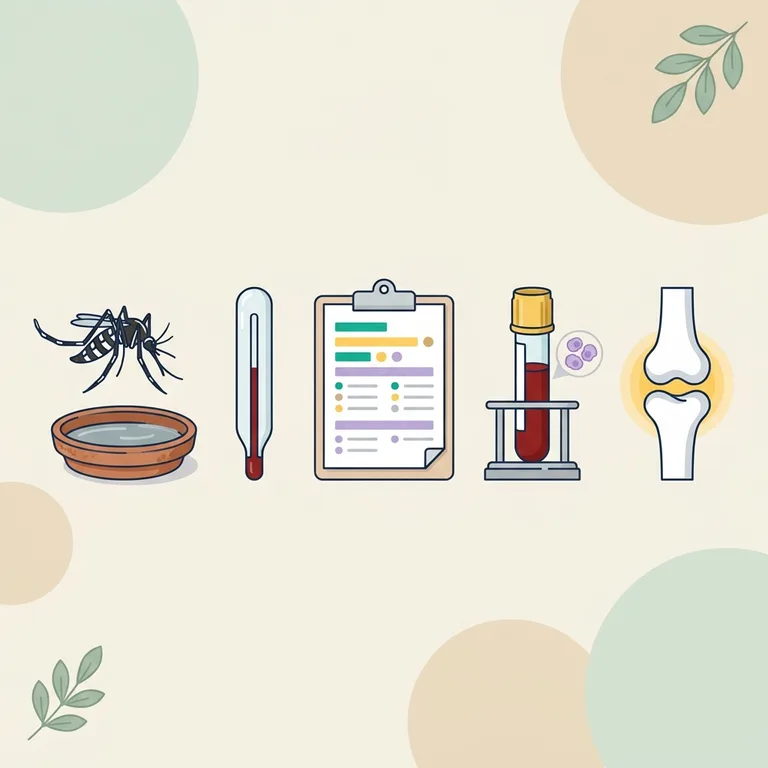
Chikungunya is a virus spread by the same daytime-biting mosquitoes that carry dengue and Zika. It causes a sudden high fever and severe joint pain that can last for months. A blood test confirms it: viral RNA in the first week, antibodies after that. Until dengue is ruled out, take acetaminophen, not aspirin or ibuprofen.
What is chikungunya, at a glance?
- Cause: the chikungunya virus (CHIKV), passed to people by Aedes aegypti and Aedes albopictus mosquitoes, which also carry dengue and Zika and bite mainly during the day[1].
- Where: the virus has been found in more than 110 countries in Asia, Africa, Europe and the Americas[1].
- In the United States: 687 travel-related cases in 2025 and 2 cases caught locally, in Florida and New York[6].
- Key tests: chikungunya RNA by RT-PCR during the first 8 days, IgM antibodies from the end of the first week, and a complete blood count that often shows low lymphocytes[2][3].
What are the symptoms of chikungunya?
Symptoms usually start 4 to 8 days after the bite, sometimes as early as 2 days or as late as 12 days[1]. Most infected people do get sick[2].
- Common A sudden fever, often above 102°F (39°C), with pain in many joints, usually on both sides of the body: hands, wrists, ankles and feet. The pain can be disabling[2].
- Common Swollen joints, muscle pain, headache, tiredness and a red, blotchy rash[1].
- Possible Red eyes (conjunctivitis), nausea or vomiting[2].
- Rare Inflammation of the eye, heart or liver, and Guillain-Barré syndrome, a nerve disorder that causes weakness[2].
How long does it last? The fever and acute symptoms usually settle within 7 to 10 days[2]. Joint pain is different. In a review of 34 studies and 6,532 patients, 43% had not fully recovered 3 months after the illness, and 21% still had symptoms after a year[9]. French guidelines call the first 3 weeks the acute phase, weeks 3 to 12 the post-acute phase and anything beyond 3 months the chronic phase[10].
When should I see a doctor for chikungunya?
When to see a doctor
- Emergency: call 911 for a newborn with fever when the mother was ill around delivery, for confusion, severe weakness, chest pain or trouble breathing, or for bleeding gums, vomiting blood, black stools or severe belly pain: these signs point to severe dengue, which can look the same at first[2][8].
- Within 24 to 48 hours for fever with joint pain within 2 weeks of a stay in an outbreak area, especially if you are over 65, pregnant near term, or live with diabetes, high blood pressure or heart disease[2].
- At your next appointment if joint pain or swelling lasts beyond 3 weeks, or comes back in flares[4][10].
How do you get chikungunya, and who is at risk?
A mosquito picks up the virus from an infected person during their first week of illness, then passes it on with its next bites[5]. The virus does not spread from person to person through coughing, sneezing or touching[5].
- Common Travel: a stay in an area with an outbreak, in the tropics. Almost all US cases are in returning travelers[6].
- Possible Local spread: in places where Aedes mosquitoes live, a sick traveler can start a local chain of cases. Climate change and travel keep widening the mosquitoes' range[11].
- Rare Mother to baby: rare during most of pregnancy, but when the mother has the virus in her blood around delivery, up to half of babies are infected, often with severe disease[5][8]. Blood transfusion is a probable route[5].
Severe disease and death are rare, mostly in newborns infected around birth, adults over 65 and people with diabetes, high blood pressure or heart disease[1][2].
Which blood tests diagnose chikungunya, and how do I read them?
The right test depends on the day of illness. During the first 8 days, RT-PCR can often find the virus's genetic material (RNA) in serum[3]. IgM antibodies, the body's first antibodies against a new infection, usually appear toward the end of the first week[3]. Because the symptoms overlap, your clinician will also look for dengue, which must be ruled out[4]. Here is a fictitious report from day 3 of fever.
| Test | Result | Reference range | Flag |
|---|---|---|---|
| Chikungunya virus RNA, RT-PCR (serum) | Detected | Not detected | A |
| Chikungunya virus IgM antibody | Negative | Negative | |
| Dengue virus NS1 antigen | Negative | Negative | |
| Lymphocytes, absolute | 0.6 x10³/µL | 1.0-4.8 x10³/µL | L |
| Platelets | 132 x103/µL | 150-400 x103/µL | L |
| ALT | 68 U/L | 7-56 U/L | H |
- RNA detected, flagged A: the virus is in your blood: the infection is confirmed[3].
- IgM negative: normal this early: antibodies are not made yet. When early tests are negative, a second sample weeks later settles it[3]. Read more on IgM antibodies.
- Dengue NS1 negative: reassuring, but your clinician decides when dengue is ruled out; until then, care follows dengue precautions[4].
- Lymphocytes, flagged L: low lymphocytes are typical of chikungunya. Dengue more often lowers neutrophils and platelets markedly[2].
- Platelets L and ALT H: slightly low platelets and high liver enzymes are possible but not specific[2]. Ranges shown are examples; your laboratory's range applies.
Low lymphocytes and a positive virus test on the same report? BloodSense reads every line of your complete report, shows which results go together and helps you prepare your questions for your doctor.
Get my full report explainedAfter the first week, the antibody test takes over. A positive IgM points to a recent infection, but false positives happen, so laboratories may confirm it with a neutralizing antibody test[3]. A raised creatinine is also possible[2].
How is chikungunya followed over time?
- First week: rest, drink enough and follow dengue precautions until dengue has been ruled out[4].
- Weeks 3 to 12: joint pain that persists is reviewed at a visit; your doctor checks for swelling and adjusts pain relief[10].
- Beyond 3 months: if joints stay swollen and stiff, your doctor may order inflammation markers such as CRP, and tests such as rheumatoid factor and anti-CCP, to look for chronic inflammatory arthritis, then refer you to a rheumatologist[10].
How is chikungunya treated?
No doses are given here: your medical team decides.
- No antiviral: no medicine kills the virus. Care means rest, fluids and relief of fever and pain[1][4].
- Acetaminophen first: until dengue is ruled out, use acetaminophen (paracetamol). Aspirin and other anti-inflammatory drugs such as ibuprofen can increase bleeding in dengue[1][4].
- Lasting joint pain: anti-inflammatory drugs, short courses of corticosteroids (sometimes as creams or gels) and physical therapy can help[4]. Chronic inflammatory arthritis is treated by a rheumatologist, sometimes with methotrexate, as for rheumatoid arthritis[10].
How can chikungunya be prevented, and how do you live with it?
- Use a repellent containing DEET, IR3535 or icaridin, wear long sleeves, and use screens; empty and clean water containers every week[1].
- If you are sick, avoid mosquito bites during the first week so you do not start local spread[1][4].
- Vaccine: in the United States, Vimkunya, a single-dose vaccine approved in February 2025 for people aged 12 and over, is recommended for travelers to an outbreak area and considered for stays of 6 months or more in a risk area[7][8]. In its main trial, 97.8% of vaccinated people made protective-level antibodies by day 22[12]. The FDA suspended the license of the other vaccine, Ixchiq, in August 2025 after serious side effects[8].
- For stiff joints after the fever, ask about physical therapy: it can lessen lasting symptoms[4].
Questions to ask your doctor
- Given the day my fever started, which test is right for me now?
- Has dengue been ruled out, and which pain medicine can I take?
- Do my blood count and liver tests need to be repeated?
- Should I see a rheumatologist if my joints stay swollen?
- Should I get the vaccine before my next trip?
Frequently asked questions
Is chikungunya the same as dengue?
No. Same mosquitoes, same fever, but chikungunya causes more joint pain and low lymphocytes, while dengue more often causes bleeding and low platelets. Read our dengue fever guide for its warning signs[2].
Can I breastfeed if I have chikungunya?
Yes. The virus has not been found in breast milk, and CDC advises continuing to breastfeed, as the benefits likely outweigh the risk[5].
Can chikungunya cause permanent joint damage?
Most people recover fully, but about 1 in 5 still has symptoms a year later[9]. A small group develops chronic inflammatory arthritis that needs specialist care[10].
Related articles
- Dengue feverThe look-alike to rule out first
- Zika virusThe third virus carried by the same mosquitoes
- Low lymphocytesThe blood count change typical of chikungunya
- Rheumatoid arthritisWhat chronic chikungunya arthritis can resemble
- MalariaAnother cause of fever after travel
- Disease guidesAll our disease guides
- World Health Organization. Chikungunya. Fact sheet, April 14, 2025. who.int (accessed November 17, 2026)
- Centers for Disease Control and Prevention. Clinical signs and symptoms of chikungunya. Reviewed October 21, 2026. cdc.gov (accessed November 17, 2026)
- Centers for Disease Control and Prevention. Clinical testing and diagnosis for chikungunya virus disease. Reviewed October 21, 2026. cdc.gov (accessed November 17, 2026)
- Centers for Disease Control and Prevention. Treatment and prevention of chikungunya virus disease. February 19, 2026. cdc.gov (accessed November 17, 2026)
- Centers for Disease Control and Prevention. Chikungunya: causes and how it spreads. July 15, 2026. cdc.gov (accessed November 17, 2026)
- Centers for Disease Control and Prevention. Chikungunya in the United States. November 10, 2026. cdc.gov (accessed November 17, 2026)
- Centers for Disease Control and Prevention. Chikungunya vaccine. January 23, 2026. cdc.gov (accessed November 17, 2026)
- Centers for Disease Control and Prevention. CDC Yellow Book 2026: Chikungunya. January 29, 2026. cdc.gov (accessed November 17, 2026)
- Paixão ES, Rodrigues LC, Costa MDCN, et al. Chikungunya chronic disease: a systematic review and meta-analysis. Trans R Soc Trop Med Hyg. 2018;112(7):301-316. doi:10.1093/trstmh/try063 (accessed November 17, 2026)
- Simon F, Javelle E, Cabie A, et al. French guidelines for the management of chikungunya (acute and persistent presentations). November 2014. Med Mal Infect. 2015;45(7):243-263. doi:10.1016/j.medmal.2015.05.007 (accessed November 17, 2026)
- Bartholomeeusen K, Daniel M, LaBeaud DA, et al. Chikungunya fever. Nat Rev Dis Primers. 2023;9(1):17. doi:10.1038/s41572-023-00429-2 (accessed November 17, 2026)
- Richardson JS, Anderson DM, Mendy J, et al. Chikungunya virus virus-like particle vaccine safety and immunogenicity in adolescents and adults in the USA: a phase 3, randomised, double-blind, placebo-controlled trial. Lancet. 2025;405(10487):1343-1352. doi:10.1016/S0140-6736(25)00345-9 (accessed November 17, 2026)
This page is general information. It does not replace the advice of a doctor, who interprets your results with your symptoms, your travel and your examination.