






The ter in die meaning is simple: it is the Latin phrase for “three times a day,” and it is the root behind the prescription abbreviations TER, t.i.d., and TID. When a clinician wants a medicine taken three times in each 24-hour period, they may write any of these forms, and a pharmacist then turns them into plain directions on your label. The phrase describes how often to take a dose, not the exact clock times, and for many medicines the three doses are spread roughly every eight hours to keep drug levels steady.
In this article you’ll learn where “ter in die” comes from, how it appears on real prescriptions, how TER relates to TID, how to space your doses sensibly, and which related Latin terms sit alongside it. You will also see what recent medication-safety research says and how to reduce confusion.
What the phrase ter in die actually means
Ter in die is Latin: ter means “three times,” in means “in,” and die means “a day.” Put together, the ter in die meaning is “three times a day.” Prescribers use the phrase to record dosing frequency in a compact, standardized way that pharmacists across the country recognize.
The phrase itself is old, but the instruction is practical. A medicine written this way should be taken three separate times within 24 hours. The prescriber is telling you how often, while the dose (how much) and the route (how you take it) are recorded separately on the same order.
Ter in die versus the clock
Three times a day does not automatically mean exactly every eight hours. For many antibiotics and other drugs that need steady blood levels, evenly spaced dosing (about every eight hours) is ideal. For gentler medicines, a prescriber may accept doses tied to breakfast, mid-day, and evening. When the timing matters, the label or your pharmacist will say so.
TER, t.i.d., and TID: the abbreviation forms
All three abbreviations trace back to the same Latin phrase. TER is a shortened written form of “ter in die.” The more familiar t.i.d. (with periods) and TID (without) are initialisms built from the same words. In everyday American pharmacy practice, TID is the most common form you will see, while TER and t.i.d. appear in some prescriber notes and older references.
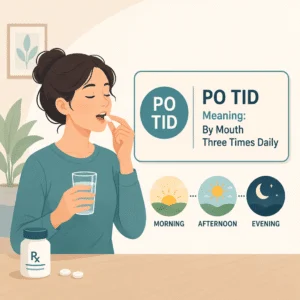
Because all three point to “three times a day,” they are interchangeable in meaning. If you want the concept explained without the Latin root, you can read our companion TID three times a day guide. When the order also states the oral route, the combined instruction is covered in our PO TID by-mouth dosing guide.
Why the same idea has several abbreviations
Medicine inherited Latin as a shared shorthand centuries ago, and different training traditions kept slightly different spellings. Electronic prescribing systems now often expand these codes into plain wording, but the shorthand persists because clinicians and pharmacists read it quickly. That variety is exactly why patients sometimes feel unsure, and why this page centers on the phrase and its forms rather than a single spelling.
How ter in die appears on your prescription
You will usually find the abbreviation in the directions area of a prescription, often called the “sig” (from the Latin signa, meaning “write”). It sits next to the dose amount and the route. A common example reads: “Amoxicillin 500 mg, take 1 capsule TID PO,” which means take one capsule by mouth three times a day.
Pharmacy labels then translate the shorthand into everyday language such as “Take 1 capsule three times daily.” Reading both the prescriber’s shorthand and the pharmacist’s printed directions helps you confirm the schedule. If the two ever seem to disagree, ask before you take the first dose.
From doctor’s order to pharmacy label
A prescriber writes the frequency; the pharmacist checks it. Along the way, the pharmacy confirms the dose, screens for interactions, and considers your age and kidney or liver function. If a medicine needs food, an empty stomach, or bedtime timing, the pharmacist adds those details so the three-times-a-day plan fits your day safely. To understand the route that often travels with this frequency, see our PO by-mouth dosage guide.
Latin dosing abbreviations at a glance
Ter in die belongs to a small family of Latin dosing and timing terms. The table below lists the common ones, their Latin origin, and a plain-English meaning so you can decode a label quickly.
| Abbreviation | Latin origin | Plain meaning |
|---|---|---|
| TER, t.i.d., TID | ter in die | Three times a day |
| BID, b.i.d. | bis in die | Twice a day |
| QID, q.i.d. | quater in die | Four times a day |
| QD, o.d. | quaque die | Once a day |
| PRN | pro re nata | As needed |
| AC | ante cibum | Before meals |
| PC | post cibum | After meals |
| HS | hora somni | At bedtime |
You can explore several of these in more depth. We cover the twice-daily instruction in our BID twice-daily dosing guide, the four-times-a-day instruction in our QID four-times-daily medication guide, and the once-a-day instruction in our QD once-daily medication guide.
Meal-timing and as-needed terms
Some terms describe when to take a dose rather than how often. For the “before meals” instruction, review our a.c. before-meals prescription guide, and for the “after meals” instruction, see our PC after-meals medication guide. When a medicine is taken only for symptoms, our PRN as-needed medication guide explains how that differs from a fixed three-times-a-day schedule.
How to space three daily doses
Spacing depends on the medicine. Even spacing keeps the amount of drug in your body more stable, which matters most for antibiotics and drugs with a narrow safe range. A practical evenly spaced plan might be 6 a.m., 2 p.m., and 10 p.m. A meal-based plan might be breakfast, lunch, and dinner. Neither is automatically right; the medicine and your prescriber’s intent decide.
- Ask whether your doses need even spacing (about every eight hours) or can follow meals.
- Set reminders or use a pill organizer so a mid-day dose is not skipped.
- Avoid crowding all three doses into a few hours, which can raise side-effect risk.
- Never double up after a missed dose without checking your pharmacist first.
If exact spacing is essential, a prescriber may write “every 8 hours” (sometimes shown as q8h) instead of the three-times-a-day phrase. That wording removes ambiguity for medicines that truly need clock-based timing.
Safety and common points of confusion
Most confusion comes from mixing up look-alike abbreviations. Three times a day (TER, t.i.d., TID) is easy to confuse with twice a day (BID) or four times a day (QID), and handwriting can blur the difference. Assuming “three times” always means breakfast, lunch, and dinner can also matter for medicines that need even spacing.
Certain abbreviations are known to be risky and are discouraged in modern practice. For example, the once-daily forms “q.d.” and “o.d.” can be misread as four-times-daily or as an instruction for the right eye. Safety organizations recommend writing out unclear terms, and pharmacists routinely translate shorthand into plain wording on your label to reduce mistakes.
Groups that need extra care
Children and older adults often need adjusted doses. Pediatric dosing is usually based on weight, and older adults may be more sensitive to side effects or have kidney and liver changes that affect timing. If you are unsure whether a standard three-times-a-day schedule suits the person taking the medicine, ask the pharmacist to confirm.
Latest scientific advances
Research from 2023 to 2026 does not focus on the exact phrase “ter in die,” so the studies below come from the broader field of medication-safety and adherence science. They still speak directly to why clear dosing frequency and readable labels matter. Figures are described in plain words rather than exact statistics.
Abbreviations and dosing errors in prescribing
A 2025 systematic review of prescription errors in children’s care found that dosing errors were the most common problem in hospital and emergency settings, while inappropriate abbreviations were a leading issue in outpatient prescriptions. The reviewers noted that clearer, templated prescriptions and better education reduced these errors.
What this means for you: the way a frequency like three times a day is written and communicated genuinely affects safety. If any instruction looks ambiguous, asking for plain-language directions is a reasonable and evidence-supported step.
Aside: a “systematic review” is a study that gathers and combines many earlier studies using a defined method, which makes its overall picture more reliable than a single report.
Electronic prescribing and clearer instructions
According to PubMed, a 2025 comparative study in hospital wards found that switching from handwritten prescriptions to a computerized order-entry system substantially lowered prescribing errors, and that problems tied to non-standard abbreviations and illegible handwriting were essentially removed. The same study noted that some frequency-related errors still needed ongoing attention even after the switch.
What this means for you: typed, standardized instructions tend to be safer than handwritten shorthand, but no system is perfect. It is still worth confirming how often and when to take a medicine.
Aside: “computerized order entry” simply means the prescriber types the order into software that can flag mistakes, rather than writing it by hand.
How dosing frequency affects adherence
According to PubMed, a 2023 systematic review and meta-analysis of anticoagulant use in patients with atrial fibrillation and chronic kidney disease reported that correct dosing and consistent day-to-day adherence were often suboptimal compared with other medicines. The authors called for more support to help people take these drugs correctly.
What this means for you: sticking to a dosing schedule is a common challenge, and simple tools such as reminders, organizers, and clear labels can help. If a three-times-a-day plan is hard to keep, tell your prescriber, since a different schedule may sometimes be possible.
Aside: “adherence” means how closely a person follows the prescribed plan; “a meta-analysis” statistically pools results from several studies.
Glossary
These short definitions cover the key terms used on this page, with acronyms written out in full.
| Term | Plain definition |
|---|---|
| Ter in die (TER, t.i.d., TID) | Latin for three times a day; the frequency for taking a medicine. |
| Dose | The amount of medicine taken at one time. |
| Dosing frequency | How often a medicine is taken, such as three times a day. |
| Route | How a medicine enters the body, such as by mouth (PO). |
| Sig (signatura) | The directions written on a prescription or label. |
| Therapeutic range | The level of a drug in the blood where it works well without undue harm. |
| Adherence | How closely a person follows the prescribed schedule. |
| Pharmacokinetics | How the body absorbs, spreads, breaks down, and removes a drug. |
| Error-prone abbreviation | A shorthand code that is easily misread and can cause a medication mistake. |
Frequently asked questions
Is TER the same as TID?
Yes. TER, t.i.d., and TID all come from the Latin phrase ter in die and all mean three times a day. TID is the most common written form in American pharmacies, while TER and t.i.d. show up in some prescriber notes and reference materials. If your label uses one and your doctor’s note uses another, they carry the same instruction.
Does ter in die always mean every eight hours?
Not always. It means three doses within 24 hours. For medicines that need steady blood levels, about every eight hours is ideal, but a prescriber may allow doses tied to meals for gentler drugs. When exact spacing matters, the order often says “every 8 hours” instead. Ask your pharmacist which approach applies to your medicine.
Can I take the three doses at breakfast, lunch, and dinner?
Sometimes yes, but not for every drug. Some medicines work best with even spacing across the full 24 hours, while others are fine with meals. Because the right choice depends on the specific medicine, confirm with your pharmacist whether meal-based timing gives safe, effective coverage.
What should I do if I miss one of the three doses?
Guidance varies by medicine. A common approach is to take the missed dose when you remember unless it is nearly time for the next one, in which case you skip it. Doubling up can raise side-effect risk. Check the medication guide or ask your pharmacist for advice specific to your prescription.
Why do some prescriptions avoid abbreviations like this?
Some shorthand codes are easy to misread, especially in handwriting, and have been linked to medication errors. Many health systems now encourage plain wording and use software that expands abbreviations automatically. This is a safety practice, not a sign that anything is wrong with your prescription.
Is a three-times-a-day schedule safe for children?
Many medicines are prescribed three times a day for children, but pediatric doses usually depend on weight and age. Use the measuring device the pharmacy provides for liquids, and confirm both the amount and the timing with the pharmacist or prescriber before starting.
Sources
- Institute for Safe Medication Practices (ISMP) — List of Error-Prone Abbreviations, Symbols, and Dose Designations: ismp.org
- MedlinePlus (NIH, National Library of Medicine) — Medicines: medlineplus.gov
- U.S. Food and Drug Administration (FDA) — Think It Through: Managing the Benefits and Risks of Medicines: fda.gov
- Hannibal GD, et al. A systematic review of prescription errors in paediatric care. BMC Health Services Research, 2025: consensus.app
- Saw CY, et al. Impact of computerized provider order entry system on medication prescribing errors in hospital wards. Medical Journal of Malaysia, 2025 (PubMed): pubmed.ncbi.nlm.nih.gov
- Emanuel S, et al. Correct dosing, adherence and persistence of DOACs in atrial fibrillation and chronic kidney disease: a systematic review and meta-analysis. Open Heart, 2023 (PubMed, DOI): doi.org/10.1136/openhrt-2023-002340
Further reading
- Review our QHS nighttime medication guide.
- Read our QDS four-times-daily dosage guide.
- Explore our QAM every-morning medication guide.
- See our STAT immediate medical order guide.
- Consult our MED medication abbreviation guide.
Understand your lab results with BloodSense
Get your results interpreted in minutes
Medication schedules and lab monitoring often work together, because how and when you take a medicine can shape what your blood tests show. When a three-times-a-day drug affects timing or monitoring, pairing that information with clear lab interpretation helps you see the fuller picture. BloodSense reads results such as liver enzymes, kidney function markers, and blood counts and explains them in plain language. It helps you understand your numbers and prepare questions for your clinician; it does not diagnose conditions and is not a replacement for your doctor.