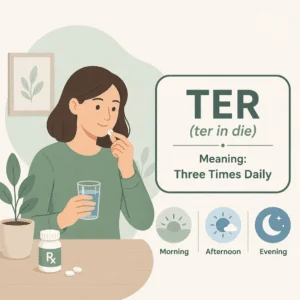







The po tid meaning is simple: it is a prescription instruction that tells you to take a medicine by mouth three times every day. PO comes from the Latin per os and means “by mouth,” while TID comes from ter in die and means “three times a day.” Put together, “PO TID” is a short code your prescriber and pharmacist use to describe both how you take the medicine (swallowed) and how often (three separate doses in 24 hours). In this article you’ll learn how to read PO TID on a real label, how to space the doses, how it differs from BID and QID, and which questions to ask so you take every dose safely and on time.
What PO TID means on a prescription
PO TID combines two separate pieces of information. PO (per os) is the route, meaning the medicine is swallowed rather than injected, inhaled, or applied to the skin. TID (ter in die) is the frequency, meaning three doses spread across the day. So an order written as “amoxicillin 500 mg PO TID” means: take one 500 mg dose of amoxicillin by mouth, three times daily.
Reading the two parts together matters. TID on its own only tells you how often; PO on its own only tells you the route. PO TID answers both questions at once, which is why prescribers pair them. If you want a deeper look at just the route, you can read our guide to the PO oral medication dosage abbreviation.
How PO TID differs from TID and TER
TID and TER both mean “three times a day” and describe frequency only. PO TID adds the oral route to that frequency, so it is a fuller instruction. If your label uses the frequency alone, you can compare it with our explainer on the TID three-times-a-day dosing abbreviation and the related note on the TER ter-in-die three-times-daily instruction.
How to read PO TID on your label
A prescription has several parts: the drug name, the dose (how much), the route (how to take it), the frequency (how often), and the duration (how long). PO TID sits in the route-and-frequency section. Modern pharmacies rarely leave the raw code on the bottle. Instead, the label usually spells it out, for example: “Take 1 tablet by mouth three times daily.”
Some labels add clock times (“Take at 8 AM, 2 PM, and 8 PM”) or tie the doses to meals (“Take with breakfast, lunch, and dinner”). Always check the printed directions for the exact dose amount and any special notes, such as taking the medicine with food or avoiding alcohol.
A worked example
Suppose your prescriber writes “cephalexin 500 mg PO TID x 7 days.” The pharmacy translates that into a label that reads: “Take one 500 mg capsule by mouth three times daily for 7 days.” The “x 7 days” is the duration. If the antibiotic needs even spacing, the pharmacist may also suggest roughly every eight hours rather than three doses bunched together.
Common dosing abbreviations at a glance
PO TID is one of a family of Latin-derived shorthand codes. The table below lists the ones you are most likely to see, with their Latin origin and plain meaning. Seeing them side by side makes it easier to spot the difference between “three times a day” and “every eight hours.”
| Abbreviation | Latin origin | Plain meaning |
|---|---|---|
| PO | per os | By mouth (swallowed) |
| TID | ter in die | Three times a day |
| BID | bis in die | Twice a day |
| QID | quater in die | Four times a day |
| QD (or once daily) | quaque die | Once a day |
| PRN | pro re nata | As needed |
| AC | ante cibum | Before meals |
| PC | post cibum | After meals |
| HS | hora somni | At bedtime |
For the neighboring frequency codes, you can read our guides to the BID twice-daily dosing schedule, the QID four-times-daily medication instruction, and the QD once-daily dosing abbreviation. For timing tied to food, see our explainers on the AC before-meals prescription instruction and the PC after-meals medication timing.
Spacing your three daily doses
“Three times a day” can mean different things depending on the medicine. For many drugs, roughly every eight hours keeps the level in your blood steady. For others, the prescriber simply wants three doses during your waking hours, often at breakfast, lunch, and dinner. The right pattern depends on the medication.
National prescribing guidance actually cautions against vague timing. The National Coordinating Council for Medication Error Reporting and Prevention advises prescribers to describe doses using general times of day, such as morning, afternoon, and evening, rather than leaving patients to guess. If your label does not give times, that is your cue to ask the pharmacist how to space the doses.
If precise timing matters
Some regimens require even eight-hour spacing, which a prescriber may write as Q8H (every eight hours) rather than TID. Antibiotics are a common example, because steady levels help clear an infection. If exact spacing is important for your medicine, confirm whether the doctor means “three convenient times” or “strictly every eight hours.”
Confusion and safety with dosing abbreviations
Shorthand saves time, but it can also be misread. Regulators keep published lists of abbreviations that cause errors so that clinics can avoid them. Common problems that touch PO TID include:
- Mixing up TID (three times daily) with QID (four times daily) or BID (twice daily), especially in rushed handwriting.
- Assuming TID always means exactly every eight hours, when some regimens tie doses to meals instead.
- Overlooking the route: PO means by mouth, while IV, IM, or SUBQ deliver the drug a completely different way.
- Misreading a poorly written order, which is one reason many systems now expand the code automatically.
The safest habit is simple: if a label looks unclear or seems to conflict with what your prescriber told you, confirm it before you take the first dose. For related route codes, you may want to review our guide to the PRN as-needed medication instruction, which behaves very differently from a scheduled TID order.
Why the route half matters
The PO part of PO TID is easy to skip over, but it carries real information. “By mouth” is only one of several routes a drug can take. Others include intravenous (into a vein), intramuscular (into a muscle), subcutaneous (under the skin), and topical (on the skin). The same drug can behave differently depending on the route, so PO signals that this version is designed to be swallowed and absorbed through the digestive tract. If your instruction changes from PO to another route, that is a meaningful change, not just a formatting detail.
Why prescribers use PO TID
Prescribers reach for codes like PO and TID because they pack route and frequency into a few characters. Latin abbreviations were originally a way to write orders that any trained clinician or pharmacist could read, regardless of their spoken language, and they fit neatly onto handwritten charts. That history is why so much prescription shorthand is Latin rather than English.
Today, most prescriptions are entered into electronic systems rather than written by hand. Many of those systems still accept PO TID as a standard entry, but they increasingly expand it into plain wording before the label prints. The goal is to keep the speed and consistency that professionals rely on while giving patients directions they can actually read.
Standardization versus plain language
There is a genuine tension here. Standard codes reduce ambiguity between a doctor and a pharmacist who both know the system. Plain language reduces ambiguity for the patient at home. The current direction of travel, supported by national safety bodies, is to use standardized entry behind the scenes but to print clear, spelled-out instructions on what you actually receive. That is why the code your doctor types may look nothing like the sentence on your bottle, even though they mean the same thing.
Questions to ask your pharmacist about PO TID
A short conversation at the pharmacy counter prevents most dosing mistakes. Useful questions include:
- What does this label mean in plain language, and how many pills do I take each time?
- What times of day should I take the three doses, and do they need even spacing?
- Should I take this with food, with a full glass of water, or on an empty stomach?
- What should I do if I miss a dose, and can I ever double up?
- Could this interact with my other medicines, supplements, or alcohol?
- How long should I keep taking it, and does it need any lab monitoring?
If the answers are still unclear, you can ask the pharmacist to write the schedule directly on the label or give you a simple dosing calendar. If your medicine comes as a liquid, our note on the SUSP medication suspension abbreviation explains how to measure oral doses accurately.
Latest scientific advances
Research on medication safety and adherence helps explain why clear PO TID instructions matter and how errors are being reduced. The studies below are summarized in plain language, with statistics left out on purpose.
Error-prone abbreviations are being retired
A hospital study tested a “Never Use” list of dangerous abbreviations, built from safety recommendations by the Institute for Safe Medication Practices and an Australian safety commission. After staff were educated, the share of prescriptions containing risky abbreviations fell.
What this means for you: the trend is away from cryptic codes and toward spelled-out instructions, which is exactly why your bottle is more likely to say “three times daily” than “TID.”
Aside: an “error-prone abbreviation” is shorthand that has caused mistakes often enough that experts advise writing it out in full.
Electronic prescribing removes some errors but not all
A 2025 comparative study found that switching from handwritten to computerized prescriptions eliminated problems like illegible orders and non-standard abbreviations. However, errors in dose, frequency, or units did not disappear on their own, so checks still matter.
What this means for you: even a neatly printed PO TID label can carry a mistake, so it remains worth confirming the dose and timing with your pharmacist.
Aside: computerized provider order entry is a system where clinicians type prescriptions into software instead of writing them by hand.
Dosing errors are the most common prescribing error
A 2023 systematic review of outpatient and clinic settings found that prescribing errors were the most frequent type, and that dosing errors were the most common of those. A 2025 systematic review focused on children reached a similar conclusion, noting that inappropriate abbreviations were a leading problem in outpatient prescriptions.
What this means for you: getting the dose and frequency right is where most attention is needed, so double-checking a “three times daily” instruction is a sensible habit, especially for children.
Aside: a systematic review gathers many separate studies and analyzes them together to find consistent patterns.
Simple counseling helps caregivers dose correctly
A 2024 study in a pediatric emergency department tested a brief intervention combining a simplified handout, a dosing syringe, a demonstration, and a “teach-back” step where caregivers repeat the instructions. Caregivers who received it were less likely to make a dosing or frequency error at follow-up.
What this means for you: asking the pharmacist to show you the schedule and repeating it back is a proven way to reduce mistakes with any PO TID medicine.
Aside: “teach-back” is a safety technique where you restate instructions in your own words so a professional can confirm you understood.
These findings come from a mix of hospital studies and reviews in different countries and settings, so exact numbers vary from place to place. The consistent message, rather than any single figure, is what matters: clearer instructions and a quick confirmation step lower the risk of dosing errors.
Glossary
| Term | Plain meaning |
|---|---|
| PO (per os) | Latin for “by mouth”; the medicine is swallowed. |
| TID (ter in die) | Latin for “three times a day.” |
| Route | How a medicine enters the body, such as oral, injected, or topical. |
| Frequency | How often a dose is taken across the day. |
| Dose | The specific amount of medicine taken at one time. |
| Duration | How many days or weeks the medicine is taken. |
| Q8H | Every eight hours; a precise version of three-times-daily spacing. |
| Sig | The directions section of a prescription (from “signatura”). |
| Adherence | How closely a patient follows the prescribed schedule. |
| Error-prone abbreviation | Shorthand that experts advise writing out because it causes mistakes. |
Frequently asked questions
Does PO TID mean exactly every eight hours?
Not necessarily. PO TID means take the medicine by mouth three times a day. For some drugs, three doses roughly every eight hours keeps the level steady; for others, the prescriber simply wants three doses during waking hours, often with meals. If even spacing matters for your medicine, ask whether the doctor intended Q8H (every eight hours) rather than three convenient times.
What if my prescription says PO but not TID?
PO on its own only tells you the route: take the medicine by mouth. It does not say how often or how much. A complete instruction also needs a frequency and a dose. If the frequency is missing from your label, contact the pharmacist or prescriber before taking the medicine, rather than guessing how many times a day to use it.
Can I take two doses together if I miss one?
As a rule, do not double up without professional advice. For many medicines, taking two doses close together can raise the risk of side effects. What to do after a missed dose depends on the drug and how much time has passed, so the safest step is to ask your pharmacist or prescriber, or check the patient information leaflet that came with the medicine.
Is PO TID used for children?
Yes, a PO TID schedule can apply to children, but pediatric dosing usually depends on the child’s weight and age, and often uses a liquid form. Confirm the exact amount and the correct measuring device, such as an oral syringe, with the pharmacist. Research shows that a short demonstration and repeating the instructions back reduces dosing mistakes for children.
Will the pharmacy actually print “PO TID” on my bottle?
Usually not. Pharmacy software typically expands the shorthand into plain language before printing, so your label is more likely to read “Take 1 tablet by mouth three times daily.” If you ever do see raw abbreviations on a label and are unsure what they mean, ask the pharmacist to rewrite them in everyday words.
Does a medicine taken PO TID need blood tests?
Some do and some do not. The three-times-daily schedule itself does not require monitoring, but the specific medicine might. Certain drugs, such as some antibiotics, seizure medicines, or blood thinners, are checked with lab tests to keep levels safe and effective. Ask your prescriber whether your particular medication needs any monitoring while you take it.
Sources
- Institute for Safe Medication Practices (ISMP) — List of Error-Prone Abbreviations, Symbols, and Dose Designations: ismp.org
- National Coordinating Council for Medication Error Reporting and Prevention (NCC MERP) — Recommendations to Enhance Accuracy of Prescription/Medication Order Writing: nccmerp.org
- MedlinePlus (U.S. National Library of Medicine) — Taking multiple medicines safely: medlineplus.gov
- Hannibal GD, et al. A systematic review of prescription errors in paediatric care. BMC Health Serv Res. 2025 (DOI 10.1186/s12913-025-13109-6): PubMed 40696335
- Naseralallah L, et al. Prevalence, contributing factors, and interventions to reduce medication errors in outpatient and ambulatory settings: a systematic review. Int J Clin Pharm. 2023 (DOI 10.1007/s11096-023-01626-5): PubMed 37682400
- Samuels-Kalow ME, et al. Analysis of a Medication Safety Intervention in the Pediatric Emergency Department. JAMA Netw Open. 2024 (DOI 10.1001/jamanetworkopen.2023.51629): PubMed 38214929
- Saw CY, et al. Impact of computerized provider order entry system on medication prescribing errors in hospital wards: a comparative study. Med J Malaysia. 2025: PubMed 40145167
- Thachaparambil A, et al. Impact of “Never Use” Abbreviations (Error-Prone Abbreviations) List on the Incidence of EPAs in Inpatient Medical Prescriptions. Curr Drug Saf. 2023 (DOI 10.2174/1574886317666220514163931): PubMed 35570538
Further reading
- BID Meaning: Twice Daily Dosing Guide
- TID Meaning: Three Times a Day Guide
- PO Meaning: Oral Medication Dosage Guide
- QID Meaning: Four Times Daily Medication Guide
- PRN Meaning: As-Needed Medication Guide
Understand your lab results with BloodSense
Get your results interpreted in minutes
Understanding a PO TID instruction keeps your daily doses on track, and some of those medicines are followed with blood tests to stay safe and effective. BloodSense reads your lab report and explains each result in plain language, so figures like a kidney function panel, a complete blood count, liver enzymes, or an INR clotting test make sense between appointments. It helps you see how your treatment is going and prepare better questions for your clinician. BloodSense does not diagnose conditions and is not a replacement for your doctor.