






The QDS meaning on a prescription is four times a day, from the Latin quater die sumendus, which translates as “to be taken four times a day.” If those three letters appear next to a medicine, they answer one question only: how often. What makes QDS worth its own explanation is not the arithmetic. It is the origin. QDS is British notation, standard in the United Kingdom, Ireland, Australia, New Zealand, India and much of the Commonwealth, and it belongs to a whole family of shorthand — od, bd, tds, qds — that looks nothing like the American system.
In this guide you’ll learn what the Latin behind QDS actually says, how each British frequency abbreviation maps onto its US counterpart, why a Commonwealth abbreviation keeps surfacing on American paperwork, where the two systems dangerously overlap, and what to do when QDS turns up on something you have been handed.
What QDS stands for
QDS is a frequency instruction and nothing more. It tells you the number of doses in a 24-hour period. It does not tell you the amount, the route into your body, or the hours of the day. Those live elsewhere on the prescription, which is why a complete order usually strings several abbreviations together in a row.
Quater die sumendus, translated
Quater means four times. Die means in a day. Sumendus is the interesting word: it is a form of the Latin verb sumere, to take, and it carries the sense of “to be taken.” Put together, quater die sumendus reads as “to be taken four times a day.” The instruction to the patient is baked into the phrase itself.
The one word that separates QDS from QID
This is where the two notations quietly diverge. The American abbreviation QID comes from quater in die, which means simply “four times a day” — a statement of frequency, with no verb attached. QDS comes from quater die sumendus, which means “to be taken four times a day” — a direction to the patient. The clinical result is identical, and no pharmacist anywhere would dispense them differently. But the grammar is genuinely different, and that difference is the fingerprint of two prescribing traditions that evolved separately. If you are holding an American prescription rather than a British one, the same schedule would be written as a four times daily QID instruction.
What QDS does not tell you
Four doses in a day implies roughly six-hour gaps, but QDS never says so. Some medicines genuinely need even six-hourly spacing to hold a steady level in the blood. Others are meant to be fitted into waking hours — breakfast, lunch, dinner and bedtime — which compresses the schedule into about sixteen hours and leaves a long overnight gap. Which of those applies is a property of the drug, not of the abbreviation. QDS is silent on the question, and guessing is exactly the wrong move.
The British dosing notation and its US equivalents
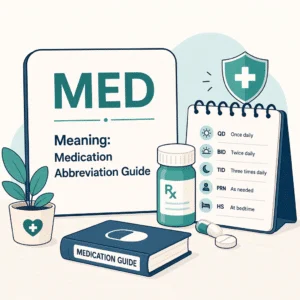
QDS almost never appears alone. It sits inside a compact system that a British prescriber uses without thinking, and that an American reader may never have been taught. Seeing the whole set at once is far easier than meeting each abbreviation separately, because the family shares a logic: the Latin number word comes first, die anchors it to the day, and sumendus marks it as an instruction.
| British notation | Latin origin | Plain meaning | Usual US equivalent |
|---|---|---|---|
| od | omni die | Once a day | QD, or increasingly the plain word daily |
| bd | bis die | Twice a day | BID, from bis in die |
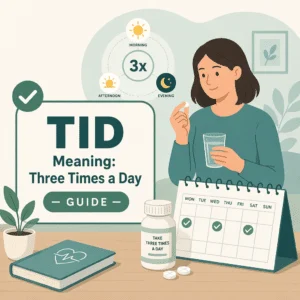
| tds | ter die sumendus | To be taken three times a day | TID, from ter in die |
| qds | quater die sumendus | To be taken four times a day | QID, from quater in die |
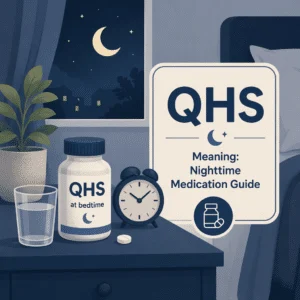
| nocte | nocte | At night | QHS, from quaque hora somni |
| mane | mane | In the morning | QAM, from quaque ante meridiem |
| prn | pro re nata | As needed, not on a fixed schedule | PRN, identical in both systems |
How to read the table
Three patterns are worth noticing. First, the British forms are lowercase by convention while the American ones are usually capitalised, which is a stylistic tell rather than a rule. Second, tds and qds both carry sumendus, while bd and od do not — the British system is not perfectly consistent with itself, because it accumulated over centuries rather than being designed. Third, nocte and mane are not abbreviations at all. They are simply Latin words for night and morning, used whole.
The two schedules on either side of QDS are the ones patients most often need next. BloodSense explains each of them separately in the twice daily dosing guide and in the once daily abbreviation QD, which also explains why American safety bodies now want that particular abbreviation retired entirely. Orders meant for bedtime carry the bedtime abbreviation QHS, and anything genuinely urgent is marked with the immediate order abbreviation STAT.
Why a British abbreviation reaches American patients
If QDS is British notation, why would anyone in the United States encounter it? The honest answer is that medicine is far more international than its paperwork admits, and three routes account for most sightings.
Documents that travel
People move, and their medicines move with them. Someone relocating from London, Dublin, Sydney or Mumbai arrives with a repeat prescription, a discharge summary or a hospital letter written in the notation of the country that produced it. A US pharmacist cannot dispense against a foreign prescription, but the patient still needs to understand what they were taking, and the new prescriber still needs to read the history. QDS survives in that paperwork long after the patient has changed continents.
Clinicians who trained abroad
A substantial share of physicians practising in the United States completed medical school in another country, and prescribing habits formed during training are durable. A doctor who spent six years writing qds on drug charts in a British or Indian teaching hospital does not unlearn it on arrival. Modern electronic prescribing usually intercepts the habit before it reaches a pharmacy label, because the software offers preset frequency options rather than free text. But handwritten notes, informal lists and clinical shorthand passed between colleagues are not filtered by any software.
Study materials and reference lists
The third route is simply reading. Nursing and pharmacy students in the US routinely work through comprehensive abbreviation lists that include Commonwealth forms, medical literature published in British journals uses them freely, and older reference books mix both systems without comment. A great many people meet QDS on a page rather than on a bottle.
Where the two systems collide
Two notations describing the same instruction would be harmless if they never touched. They do touch, and one collision in particular has caused documented harm.
The od problem
In the British system, od means once daily. In American medicine, and in ophthalmology everywhere including Britain, OD means oculus dexter — the right eye. The Institute for Safe Medication Practices, which runs the US national medication error reporting programme, records this exact pairing on its published list of error-prone abbreviations, with a blunt description of the consequence: oral liquid medications administered into the eye. Its recommended fix is deliberately unglamorous. Write daily. Because the eye meaning is the one Americans reach for first, BloodSense treats it separately in the right eye abbreviation OD.
QDS itself is not part of that collision, and it is worth saying so plainly rather than manufacturing alarm. Three letters ending in S do not resemble anything else in common use. The risk attached to QDS is not misreading. It is non-recognition — an American reader who simply does not know the convention and guesses.
What the US safety lists do and do not cover
Here is a detail that surprises people. QDS does not appear on the ISMP list of error-prone abbreviations at all. Neither do bd or tds. The American safety canon was built from American error reports, so it flags QD, QOD, q1d and the OD-versus-right-eye trap, all of which are homegrown problems. The British notation is simply outside its frame of reference. That absence is not a safety endorsement of QDS. It means the question has not been asked in the place where the list was written, which is a different thing entirely, and worth knowing if you are trying to work out how seriously to take a piece of shorthand.
What four times a day actually asks of you
Strip away the notation and QDS describes the most demanding common dosing schedule in medicine. Once-daily and twice-daily regimens attach easily to fixed anchors — waking up, going to bed. Four doses do not. At least one of them lands in the middle of an ordinary working day, away from home, without a routine to hang it on.
This matters more than the Latin does. A prescriber who writes qds is asking for something genuinely harder than a prescriber who writes od, and the research on whether patients manage it is unambiguous in direction. If a four-times-daily schedule looks unworkable against your actual day, that is a conversation to have before the first dose rather than a private failure to conceal. For some drugs a longer-acting alternative exists; for others the spacing is negotiable within limits. Only the prescriber can tell you which case you are in.
What to do when QDS appears on your paperwork
Seeing QDS is not a reason for alarm. It is a reason for one clarifying question, and pharmacists would far rather answer it than intercept a problem later.
- Read it as four doses in 24 hours, then confirm that number out loud with the pharmacy rather than assuming.
- Ask whether your medicine needs even six-hourly spacing or whether the four doses can sit inside your waking hours.
- Ask the pharmacy to print the frequency in plain English. “Take four times a day” leaves nothing to interpret, and you are entitled to ask for it.
- If the document is a foreign prescription or discharge letter, hand it to your US prescriber rather than acting on it yourself.
- Do not copy qds into your own medication list. Write “four times a day.” The reasoning that pushed hospitals away from Latin shorthand applies just as much to a note you may hand to a stranger in an emergency.
- If an instruction is ambiguous, ask the person who wrote it. That principle is the backbone of every do-not-use list ever published.
Latest scientific advances
Recent research on abbreviations and dosing frequency speaks directly to the two things QDS is: a piece of shorthand that has to be understood, and a schedule that has to be kept.
Clinicians misread abbreviations more often than you would expect
A 2023 survey at a British hospital asked 46 consultants, doctors in training and nurses to write out the full meaning of 20 abbreviations taken from real patient records. The average score was 6.39 out of 20 — about a third. Only four of the 20 abbreviations were correctly defined by more than half the group, and three-quarters of them had at least one competing definition in circulation.
What this means for you: if you have ever felt foolish for not knowing what QDS meant, this is your reassurance. The professionals reading the same notes get roughly two-thirds of them wrong, in their own hospital, in their own country. Asking is the normal, competent response to an abbreviation, not an admission of ignorance.
The jargon, explained: a cross-sectional survey captures a group at a single moment rather than following them over time. Reliability note: this was 46 volunteers at one hospital, so the precise percentages will not transfer elsewhere — but the direction of the finding is what matters here.
Adherence falls as the number of daily doses rises
A meta-analysis pooled 51 studies in which patients with long-term conditions had their pill bottles electronically monitored, so the record reflected when the bottle was actually opened rather than what anyone remembered. Compared with a once-daily schedule, four-times-daily regimens saw patients take about 19% fewer of their doses. When the researchers applied the strictest measure — whether doses were taken at the right times, not merely taken — the four-times-daily gap widened to roughly 54%.
What this means for you: struggling with a QDS schedule is the statistical norm, not a personal failing. It also explains why prescribers reach for four-times-daily dosing only when the drug genuinely requires it.
The jargon, explained: a meta-analysis combines results from many studies into one estimate. Reliability note: this analysis is from 2012 and remains the most-cited evidence that isolates four-times-daily dosing specifically — more recent work tends to compare once against twice daily, so the four-dose figure has not been refreshed with newer data.
Newer real-world data points the same way
A 2023 study tracked more than 8,000 patients with asthma or COPD using electronic monitors built into their inhalers. Those on a once-daily inhaler took a median 63% of doses, against 50% for twice-daily users in asthma; in COPD the figures were 83% against 65%. The pattern held across nearly every age group.
What this means for you: even the step from one dose to two costs something measurable. Four is a much larger step, which is worth naming honestly with your prescriber rather than discovering three weeks in.
The jargon, explained: a median is the middle value, so half of patients did better and half worse. Reliability note: this was an observational study of inhalers, not tablets, and the dosing schedule was self-reported.
Glossary
| Term | Definition |
|---|---|
| Quater die sumendus | The Latin phrase behind QDS, meaning “to be taken four times a day.” |
| Quater in die | The Latin phrase behind the American abbreviation QID, meaning “four times a day.” The same schedule, different grammar. |
| Commonwealth notation | The od, bd, tds, qds family of dosing abbreviations used in the UK, Ireland, Australia, New Zealand, India and elsewhere. |
| Dosing interval | The time between one dose and the next, such as six hours. |
| Sig | Short for the Latin signatura. The part of a prescription carrying the directions: dose, route and frequency. |
| ISMP | The Institute for Safe Medication Practices, a US nonprofit that collects medication error reports and publishes the reference list of error-prone abbreviations. |
| Error-prone abbreviation | A shorthand that has been reported to cause real medication errors and that safety bodies ask clinicians to stop using. |
| Adherence | How consistently a person takes a medicine as prescribed over time. |
| Oculus dexter | Latin for “right eye,” abbreviated OD. The reason od is unsafe as a dosing abbreviation. |
| Steady state | The point at which repeated doses keep the amount of drug in the blood roughly level between doses. |
Frequently asked questions
Is QDS the same as QID?
In practice, yes. Both mean four doses in a 24-hour period, and a pharmacist would dispense them identically. The difference is regional and grammatical: QDS comes from quater die sumendus and is standard in the UK, Ireland, Australia and much of the Commonwealth, while QID comes from quater in die and is the American form. If you have documents from two countries and see both, they are not describing different schedules.
Does QDS mean every six hours?
Not necessarily. Four doses spread evenly across 24 hours would fall every six hours, but QDS states the count, not the interval. Some medicines need even spacing to keep a steady level in the blood; others are intended to fit into waking hours, which leaves a longer overnight gap. Which applies depends on the specific drug, so ask the pharmacist or prescriber to spell out the timing rather than working it out from the abbreviation.
Why does my prescription use QDS when I am in the United States?
Most commonly because the document came from abroad, or because the person who wrote it trained in a country where qds is standard. Prescribing habits formed during training are long-lived, and handwritten notes are not filtered by prescribing software the way pharmacy labels are. It is not a sign that anything is wrong, but it is a good reason to have the instruction confirmed in plain English before you act on it.
Is QDS a banned abbreviation?
No. QDS does not appear on the ISMP list of error-prone abbreviations, and it is not on The Joint Commission’s Do Not Use list. Those lists were built from US error reports and address US shorthand, so British notation falls outside their scope rather than having been assessed and cleared. The broader advice from safety bodies still applies: plain words are safer than any Latin abbreviation, whichever tradition it comes from.
What does PO QDS mean together?
PO comes from per os, Latin for “by mouth,” and QDS means four times a day. Together they instruct you to swallow a dose four times in each 24-hour period. A full line such as “1 tab PO QDS” means take one tablet by mouth four times daily. The line still does not tell you the hours, so confirm the spacing with your pharmacy before starting.
What should I do if I miss a QDS dose?
The right answer depends entirely on the medicine, so this is a question for your pharmacist rather than a rule you can apply generally. What is worth avoiding is doubling up to catch up, since taking two doses close together is precisely the scenario that turns a missed dose into a side-effect problem. If you find yourself missing doses regularly, say so at your next appointment; it is common with four-times-daily schedules and it is useful information for your prescriber.
Sources
- Institute for Safe Medication Practices — ISMP List of Error-Prone Abbreviations, Symbols, and Dose Designations — ISMP, 2024 — ismp.org
- Tariq RA, Sharma S — Inappropriate Medical Abbreviations — StatPearls, NCBI Bookshelf, updated 2023 — ncbi.nlm.nih.gov
- Jayatilake DC, Oyibo SO — Interpretation and Misinterpretation of Medical Abbreviations Found in Patient Medical Records: A Cross-Sectional Survey — Cureus, 2023 — doi.org/10.7759/cureus.44735
- Coleman CI, Limone B, Sobieraj DM, Lee S, Roberts MS, Kaur R, Alam T — Dosing Frequency and Medication Adherence in Chronic Disease — Journal of Managed Care Pharmacy, 2012 — pmc.ncbi.nlm.nih.gov
- De Keyser H, Vuong V, Kaye L, Anderson WC, Szefler S, Stempel DA — Is Once Versus Twice Daily Dosing Better for Adherence in Asthma and Chronic Obstructive Pulmonary Disease? — The Journal of Allergy and Clinical Immunology: In Practice, 2023 — doi.org/10.1016/j.jaip.2023.03.053
Further reading
- Compare the American shorthand for the same schedule by reading the four times daily abbreviation QID.
- See why safety bodies want one abbreviation retired altogether in the once daily abbreviation QD.
- Learn how the simplest schedule is written and kept with the once-daily prescription guide QDAY.
- Understand the twice-daily instruction you may meet on the same label by reading the twice daily dosing guide.
- Read a plain-language walkthrough of reference ranges and lab report flags.
Understand your lab results with BloodSense
Get your results interpreted in minutes
Many of the medicines written as four doses a day are the same ones your care team follows through blood work. An antibiotic course may prompt a complete blood count to check how an infection is settling, a drug cleared by the kidneys or liver is tracked with a comprehensive metabolic panel, and long-term treatments are often watched with a liver enzyme panel. Reading those numbers alongside your dosing schedule can turn a vague worry into a specific question for your next appointment. BloodSense helps you understand what your results say in plain language; it does not diagnose, and it does not replace your doctor.