





Varicella (Chickenpox): Symptoms, Causes, Treatments, Prevention
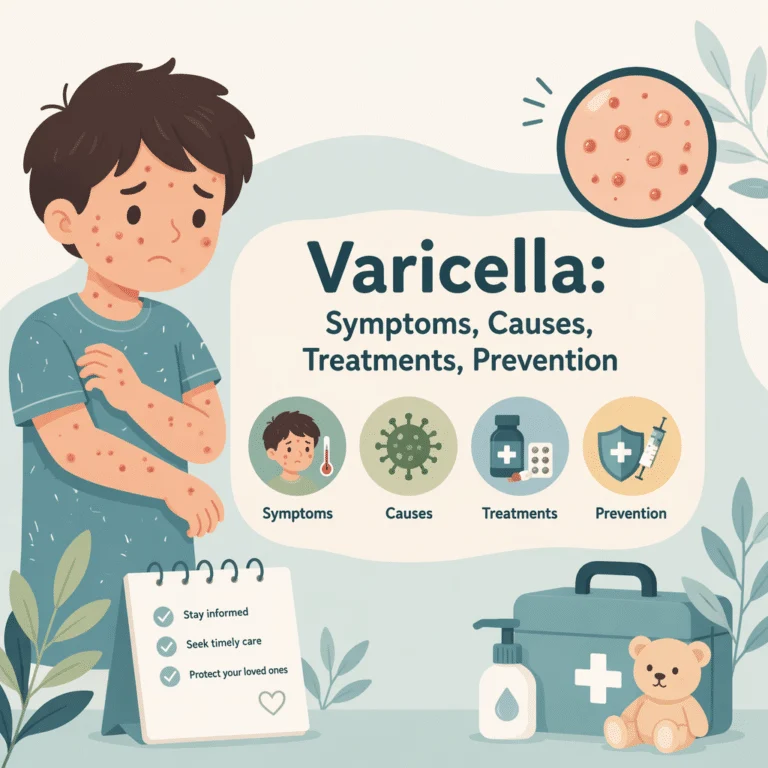
Chickenpox, known medically as varicella, is a common illness that causes an itchy rash of red bumps, fluid-filled blisters, and scabs, often along with a mild fever. It is caused by the varicella-zoster virus, one of the most contagious viruses there is, but for most healthy children it is a manageable illness that clears up on its own within one to two weeks. Chickenpox is far less common today than it once was, since a highly effective vaccine now prevents the large majority of cases in the United States, and most people who do get it recover fully with simple care at home. This guide explains what chickenpox is, its symptoms, causes, how it is diagnosed, the treatments available, and the latest research.
What is chickenpox (varicella)?
Chickenpox is an acute, highly contagious infection caused by the varicella-zoster virus, or VZV, a member of the herpesvirus family. Once VZV infects a person, usually through the air or direct contact with fluid from an infected person’s blisters, it spreads through the body and produces the disease’s signature itchy rash within a couple of weeks. Because it spreads so easily, nearly everyone caught chickenpox before a vaccine existed, most often in early childhood.
Vaccination has changed the picture dramatically. Since the US chickenpox vaccination program began in 1995, cases have fallen by more than 97 percent, preventing an estimated 91 million infections and making severe illness, hospitalization, and death rare. Chickenpox can still occur in people who were never vaccinated, and it can also occur, usually in a milder form, in some vaccinated people, which is why it remains worth recognizing even though it is far less common than it used to be.
Symptoms of chickenpox
Chickenpox typically develops 10 to 21 days after exposure, with most people becoming ill around 14 to 16 days afterward. A day or two before the rash appears, many people, especially teenagers and adults, have a mild prodrome of fever, tiredness, headache, and loss of appetite; young children often skip this stage, and the rash is the first sign anyone notices.
The rash is the hallmark of chickenpox, and it appears in successive crops rather than all at once. Each new spot starts as a small, itchy red bump, quickly fills with clear fluid to become a blister, then clouds over and dries into a crust within a day or two. Because fresh crops keep forming for several days while older spots are already blistering or scabbing, a person with chickenpox usually has bumps, blisters, and scabs on the skin all at the same time, the classic feature that identifies chickenpox. The rash usually starts on the chest, back, and face before spreading, and it can produce roughly 250 to 500 lesions over five to ten days, often with intense itching.
What causes chickenpox and its risk factors
Chickenpox is caused by infection with the varicella-zoster virus, which spreads easily through the tiny respiratory droplets released when an infected person coughs or sneezes, and through direct contact with fluid from their blisters. A person is contagious starting about 1 to 2 days before the rash appears and remains contagious until every lesion has crusted over, typically 5 to 7 days later, and roughly 9 in 10 susceptible household members catch it after this kind of exposure. Understanding the lifelong latency of herpes virus infections helps explain why VZV, a relative of the viruses that cause cold sores and genital herpes, is never completely cleared from the body once someone is infected.
The biggest risk factor for catching chickenpox is simply never having had the infection or the vaccine, which is why close contact in households, schools, and childcare settings spreads it so effectively. Anyone can develop complications, but severe disease is more likely in infants, adolescents and adults, pregnant people, and anyone with a weakened immune system. Because vaccination status is the main factor separating who is protected, staying up to date with both recommended doses is the most effective way to lower personal risk.
How chickenpox is diagnosed
Chickenpox is usually diagnosed clinically, meaning a doctor recognizes it from the rash alone, without any testing. The most telling clue is timing: because new crops keep forming over several days while earlier spots are already blistering or crusting, lesions at multiple stages are typically visible at the same time, which is what separates chickenpox from rashes that appear all at once. Healthy children with a typical rash and known exposure usually need no laboratory confirmation.
| Stage | What it looks like |
|---|---|
| Papule | A small, itchy red bump; the first stage of each new lesion |
| Vesicle | A clear, fluid-filled blister forming on top of the red base |
| Pustule | The blister clouds over and often breaks open |
| Crust (scab) | The lesion dries into a scab as it heals, usually within about a week |
Testing becomes more useful when the picture is less clear, such as in a vaccinated person with a mild breakthrough rash, an adult, or someone with a weakened immune system. PCR testing of fluid from a fresh blister is the preferred, most reliable way to confirm active infection. Checking the IgG antibody level for varicella immunity does not diagnose an active case but confirms existing immunity, which is why doctors order it for healthcare workers, during pregnancy, and before immunosuppressive treatment. IgM testing is not recommended for diagnosis because results are often unreliable, and checking antibody levels right after the two-dose vaccine series is not generally recommended either, since standard tests are not sensitive enough to confirm vaccine-induced immunity.
Treatment options for chickenpox
Most healthy children and adults recover from chickenpox on their own, and treatment focuses on relieving itching, watching for complications, and limiting spread. The most effective way to avoid it altogether is the two-dose varicella vaccine, given around 12 to 15 months of age and again at 4 to 6 years, about 90 percent effective and able to make breakthrough illness much milder. Someone exposed who is not already immune may still be protected afterward: the vaccine soon after exposure can help, and for those at higher risk who cannot be vaccinated, an immune globulin called VariZIG can be given within 10 days.
| Approach | Role |
|---|---|
| Supportive care at home | Calamine lotion, cool oatmeal or baking-soda baths, and antihistamines ease itching, while short, clean nails help prevent skin infections from scratching |
| Acetaminophen | The appropriate medicine for controlling fever and general discomfort |
| Antiviral medication (acyclovir or valacyclovir) | Used for people at higher risk of severe disease; works best when started within 24 hours of the rash appearing |
| Varicella vaccine (two doses) | Routine immunization that prevents most infections and makes breakthrough cases much milder |
| Post-exposure prophylaxis | Vaccine or varicella-zoster immune globulin given soon after exposure to prevent or lessen illness in someone not yet immune |
Two safety rules matter for every case of chickenpox in a child or teenager. Aspirin should never be given, since using it during a viral illness like chickenpox raises the risk of Reye syndrome, a rare but serious illness affecting the liver and brain. Ibuprofen and other NSAIDs should also be avoided, because they have been linked to more severe bacterial skin infections. Acetaminophen is the appropriate choice for fever and discomfort. For those at higher risk of severe disease, an antiviral such as acyclovir or valacyclovir works best when started within 24 hours of the rash appearing.
Living with chickenpox and long-term outlook
Most people recover fully from chickenpox within one to two weeks; keeping fingernails short, using cool baths, and applying calamine lotion helps avoid scarring from scratching. Complications are uncommon in healthy children but more likely in infants, adolescents, adults, pregnant people, and anyone immunocompromised; they can include bacterial skin infections, dehydration, and, less often, inflammation of the brain or its coordination centers. Recognizing the cough and breathing difficulty of pneumonia early can prompt faster treatment, one of the more serious complications in adults. Chickenpox in early pregnancy carries a small but real risk, around 0.4 to 2 percent, of congenital varicella syndrome, affecting a baby’s skin, limbs, and nervous system, while a rash just before or after delivery can cause severe newborn illness, so exposed or symptomatic pregnant people should contact a doctor promptly.
Chickenpox is not entirely finished once the rash clears. The virus travels along nerve pathways into tissue near the spine and brain, called the dorsal root ganglia, where it stays dormant, often for decades, kept in check by the immune system. Later in life, particularly as immunity weakens with age or illness, the virus can reactivate. Understanding the painful, band-like rash of shingles shows why anyone who has had chickenpox carries a lifelong chance of this second illness, and why an unvaccinated person can catch chickenpox from an active shingles rash. Thanks to widespread vaccination, severe illness from chickenpox is now uncommon in the United States.
Latest scientific advances in chickenpox research
According to PubMed-indexed research, real-world testing patterns for chickenpox in the United States do not always match guidelines. A 2025 study in the American Journal of Preventive Medicine, reviewing five large US insurance-claims databases from 2016 to 2023, found that antibody testing for VZV, mostly the IgG test, was ordered 50 to 60 times more often than PCR testing, and that IgM testing, despite not being recommended, still made up as much as 11 percent of VZV tests (Raparti et al., 2025). What this means for you: PCR of blister fluid is the right test to confirm active infection, while the IgG test, not IgM, is the right one to check immunity. A 2024 MMWR report described a sustained, multi-year outbreak among recently arrived, largely unvaccinated immigrants to New York City from 2022 to 2024, even as chickenpox cases nationally stayed near record lows (Graham et al., 2024). What this means for you: chickenpox has not disappeared from the United States, and pockets of low vaccination coverage can still allow real outbreaks.
A 2026 study in the journal Vaccine followed more than 5.7 million vaccinated people and found that breakthrough-varicella risk rose the longer it had been since the last dose, climbing as much as fivefold for those three or more years past their most recent dose versus those vaccinated within the previous year; a second dose lowered that risk by about 70 percent compared with just one dose (Wang et al., 2026). What this means for you: protection can fade with time, and completing both recommended doses gives noticeably stronger, longer-lasting protection, the reasoning behind the standard two-dose US schedule.
Glossary of key chickenpox terms
| Term | Definition |
|---|---|
| Varicella-zoster virus (VZV) | The herpesvirus that causes chickenpox and, upon reactivation later in life, shingles. |
| Prodrome | Early symptoms, such as fever and tiredness, that can appear a day or two before the rash. |
| Vesicle | A small, clear, fluid-filled blister; one of the stages of each chickenpox lesion. |
| Crop | A new wave of rash lesions; chickenpox produces several crops over the course of the illness. |
| Breakthrough varicella | Chickenpox occurring in a vaccinated person, usually causing milder illness than in someone unvaccinated. |
| Post-exposure prophylaxis | Vaccine or immune globulin given soon after exposure to prevent or lessen illness in someone not yet immune. |
| Shingles (herpes zoster) | A painful rash caused by reactivation of the dormant varicella-zoster virus, often decades after chickenpox. |
Frequently asked questions about chickenpox
How long is chickenpox contagious?
A person with chickenpox is contagious from 1 to 2 days before the rash appears until every blister has crusted over, usually 5 to 7 days later. Because it spreads through the air and through contact with blister fluid, avoiding others until all spots have scabbed is safest, especially around pregnant people and anyone immunocompromised.
What does the chickenpox rash look like at each stage?
The rash starts as small red bumps, or papules, that quickly turn into fluid-filled blisters, or vesicles, then cloud over and dry into crusted scabs. New crops keep appearing for several days, so a person typically has bumps, blisters, and scabs visible together, the clearest sign a rash is chickenpox.
Can you still get chickenpox after being vaccinated?
Yes, though it is uncommon and usually mild, a pattern called breakthrough varicella. Vaccinated people who develop it typically have fewer blisters, little or no fever, and a shorter illness than someone never vaccinated. This risk rises somewhat the longer it has been since the last dose, one reason the two-dose schedule matters.
Is it safe to give a child ibuprofen for chickenpox?
No. Ibuprofen and other NSAIDs are best avoided during chickenpox because they have been linked to more severe bacterial skin infections. Aspirin should never be given to a child or teenager with chickenpox, or any viral illness, because of the risk of Reye syndrome, a rare but serious condition. Acetaminophen is the appropriate choice.
What’s the difference between chickenpox and shingles?
Chickenpox is the first infection with the varicella-zoster virus, usually in childhood, causing an itchy rash over much of the body. Shingles happens when that same dormant virus reactivates later in life, causing a painful rash usually limited to one band on one side of the body. An unvaccinated person can catch chickenpox from an active shingles rash.
When should you see a doctor for chickenpox?
Call a doctor if the rash spreads to the eyes, becomes warm, red, swollen, or tender, which can signal a bacterial infection, or if there is a high fever, trouble breathing, unusual sleepiness, a stiff neck, or dehydration. Anyone at higher risk of severe disease, including pregnant people, newborns, and anyone immunocompromised, should contact a doctor as soon as chickenpox is suspected.
Sources
- Centers for Disease Control and Prevention — Clinical Overview of Chickenpox (Varicella) — CDC, 2024 — cdc.gov
- Mayo Clinic — Chickenpox — Mayo Clinic, 2024 — mayoclinic.org
- Cleveland Clinic — Chickenpox — Cleveland Clinic Health Library, 2023 — my.clevelandclinic.org
- Raparti L, Leung J, Anderson TC, Wakeman B, Beard S, et al. — Varicella-Zoster Virus Testing in Clinical Practice in the U.S., 2016–2023 — American Journal of Preventive Medicine, 2025 — doi.org/10.1016/j.amepre.2025.03.007
- Graham KA, Arciuolo RJ, Matalka O, Isaac BM, Jean A, et al. — Varicella Outbreak Among Recent Arrivals to New York City, 2022–2024 — MMWR Morbidity and Mortality Weekly Report, 2024 — doi.org/10.15585/mmwr.mm7321a1
- Wang J, Li S, Zhou W, Huang J, Huang Y, et al. — Breakthrough varicella infection: a retrospective cohort study based on large-scale real-world data in Guangxi, China, 2014–2025 — Vaccine, 2026 — doi.org/10.1016/j.vaccine.2026.128838
Further reading
- Compare another vaccine-preventable childhood illness in this guide to measles symptoms, causes, and treatment.
- Explore a related childhood infection prevented by routine vaccination in this guide to mumps symptoms, causes, and treatment.
- Build confidence reading test results with this guide to reference ranges, flags, and next steps on a lab report.
Understand your lab results with BloodSense
Chickenpox itself is usually diagnosed just by looking at the rash, but lab tests still play a supporting role, whether that means confirming an unclear case with a PCR swab or checking IgG antibody levels to see if someone is truly immune before pregnancy, immune-suppressing treatment, or a healthcare job. Seeing where an antibody result falls is easier to act on when it is explained in plain language rather than left as a single number on a lab report.
BloodSense translates a full lab report into plain language, showing what markers like VZV IgG mean in context and helping you track your immune status over time instead of interpreting an isolated result on your own.