






Clostridioides difficile is the leading cause of healthcare-associated infectious diarrhea, and its toxin test is one of the few laboratory results where the interpretation depends as much on your symptoms as on the number on the page. That is because a large share of people carry the organism harmlessly, and treating carriage is both unnecessary and counterproductive.
The bacterium itself is not what damages the colon. Two toxins do that, and testing is built around detecting them, or around detecting the genes that make them and then working out whether they are actually active.
What is Clostridioides difficile toxin?
Clostridioides difficile, formerly called Clostridium difficile, is an anaerobic, spore-forming bacterium found in soil, water, and the human gut. Toxigenic strains produce two large protein toxins.
- Toxin A, an enterotoxin that damages the intestinal lining and draws fluid into the bowel
- Toxin B, a cytotoxin roughly ten times more potent, responsible for most of the tissue destruction
- Binary toxin, produced by some hypervirulent strains and associated with more severe disease
Non-toxigenic strains exist and cause no disease at all, which is why a test that only detects the organism cannot by itself establish that C. difficile is the reason someone is unwell.
Behind the scenes: how C. difficile causes disease
The infection is fundamentally a disorder of the gut microbiome. In a healthy colon, hundreds of bacterial species compete for nutrients and attachment sites, and C. difficile cannot establish itself. Broad-spectrum antibiotics disrupt that community, clearing ecological space. Spores, which survive alcohol hand rub and most routine surface cleaning, then germinate and colonize.
Once established, toxigenic strains release toxins A and B, which enter colonic epithelial cells and inactivate Rho family GTPases. The cytoskeleton collapses, tight junctions between cells fail, cells die, and an intense inflammatory response follows. The result is watery diarrhea, and in severe cases the characteristic yellowish plaques of pseudomembranous colitis, toxic megacolon, or perforation.
Antibiotics most strongly associated with the disruption include clindamycin, fluoroquinolones, third and fourth generation cephalosporins, and broad-spectrum penicillins, though almost any antibiotic can precipitate it.
The C. difficile test: before, during, and after
Who should be tested
This is the most important part of the process, and the point where testing most often goes wrong. Testing is indicated only in patients with clinically significant diarrhea, usually defined as three or more unformed stools in 24 hours, without another obvious explanation. Testing formed stool, testing patients whose diarrhea is explained by laxatives or tube feeding, and repeat testing after a recent negative all generate misleading results, because they detect colonization rather than infection.
During collection
A single fresh unformed stool sample is required, and it must take the shape of the container. Laboratories routinely reject formed samples. Deliver promptly or refrigerate, since toxin degrades at room temperature within about two hours, which is a real cause of false negative toxin immunoassay results.
After the test
Rapid immunoassays return within hours; PCR is usually available the same day; toxigenic culture and cell cytotoxicity neutralization assay take two to three days and are rarely used outside reference settings. Testing after treatment is explicitly not recommended, because both toxin and DNA can persist for weeks in people who have recovered fully.
How to read your lab report
Most laboratories now use a multistep algorithm rather than a single test, and understanding the components makes the report readable.
| Component | What it detects | Strength |
|---|---|---|
| GDH antigen | Glutamate dehydrogenase, an enzyme produced by all C. difficile strains | Highly sensitive screen; does not distinguish toxigenic strains |
| Toxin A/B immunoassay | Toxin protein actually present in stool | Highly specific for active disease; misses some true infections |
| NAAT or PCR | The toxin gene in the sample | Very sensitive; detects carriage as well as infection |
Interpreting combinations
| GDH | Toxin | Interpretation |
|---|---|---|
| Negative | Negative | Infection effectively excluded; look for another cause |
| Positive | Positive | Active infection; treat if symptoms are present |
| Positive | Negative | Discordant; resolved by PCR, and interpreted alongside clinical severity |
| Negative | Positive | Uncommon; usually repeated, as it suggests a technical issue |
The discordant GDH-positive, toxin-negative result is the one that causes most confusion. A positive PCR in that setting confirms a toxigenic organism is present but not that toxin is being produced in damaging quantities. In a patient with clear-cut diarrhea and no alternative explanation, treatment is reasonable; in a patient with minimal symptoms, it often represents colonization.
What health conditions are related to C. difficile toxin?
- Antibiotic-associated diarrhea, the most common presentation
- Pseudomembranous colitis, with visible plaques on endoscopy
- Toxic megacolon and colonic perforation in severe disease
- Recurrent infection, which follows 15% to 30% of first episodes and becomes more likely with each recurrence
- Flares of inflammatory bowel disease, where C. difficile is a frequent and easily missed trigger
- Sepsis and multi-organ failure in fulminant cases
Because inflammatory bowel disease and C. difficile infection can look identical and often coexist, clinicians frequently order inflammatory markers at the same time. Our fecal calprotectin results guide explains the marker most used for that purpose, and our fecal lactoferrin test guide covers a related inflammatory measure.
C. difficile testing in a broader context
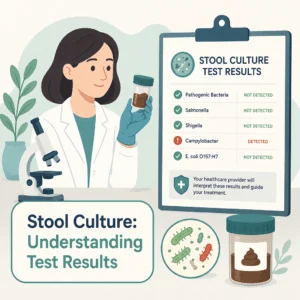
A toxin test answers one narrow question. When diarrhea has an unclear cause, it usually sits alongside other stool investigations. Culture identifies bacterial pathogens such as Salmonella, Shigella, and Campylobacter, and our stool culture results guide explains what it covers. Molecular syndromic testing screens many pathogens at once, and our multiplex panel results guide describes how those panels work and where they mislead. Where fat malabsorption or pancreatic insufficiency is suspected instead, clinicians consult our fecal elastase results guide.
Latest scientific advances
Recent work has concentrated on avoiding overdiagnosis and on reducing recurrence. The sources below are PubMed-indexed.
Testing only symptomatic patients
A 2025 review of diagnostic approaches published in Infectious Disease Clinics of North America emphasized testing only symptomatic patients and distinguishing true infection from colonization, and reviewed multistep algorithms that pair GDH testing with toxin detection. The clinical message is that a positive PCR in a patient without meaningful diarrhea is not a diagnosis.
Persistent variation in real-world practice
A nationwide survey of physicians published in the Journal of Korean Medical Science in 2026 documented substantial variability in how C. difficile infection is diagnosed and managed, reflecting a gap between guideline recommendations and everyday practice that has been reported repeatedly across health systems.
Fidaxomicin over vancomycin
Major guidelines have shifted first-line treatment toward fidaxomicin ahead of oral vancomycin for both initial episodes and first recurrence, on the basis of lower recurrence rates attributed to its narrower spectrum and reduced disruption of the surrounding microbiome. Metronidazole is no longer recommended first-line in adults except where the preferred agents are unavailable.
Microbiome restoration therapies
Recurrent infection is now treated as a microbiome problem. Fecal microbiota transplantation remains highly effective for multiply recurrent disease, and standardized live microbiota-based products have been approved to reduce recurrence after antibiotic treatment, moving this approach from specialist procedure toward routine therapy.
Monoclonal antibody prophylaxis
Bezlotoxumab, a monoclonal antibody against toxin B, is used as an adjunct in selected patients at high risk of recurrence. It does not treat the acute episode; it neutralizes toxin to reduce the chance of the infection returning.
The future of C. difficile testing
The field is moving toward quantification rather than yes-or-no answers. Ultrasensitive toxin assays that measure toxin concentration are being developed to separate infection from colonization more reliably than current algorithms manage. Combining toxin quantification with host inflammatory markers is another active direction. Vaccine development targeting toxins A and B continues, and rapid strain typing may eventually guide both treatment intensity and infection control.
Variations in specific populations
- Infants and children under one year: colonization rates reach 50% or higher and testing is generally not recommended, because a positive result almost never explains the symptoms
- Older adults: highest incidence, highest severity, and highest recurrence rates, particularly in long-term care settings
- Hospitalized patients: risk rises with length of stay and cumulative antibiotic exposure
- Inflammatory bowel disease: higher incidence, more atypical presentations, and worse outcomes when the diagnosis is delayed
- Immunocompromised patients: including transplant recipients and those receiving chemotherapy, where severity and recurrence are both increased
- Community-onset cases: increasingly recognized in people without recent hospitalization, sometimes without any recent antibiotic exposure
How lifestyle and medication affect risk
The dominant modifiable factor is antibiotic exposure. Using antibiotics only when genuinely indicated, choosing the narrowest effective agent, and keeping courses short all reduce risk more than any dietary measure. Proton pump inhibitors are associated with increased risk and are worth reviewing if taken without a clear indication.
Hand washing with soap and water matters specifically here, because alcohol-based hand rub does not kill spores. Surfaces need chlorine-based disinfectants for the same reason. Probiotics have mixed evidence for prevention during antibiotic courses and are not a substitute for antibiotic stewardship. After an episode, rebuilding the microbiome through a varied, fiber-rich diet supports recovery, though it does not replace specific therapy for recurrence.
Next steps and practical advice
If your test is positive and you have significant diarrhea, expect the offending antibiotic to be stopped where possible and treatment with fidaxomicin or oral vancomycin for ten days. Improvement usually begins within a few days. Do not repeat the test to confirm cure, because it will often remain positive despite full recovery.
Seek urgent care for severe abdominal pain, abdominal distension, fever with worsening diarrhea, blood in stool, or signs of dehydration. Recurrence, signaled by returning diarrhea within eight weeks of finishing treatment, warrants prompt reassessment rather than self-management, since second and subsequent recurrences are treated differently from the first episode.
Myths and facts about C. difficile
| Myth | Fact |
|---|---|
| A positive test always means infection | Colonization is common; a positive result in someone without significant diarrhea usually reflects carriage |
| You should retest after treatment | Toxin and DNA persist for weeks after recovery, so testing for cure produces misleading positives |
| Alcohol hand sanitizer prevents transmission | Spores resist alcohol; soap and water are required |
| Only hospital patients get it | Community-onset cases are increasingly common, sometimes without recent antibiotic use |
| Metronidazole is the standard treatment | Fidaxomicin and oral vancomycin are now preferred; metronidazole is reserved for when neither is available |
| Probiotics reliably prevent it | Evidence is mixed and inconsistent; antibiotic stewardship is far more effective |
Frequently asked questions
What does a positive C. difficile toxin test mean?
Combined with three or more unformed stools in 24 hours and no alternative explanation, it indicates active infection requiring treatment. Without significant diarrhea, it more often reflects colonization.
What is the difference between GDH, toxin, and PCR testing?
GDH detects an enzyme present in all strains and works as a sensitive screen. Toxin immunoassay detects the toxin proteins themselves and is specific for active disease. PCR detects the toxin gene and is highly sensitive but cannot distinguish infection from carriage.
Why did my doctor order more than one test?
Because no single test balances sensitivity and specificity adequately. Two-step and three-step algorithms combine a sensitive screen with a specific confirmation to reduce both missed infections and false diagnoses.
Can I be tested if my stool is formed?
No. Laboratories reject formed samples, because a positive result in that setting reflects colonization rather than infection.
How long does C. difficile take to resolve?
Symptoms usually begin improving within two to four days of starting appropriate treatment, with resolution over about ten days. Persistent or worsening symptoms need reassessment.
How common is recurrence?
Roughly 15% to 30% after a first episode, and higher after each subsequent one. Fidaxomicin, bezlotoxumab, and microbiota-based therapies are all used specifically to reduce that risk.
Is C. difficile contagious?
Yes. Spores spread through the fecal-oral route and survive on surfaces for months. Hand washing with soap and water and chlorine-based surface cleaning are the effective measures.
Can you get it without taking antibiotics?
Yes, though it is less common. Advanced age, hospitalization, inflammatory bowel disease, immunosuppression, and proton pump inhibitor use are all independent risk factors.
Glossary of key terms
- Toxin A: the enterotoxin that damages intestinal lining and causes fluid secretion
- Toxin B: the more potent cytotoxin responsible for most tissue damage
- GDH: glutamate dehydrogenase, an enzyme produced by all C. difficile strains
- NAAT: nucleic acid amplification test, detecting the toxin gene
- Colonization: presence of the organism without disease
- Pseudomembranous colitis: severe colitis with characteristic plaques on the colon lining
- Fecal microbiota transplantation: transfer of donor stool microbiota to restore a disrupted gut community
- Antibiotic stewardship: systematic effort to use antibiotics only when needed and as narrowly as possible
Sources
- Diagnostic Approaches for Clostridioides difficile Infection — Infectious Disease Clinics of North America, 2025 — doi.org/10.1016/j.idc.2025.07.014
- Clinical Approaches to Clostridioides difficile Infection Management: Insights From a Nationwide Survey of Korean Physicians — Journal of Korean Medical Science, 2026 — doi.org/10.3346/jkms.2026.41.e150
- Update in Diagnosis and Management of Clostridioides difficile — Revista Médica de Chile, 2023 — doi.org/10.4067/s0034-98872023000700887
- Centers for Disease Control and Prevention — C. diff (Clostridioides difficile) — CDC Topic Page, 2024 — cdc.gov
- MedlinePlus, National Library of Medicine — C. diff Testing — MedlinePlus Medical Test, reviewed 2025 — medlineplus.gov
- Cleveland Clinic — C. diff Infection — Cleveland Clinic Health Library, 2024 — my.clevelandclinic.org
Further reading
- Distinguish infection from an inflammatory bowel flare by reading our fecal calprotectin results guide.
- Compare the second inflammatory stool marker used alongside calprotectin in our fecal lactoferrin test results guide.
- Understand what culture adds that molecular testing cannot with our stool culture results guide.
- See how the toxin gene appears on a broad syndromic assay in our multiplex panel results guide.
- Explore the colitis most often confused with this infection by reviewing our ulcerative colitis symptoms and treatments guide.
- Rule out pancreatic causes of persistent diarrhea with our fecal elastase results guide.
Understand your lab results with BloodSense
A C. difficile result rarely stands alone. Inflammatory markers, stool culture, white cell count, kidney function, and albumin all feed into how severe an episode is and what treatment it needs. BloodSense reads your stool and blood results together, explains each value in plain language, and shows which combinations matter.
Understand your lab results with BloodSense
This article is for informational purposes and does not replace medical advice. Severe abdominal pain, distension, or bloody diarrhea require urgent medical assessment.