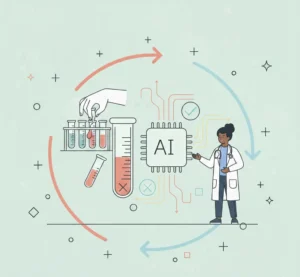







The benefits of AI in healthcare are practical and increasingly personal: faster answers, plainer explanations, and fewer moments of staring at a report you cannot decode. For patients, artificial intelligence now works quietly in the background of modern medicine, helping clinicians spot disease sooner, translating lab jargon into plain language, and easing the paperwork that slows care down. It is a support tool, not a replacement for your doctor.
In this article you will learn where these advantages are real today, where they are still limited, and what they mean for you as a patient. We cover earlier and faster diagnosis, plain-language interpretation of test results, triage and access, personalized care, error reduction, administrative savings, and the privacy questions worth asking. Throughout, the goal is a calm, honest picture rather than hype.
What people mean by AI in healthcare
Artificial intelligence in medicine refers to software that learns patterns from large amounts of data and uses them to support a task, such as reading a scan, flagging a risky lab trend, or summarizing a clinical note. Most tools you will encounter are narrow: each does one job well, rather than thinking like a human clinician. They surface suggestions; a licensed professional still makes the decision.
For a patient, this matters because it sets expectations. The benefits of AI in healthcare come from speed, consistency, and pattern-spotting across huge datasets, not from independent judgment. A model can highlight that a cluster of results looks unusual, but the meaning of that pattern for your body still belongs to your care team.
Where you already meet it
You may have met these tools without noticing. AI helps radiologists prioritize scans that look urgent, assists laboratories in checking sample quality, and powers the plain-language explanations that some patient portals now attach to results. If you have used a symptom checker or received an automated reminder to book a screening, that is AI-adjacent technology working to keep care timely.
Faster and earlier diagnosis
One of the clearest benefits of AI in healthcare is speed. Models can scan an image or a dataset in seconds and mark areas that deserve a closer human look, which can shorten the wait between a test and an answer. In fields such as radiology, pathology, and eye care, well-validated tools reach accuracy comparable to specialists for specific, narrow tasks, though performance varies by setting and by the population a model was trained on.
Earlier detection is the deeper prize. By learning the subtle patterns that precede a diagnosis, some tools help flag disease before symptoms are obvious, buying time for treatment that works better when started sooner. This is promise, not a guarantee: a flag is a prompt for evaluation, and false alarms still happen, so a suggestion always needs confirmation.
What this means when you are waiting for results
If your clinic uses these tools, an urgent finding may reach a specialist faster, and routine cases may be processed more efficiently. It does not mean a machine has diagnosed you. When results arrive, the sensible questions stay the same: what does this mean for me, does it fit my symptoms, and what is the next step? A helpful next read is our guide to how to understand your lab results with reference ranges and flags.
Plain-language interpretation of lab results
Perhaps the most visible benefit of AI for everyday patients is translation. Lab reports are written for clinicians, dense with abbreviations, units, and reference ranges. AI-driven tools can turn that page of numbers into readable context, explaining what a marker measures and where your value sits relative to a typical range, so a bold red flag becomes a question you can actually ask.
This is the bridge to what BloodSense does. Rather than judging a single number in isolation, pattern-based interpretation reads a result alongside related markers and your profile, which helps separate a meaningful signal from ordinary day-to-day noise. It is designed to reduce late-night anxiety and sharpen your questions, never to hand down a diagnosis. You can explore this idea in depth in our overview of the patient’s guide to AI lab interpretation.
A concrete example: reading a urinalysis
Consider a urinalysis, which reports items like pH, specific gravity, protein, and glucose on an unfamiliar scale. An interpretation tool can explain that a mildly concentrated sample often reflects hydration rather than disease, and that a positive strip is a signal to investigate rather than a verdict. If you want a worked example, see how markers behave in our guide to tracking hydration and recovery with urinalysis, and how to interpret a full panel with our AI-powered urine test analyzer.
Triage, access, and reaching more people
AI can help systems decide who needs attention first and extend specialist-level screening to places that lack specialists. In busy emergency departments, machine-learning models have been studied as a way to prioritize patients more consistently than traditional scoring alone, helping the sickest people get seen sooner. In under-resourced regions, a validated screening model on a phone or portable device can flag conditions that would otherwise go undetected.
For you, better triage means the health system can allocate attention where it is most needed, which can shorten waits for genuinely urgent problems. Access tools also lower barriers, letting people in remote areas benefit from a level of screening once limited to large hospitals. The human clinician remains central; AI widens the funnel rather than replacing the expert at the end of it.
Personalized and preventive care
Because AI can weigh many variables at once, it supports care tuned to the individual rather than the average. Models can combine your history, current results, and trends to estimate risk, suggest which follow-up test might clarify a picture, or help a clinician tailor a plan. Watching how a value moves over time, rather than reacting to one snapshot, is exactly the kind of pattern work these tools do well.
Prevention is where this becomes powerful for healthy people. A tool that notices a marker drifting slowly upward across several years can prompt a conversation before a threshold is crossed. This complements, and never replaces, a clinician’s judgment. To see how context reframes a scary number, read why you can have abnormal blood test results while feeling completely fine, and how co-factors matter when your vitamin D supplement is not working.
Tracking trends that matter to you
Preventive value grows when you keep your results in one place and line up the same test across dates. Whether the marker is a liver enzyme, a fasting sugar, or an inflammation signal, a steady trend tells a richer story than a lone reading. Our explainer on how to read ALT, AST, ALP and GGT liver enzymes shows how a single spike is read differently once you see the pattern behind it.
Reducing errors and catching false alarms
AI can act as a second set of eyes. By cross-checking results against related markers and known interference patterns, software can help flag values that look biologically implausible, prompting a repeat test rather than an unnecessary scare. This is valuable because many alarming results are not the body in crisis but a sample or handling problem that a careful recheck resolves.
That said, AI introduces its own error modes. A model can be confidently wrong, especially on cases unlike its training data, and it may explain a correct answer with flawed reasoning. The safeguard is human oversight and confirmation. For a plain-language look at why many scary numbers are artifacts, see our guide on telling lab errors apart from real emergencies.
Administrative savings that reach patients
A large, underappreciated benefit is behind the scenes. AI helps automate documentation, coding, scheduling, and note summarization, work that consumes hours clinicians would rather spend with patients. When paperwork shrinks, appointments can feel less rushed and burnout eases, which studies link to safer, more attentive care.
These gains reach you indirectly but meaningfully: a clinician less buried in admin has more attention for your questions. Economic reviews suggest AI can also reduce costs by trimming unnecessary procedures, although the savings depend heavily on how carefully a tool is chosen, validated, and monitored in real-world use.
Realistic limits and privacy
An honest account of the benefits of AI in healthcare has to name the limits. Models can inherit bias from their training data, performing less well for groups who were underrepresented. They can struggle to explain their reasoning, a problem often called the black box. And a tool that shines in a research paper can falter in a different clinic with different equipment and patients. None of this cancels the benefits; it defines the conditions under which they hold.
Privacy deserves particular attention because health data is sensitive. Reputable tools should be clear about what they collect, how it is stored, and whether it is used to train models. In the United States, HIPAA governs how protected health information is handled, and it is reasonable to ask any service how it complies. Treat data practices as a feature to evaluate, not an afterthought.
Questions worth asking about any AI health tool
- Was this tool validated on people like me, and by whom?
- Does a licensed clinician review or oversee its output?
- What data does it collect, where is it stored, and is it used for training?
- Is it meant to inform a conversation with my doctor rather than replace it?
- How does it handle uncertainty, and does it flag when it is unsure?
How the benefits compare at a glance
| Benefit | What it can do today | Where caution still applies |
|---|---|---|
| Faster and earlier diagnosis | Prioritize scans and flag subtle patterns for specialist review | Findings need human confirmation; false alarms occur |
| Plain-language results | Explain markers and context in readable terms | Information, not a diagnosis or treatment plan |
| Triage and access | Help route urgent cases and extend screening reach | Performance varies by setting and population |
| Personalized prevention | Estimate risk and highlight trends over time | Estimates support, never replace, clinical judgment |
| Error reduction | Cross-check implausible values and suggest a recheck | Models can be confidently wrong on unfamiliar cases |
| Administrative savings | Automate notes and coding, freeing clinician time | Cost savings depend on careful validation and oversight |
Latest scientific advances
Recent research paints a consistent picture: artificial intelligence adds real value across several corners of medicine, while its benefits depend on careful validation and human oversight. The studies below are recent systematic reviews and meta-analyses, which pool many studies to give a steadier signal than any single trial.
A 2026 meta-analysis comparing artificial intelligence with clinicians found that AI tools matched expert diagnostic accuracy on the tasks studied and outperformed non-expert clinicians, while clinicians working with AI support reported meaningfully lower workload-related stress. What this means for you: on well-defined tasks, these tools can strengthen a diagnosis and ease the pressure on your care team, though the human expert remains the decision-maker. (Aside: a meta-analysis statistically combines results from many separate studies to reach a more reliable overall conclusion.)
A 2024 systematic review published in Medical Archives examined AI and machine learning in emergency-department triage and found these models often prioritized patients more effectively than conventional severity scores alone. What this means for you: in a crowded emergency room, such tools may help ensure the sickest patients are identified sooner, supporting rather than replacing the triage nurse’s judgment. (Aside: triage is the process of sorting patients by how urgently they need care.)
A 2025 systematic review in a digital-medicine journal assessed the cost-effectiveness of clinical AI and found that, across oncology, cardiology, and other fields, AI often improved diagnostic accuracy and reduced costs by minimizing unnecessary procedures. The authors caution that some analyses may overstate savings by relying on simplified models. What this means for you: AI can help a health system spend resources more wisely, but the reassuring headline deserves a measure of healthy skepticism. (Aside: cost-effectiveness weighs the health benefit of a tool against what it costs to use.)
A broad 2023 review of AI in clinical practice summarized its potential across diagnosis, treatment selection, and patient engagement, while stressing persistent challenges around data privacy, bias, and the continued need for human expertise. What this means for you: the direction of travel is genuinely promising, yet the same review is candid that responsible use, not blind trust, is what turns potential into safe, everyday benefit. A 2024 report from the National Institutes of Health reinforced this balance, showing an AI model answered medical image questions with high accuracy yet sometimes explained its correct answers with flawed reasoning. (Aside: bias here means a model performing unevenly across different groups of people because of gaps in its training data.)
Glossary
| Term | Definition |
|---|---|
| Artificial intelligence (AI) | Software that learns patterns from data to support a task, such as reading a scan or explaining a result. |
| Machine learning | A branch of AI in which a program improves at a task by learning from examples rather than fixed rules. |
| Algorithm | A set of step-by-step instructions a computer follows to reach a result. |
| Biomarker | A measurable signal in the body, such as a blood or urine value, that reflects a physiological process. |
| Reference range | The band of values seen in most healthy people, used to judge whether a result is low, normal, or high. |
| Triage | Sorting patients by how urgently they need care so the sickest are seen first. |
| Black box | A model whose internal reasoning is hard to see or explain, even when its output is accurate. |
| Sensitivity | How well a test or model correctly identifies people who truly have a condition. |
| HIPAA | The Health Insurance Portability and Accountability Act, a US law protecting personal health information. |
| Clinical validation | Testing that checks whether a tool performs safely and accurately in real patient care. |
Frequently asked questions
Will AI replace my doctor?
No. Today’s tools are narrow assistants that support specific tasks, such as flagging a pattern or drafting a note. They can be fast and accurate on well-defined problems, but they do not weigh your full history, examine you, or take responsibility for a decision. Reviews of clinical AI consistently conclude that human expertise remains essential, both to interpret results in context and to catch the mistakes a model can make. The realistic future is a clinician supported by AI, not one replaced by it.
Is AI in healthcare safe and accurate?
For narrowly defined tasks with strong validation, some AI tools reach accuracy comparable to specialists. Accuracy is not uniform, though: performance can drop on patients or equipment unlike the training data, and a model may explain a correct answer with faulty reasoning. That is why human oversight and confirmation matter. Safety depends less on the technology in the abstract and more on whether a specific tool was validated for your situation and is monitored in everyday use.
How does AI help me understand my own lab results?
AI-driven interpretation turns a dense report into plain language, explaining what each marker measures and where your value sits relative to a typical range. Instead of a bare red flag, you get context, which helps you tell a likely benign fluctuation from a result worth discussing. The aim is to reduce anxiety and sharpen the questions you bring to your clinician. It is information to inform a conversation, not a diagnosis, and it does not replace professional interpretation.
Can AI detect disease earlier than a doctor?
Sometimes it can help. By learning subtle patterns in scans or data, some tools flag signs before they are obvious, which can prompt earlier evaluation. This is a prompt, not a diagnosis, and false alarms happen, so a flagged finding always needs confirmation. Earlier detection tends to help most when a validated tool is used within a care pathway that ensures suspicious results are reviewed promptly by a professional who knows your history.
What about my privacy when I use an AI health tool?
Health data is sensitive, so privacy is worth scrutinizing. Ask any tool what it collects, where data is stored, and whether your information is used to train models. In the United States, HIPAA sets rules for protecting health information, and a trustworthy service should explain how it complies. Reading the privacy policy before uploading anything is a sensible habit, and being cautious with personal identifiers is reasonable rather than paranoid.
Are these tools useful if I feel healthy?
Yes, particularly for prevention. If you track results over time, a tool that highlights a marker drifting slowly in one direction can prompt a timely conversation before a threshold is crossed. It can also reassure you when an isolated flag is likely harmless, sparing needless worry. The value lies in context and trend-spotting; the tool informs your questions and supports your clinician rather than issuing verdicts about your health.
Sources
- National Institutes of Health (NIH/NLM) — NIH findings shed light on risks and benefits of integrating AI into medical decision-making, 2024 — nih.gov
- MedlinePlus, National Library of Medicine — Medical Tests: what tests are used for and what results mean, 2024 — medlineplus.gov
- U.S. Food and Drug Administration — Artificial Intelligence-Enabled Medical Devices, 2024 — fda.gov
- Kumar P and colleagues — Meta-Analysis on Comparison of Diagnostic Accuracy Between Artificial Intelligence and Healthcare Professionals — Sci, 2026 — consensus.app
- El Arab RA and colleagues — Systematic review of cost effectiveness and budget impact of artificial intelligence in healthcare — npj Digital Medicine, 2025 — consensus.app
- Almulihi QA and colleagues — Applications of Artificial Intelligence and Machine Learning in Emergency Medicine Triage: A Systematic Review — Medical Archives, 2024 — doi.org/10.5455/medarh.2024.78.198-206
- Alowais SA and colleagues — Revolutionizing healthcare: the role of artificial intelligence in clinical practice — BMC Medical Education, 2023 — consensus.app
Further reading
- Get a plain-language walkthrough of how to understand your lab results and reference ranges.
- Explore the deeper method behind the patient’s guide to AI lab interpretation.
- Learn how to spot early insulin resistance before your A1c rises.
- Discover what an hs-CRP test and CBC markers of silent inflammation reveal.
- See how AI connects the dots across gut, blood, and metabolism markers.
Understand your lab results with BloodSense
Get your results interpreted in minutes
The clearest everyday benefit of AI in healthcare is turning a confusing report into something you can actually understand. BloodSense reads values such as liver enzymes, a fasting glucose panel, vitamin D, and a urinalysis in plain language, showing where each sits relative to its reference range and how markers relate to one another. It helps you understand what your results say and prepare sharper questions for your visit. It does not diagnose conditions and does not replace your doctor, who remains the person who interprets your results for your situation.