






A leukocytes blood test counts the white blood cells circulating in your bloodstream, and it is one of the most frequently ordered measurements in routine care. Leukocytes are your immune system’s mobile workforce: they detect bacteria, viruses, parasites and damaged tissue, then coordinate the response. Because their number rises and falls with infection, inflammation, stress, medication and even the time of day, a single figure on a lab report rarely tells the whole story. In this article you will learn what the test measures, how the five white blood cell subtypes differ, what typical adult ranges look like, what high and low results usually point to, and which findings deserve a conversation with your clinician rather than a search engine.
What a leukocytes blood test measures
Leukocytes, also called white blood cells or WBCs, are produced mainly in the bone marrow and released into the bloodstream, where they patrol for threats. A leukocyte measurement is almost never ordered on its own. It arrives as one line of a complete blood count, alongside red cells, hemoglobin and platelets, so results are always read in context. To see how the whole panel fits together, review our complete blood count results guide.
The laboratory reports two related things. The first is the total leukocyte count, expressed as cells per microliter of blood or as a figure such as 7.2 x 10⁹/L. The second is the differential, which breaks that total down into the five main cell types and shows each one as a percentage and often as an absolute number. The differential is where most of the useful detail lives: two people can share an identical total while having very different immune situations underneath.
According to MedlinePlus, clinicians order this test to help investigate infection, inflammation, unexplained fever, fatigue, bruising or a known condition affecting the bone marrow, and to monitor treatments such as chemotherapy that suppress white cell production.
The five types of white blood cells and what each one does
Each subtype has a distinct job, which is why the differential often points toward a cause faster than the total does.
| Cell type | Main role | Typically rises with |
|---|---|---|
| Neutrophils | First responders against bacteria and fungi | Bacterial infection, tissue injury, physical stress |
| Lymphocytes | Targeted defense and antibody production | Viral infection, some chronic immune conditions |
| Monocytes | Clearing debris and dead cells, longer-term defense | Recovering infection, chronic inflammation |
| Eosinophils | Response to parasites and allergens | Allergy, asthma, parasitic infection |
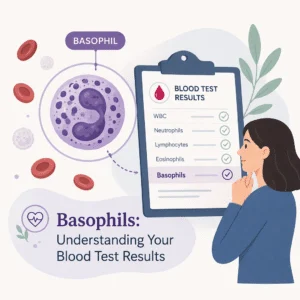
| Basophils | Release of histamine in allergic reactions | Allergic reactions, rare marrow disorders |
Neutrophils usually make up the largest share, which is why a bacterial infection often pushes the total upward quickly. Explore this subtype further in our neutrophil blood results guide. When a viral illness dominates, the balance often shifts toward lymphocytes instead, a pattern covered in our lymphocyte blood test guide.
The three less abundant subtypes still carry information. Monocytes often climb during recovery or long-running inflammation, as described in our monocyte test results guide. Eosinophils track allergic and parasitic activity, detailed in our eosinophil blood level guide, while basophils are the rarest of the five and are explained in our basophil test results guide.
Typical adult reference ranges for leukocytes
Cleveland Clinic describes a usual adult total of roughly 4,000 to 11,000 cells per microliter, with counts below that band considered low and counts above it considered high. Mayo Clinic uses a slightly different lower threshold, describing counts under about 3,500 cells per microliter as low for adults, and notes that laboratories set their own cutoffs. That difference is a useful reminder: the range printed on your own report is the one that applies to you.
| Measurement | Common adult range | Note |
|---|---|---|
| Total leukocytes | About 4,000 to 11,000 cells per microliter | Lower cutoffs vary between laboratories |
| Neutrophils | Roughly 40 to 60 percent of the total | Usually the largest fraction in adults |
| Lymphocytes | Roughly 20 to 40 percent | Proportionally higher in young children |
| Monocytes | Roughly 2 to 8 percent | Often rises late in an infection |
| Eosinophils | Roughly 1 to 4 percent | Allergy season can shift this figure |
| Basophils | Under about 1 percent | Small changes are hard to interpret alone |
Ranges also shift with age. Newborns and infants normally run higher totals than adults, and the lymphocyte share is larger in early childhood before neutrophils take over as the dominant subtype. Pregnancy, recent vigorous exercise, smoking and acute emotional stress can all nudge the number upward without any illness being present.
What a high leukocyte count usually means
A high count is called leukocytosis. The most common explanation by far is that your immune system is doing exactly what it should. MedlinePlus lists bacterial and viral infection, inflammatory conditions such as rheumatoid arthritis, allergic reactions, tissue damage from burns or surgery, smoking, physical stress, certain medications and pregnancy among the recognized causes, along with less common blood cancers such as leukemia.
Corticosteroid medication is a frequently missed explanation: these drugs pull neutrophils out of the vessel walls and into circulation, so the count rises without any new infection. Recent strenuous exercise can do something similar for a few hours. This is one reason clinicians rarely act on a single elevated value and instead repeat the test once the obvious triggers have passed.
Context from other markers helps enormously here. Inflammation markers move on a different timescale than leukocytes do, so pairing them sharpens the picture. Compare your result with our C-reactive protein test guide, since a high leukocyte count with normal inflammation markers suggests a different story than one where both are elevated.
What a low leukocyte count usually means
A low count is called leukopenia, and when the shortfall specifically involves neutrophils it is called neutropenia. Mayo Clinic lists bone marrow conditions such as aplastic anemia and leukemia, infections including HIV, hepatitis and tuberculosis, treatments such as chemotherapy and radiation, autoimmune diseases including lupus, some antibiotics and other medications, nutritional deficiencies and severe infection among the causes.
Two points matter for interpretation. First, a mild dip after a viral illness is common and often resolves on its own within a few weeks. Second, and importantly, some healthy people simply run lower counts as a stable personal baseline, without any illness or increased risk of infection. Mayo Clinic notes explicitly that Black individuals on average have naturally lower white blood cell counts than white populations, a benign pattern that has been misread as disease for decades.
Because low counts can accompany autoimmune disease, clinicians sometimes order additional testing. Platelet numbers frequently move in parallel when the bone marrow is the source of the problem, so it is worth checking our platelet count results guide alongside your white cell figures.
Leukocytes outside the bloodstream: urine and stool
White blood cells are not confined to blood samples. They show up wherever the immune system is active, and finding them in other body fluids carries a different meaning than a blood count does.
In a urine sample, leukocytes usually point toward irritation or infection somewhere along the urinary tract rather than a whole-body immune response. Two related tests appear on most urinalysis reports: the microscopic cell count, explained in our white blood cells in urine guide, and the chemical strip result covered in our leukocyte esterase results guide.
In a stool sample, white blood cells suggest inflammation of the intestinal lining, which helps separate inflammatory causes of diarrhea from non-inflammatory ones. Our fecal leukocytes test results guide walks through what that finding does and does not establish.
How to read your own leukocyte report step by step
Working through a report in a fixed order keeps you from over-reacting to a single number.
- Find the total leukocyte count and compare it with the reference range printed on your own report, not a range you found elsewhere.
- Note how far outside the range it sits. A value a few hundred cells beyond the cutoff carries very different weight than one several times higher.
- Read the differential next. Ask which subtype is driving the change, since neutrophil-led and lymphocyte-led shifts point in different directions.
- Look at the rest of the complete blood count. Red cells and platelets moving in the same direction raise different questions than an isolated white cell change.
- Add the practical context: any infection in the past two weeks, new medication, corticosteroids, recent surgery, pregnancy, smoking or a hard workout the day before.
- Compare with your own previous results if you have them. Your personal trend is more informative than any population range.
If you have earlier panels, a stable pattern across several years is reassuring even when the value sits slightly outside the printed band. A count that has moved steadily in one direction over consecutive tests deserves attention even when each individual result still looks acceptable.
When to see a doctor
Most abnormal leukocyte results are transient and explained by something ordinary. Some situations warrant prompt medical attention rather than watchful waiting.
- A very high or very low count reported alongside fever, chills, confusion, rapid breathing or a rapid heartbeat.
- Any low count while you are receiving chemotherapy, immunosuppressive therapy or radiation, particularly with a new fever.
- An abnormal count combined with unexplained weight loss, drenching night sweats, easy bruising, bone pain or swollen lymph nodes.
- Repeated infections that are unusually frequent, severe or slow to clear.
- A result that stays outside the range on a repeat test several weeks later, without an obvious cause.
Recurrent infections often prompt a targeted search for a source. A urinary tract infection is one of the most common findings in adults with repeated symptoms, and our urinary tract infection symptoms and treatment guide outlines what that evaluation usually involves.
Latest scientific advances
Research over the past three years has changed how specialists think about what counts as a normal leukocyte result, and it is worth knowing where that thinking is heading.
The biggest shift concerns people with the Duffy-null blood group, an inherited and entirely harmless variant that is common in people of African and Middle Eastern ancestry. A 2026 study in Hematology Reports measured white blood cell and neutrophil counts in a group of healthy Duffy-null adults and found their normal values sat clearly below the standard laboratory band, with the lower end falling under the usual cutoff used to diagnose neutropenia. In plain terms, a perfectly healthy person can be labeled as having too few white blood cells simply because the comparison range was built on a different population. What this means for you: if you have been told your white cell count is low but you feel well and get sick no more often than anyone else, it is reasonable to ask your clinician whether a Duffy-null pattern could explain it, since that answer may spare you further testing.
The practical stakes of that mislabeling were documented in a 2024 analysis published in JAMA Network Open. The researchers reviewed hundreds of recent cancer trials and standard treatment protocols and found that most of them would exclude patients, or reduce their drug doses, on the basis of neutrophil counts that are normal for Duffy-null individuals. What this means for you: professional bodies are now revisiting these thresholds, and if you are being considered for a clinical trial or a chemotherapy regimen, a naturally low baseline count is a fair thing to raise with your oncology team rather than accept as a barrier.
A second area of progress involves reading the balance between subtypes rather than the total alone. A 2024 meta-analysis in Frontiers in Immunology pooled twelve studies covering more than ten thousand adults with sepsis, a life-threatening reaction to infection, and found that a higher ratio of neutrophils to lymphocytes was consistently linked to worse outcomes. The authors describe the evidence as variable between studies, so it is a signal that helps rank risk rather than a standalone verdict. What this means for you: this ratio is not something to calculate for yourself from a routine panel, but it explains why your clinician may pay attention to the balance of your differential rather than only the headline number.
Hospital research points the same way. A 2024 multicenter cohort study in Resuscitation Plus followed intensive care patients and found that white blood cell counts measured in the first day, when markedly abnormal in either direction, tracked with poorer one-year outcomes. A cohort study simply follows a defined group over time and reports what happens, so it shows association rather than cause. What this means for you: in critical illness the leukocyte count works as a severity gauge alongside other measurements, which is very different from how a single routine result should be read in an otherwise healthy person.
Taken together, these findings support a shift away from one universal range toward interpretation that accounts for ancestry, personal baseline and the clinical picture. None of them change what you should do with a routine result: bring it to the clinician who knows your history.
Glossary
| Term | Definition |
|---|---|
| Leukocyte | Another name for a white blood cell, the immune system cells that circulate in blood and tissue. |
| Leukocytosis | A white blood cell count above the laboratory reference range. Infection and inflammation are the usual causes. |
| Leukopenia | A white blood cell count below the laboratory reference range. |
| Neutropenia | A specifically low neutrophil count, which can raise the risk of bacterial infection when severe. |
| Differential | The part of a blood count that breaks the white cell total into its five subtypes. |
| Absolute neutrophil count (ANC) | The actual number of neutrophils per microliter, rather than their percentage share. |
| Reference range | The band of values seen in most healthy people tested by that laboratory. It describes a population, not an individual. |
| Duffy-null phenotype | An inherited and harmless blood group variant associated with naturally lower white cell and neutrophil counts. |
| Bone marrow | The tissue inside bones where blood cells, including leukocytes, are produced. |
| Microliter | A very small unit of volume, abbreviated µL, used to express blood cell concentrations. |
Frequently asked questions
What is a dangerous white blood cell count?
There is no single number that is dangerous on its own, because what matters is the combination of the value, how fast it changed and how you feel. In general, clinicians pay close attention when the total falls far below the lower limit, particularly when neutrophils specifically are very low, because that raises the risk of serious bacterial infection. Very high counts, especially several times the upper limit or accompanied by fever and feeling unwell, also prompt urgent evaluation. A modestly abnormal value in someone who feels fine is usually rechecked rather than treated as an emergency.
What is a normal white blood cell count for a woman?
Adult reference ranges for leukocytes are broadly the same for women and men, generally around 4,000 to 11,000 cells per microliter depending on the laboratory. Pregnancy is the main exception: counts commonly rise during pregnancy and immediately after delivery without indicating illness. Hormonal cycles produce only small fluctuations. Always compare your value with the range printed on your own report, since laboratory methods differ.
Does a normal WBC count rule out infection?
No. Many infections, particularly mild viral ones, run their course without pushing the total outside the reference range, and some serious infections in older adults or people on immunosuppressive treatment occur with a normal or even low count. This is why clinicians combine the leukocyte result with symptoms, examination and other markers rather than relying on it as a single screening test.
Can stress or exercise raise my leukocyte count?
Yes, temporarily. Vigorous exercise, acute emotional stress and even a difficult night can move white blood cells from the vessel walls into circulation, raising the measured count for a few hours. Smoking produces a more sustained elevation. If your test followed a hard workout or a stressful event, mention it to your clinician, since repeating the sample under calmer conditions often resolves the question.
How can I lower a high white blood cell count?
The count itself is not the target: treating the underlying cause is what brings it down. If an infection is responsible, resolving that infection normalizes the number. If smoking is contributing, stopping lowers it over months. If a medication such as a corticosteroid is the explanation, only the prescribing clinician should adjust it. No food, supplement or over-the-counter product has been shown to reliably lower a white blood cell count, and chasing the number without identifying its cause is not useful.
How often should a leukocyte count be repeated?
That depends entirely on why it was ordered. A mildly abnormal result in someone who feels well is often rechecked in a few weeks, once any recent infection or medication effect has passed. People on chemotherapy or certain immune-modulating drugs are monitored on a schedule set by their treating team, sometimes weekly. If your result is part of a routine annual panel and sits inside the range, no extra testing is usually needed.
Sources
- MedlinePlus, National Library of Medicine — White Blood Count (WBC) — MedlinePlus Medical Test — medlineplus.gov
- Cleveland Clinic — White Blood Cells: Types, Function and Normal Ranges — Cleveland Clinic Health Library — my.clevelandclinic.org
- Mayo Clinic — Low White Blood Cell Count: Causes — Mayo Clinic Symptoms — mayoclinic.org
- Barouqa M, Ashfaq MA, Jiang KJ, et al. — Establishing Reference Intervals for White Blood Cell and Absolute Neutrophil Counts in Duffy Null Individuals — Hematology Reports, 2026 — doi.org/10.3390/hematolrep18030038
- Hibbs SP, Aiken L, Vora K, et al. — Cancer Trial Eligibility and Therapy Modifications for Individuals With Duffy Null-Associated Neutrophil Count — JAMA Network Open, 2024 — doi.org/10.1001/jamanetworkopen.2024.32475
- Wu H, Cao T, Ji T, et al. — Predictive Value of the Neutrophil-to-Lymphocyte Ratio in the Prognosis and Risk of Death for Adult Sepsis Patients: a Meta-Analysis — Frontiers in Immunology, 2024 — doi.org/10.3389/fimmu.2024.1336456
- Seppä AMJ, Skrifvars MB, Vuopio H, et al. — Association of White Blood Cell Count with One-Year Mortality After Cardiac Arrest — Resuscitation Plus, 2024 — doi.org/10.1016/j.resplu.2024.100816
Further reading
- Check the oxygen-carrying protein measured beside your white cells by reading our hemoglobin blood test results guide.
- Track how quickly your bone marrow replaces red cells with our reticulocyte blood test results guide.
- Investigate autoimmune causes behind a persistently low count using our antinuclear antibody test results guide.
- Understand the low-grade inflammation that routine panels often miss with our hs-CRP silent inflammation guide.
- Review how the full panel frames every white cell figure in our complete blood count interpretation guide.
Understand your lab results with BloodSense
A leukocyte figure makes far more sense when it is read next to the rest of your panel. BloodSense reads your uploaded results and explains, in plain language, how your white blood cell count, differential, hemoglobin and platelet numbers fit together and what has changed since your last test. It helps you arrive at your appointment with clear questions instead of guesses. It does not diagnose and it does not replace your doctor.